
Chef Juliana
Arroz de Natal com Passas e Nozes
You already know more than you think. Make arroz soltinho, dress it for Christmas, and the holiday plate suddenly looks generous without turning dinner into theater.
A cooking platform built around craft, culture, and the stories behind what we eat.
Created by
You can bake the Christmas bread you usually buy in a box. Slow dough, soft butter, real citrus, and patient rises. No mystery, just a method you can repeat.
You've looked at that tall paper mold and thought, quietly, isso não é pra mim. Bread with eggs, butter, fruit, those December boxes stacked to the ceiling, surely that's bakery business. No. Cozinhar não é dom, é um aprendizado, and enriched dough is only dough that asks you to slow down and pay attention.
In São Paulo, panettone shows up after the meal, beside coffee, on the counter where everyone keeps cutting one more thin slice and pretending that wasn't the third. The everyday plate still does the serious work: arroz, feijão, a piece of chicken or an egg, something green. That's the pê-efe, the formula that keeps a country fed. Panettone doesn't replace it. It arrives after it, because comida de verdade also has room for butter, fruit, and Christmas.
The method is plain. Wake the yeast first so you know it's alive before you spend your eggs and butter. Add the butter little by little because fat slows the dough down if you dump it all in at once. Soak the fruit so it doesn't steal moisture from the crumb. Let the rises take the time they need, because sugar and butter make yeast move like it has all afternoon. It does.
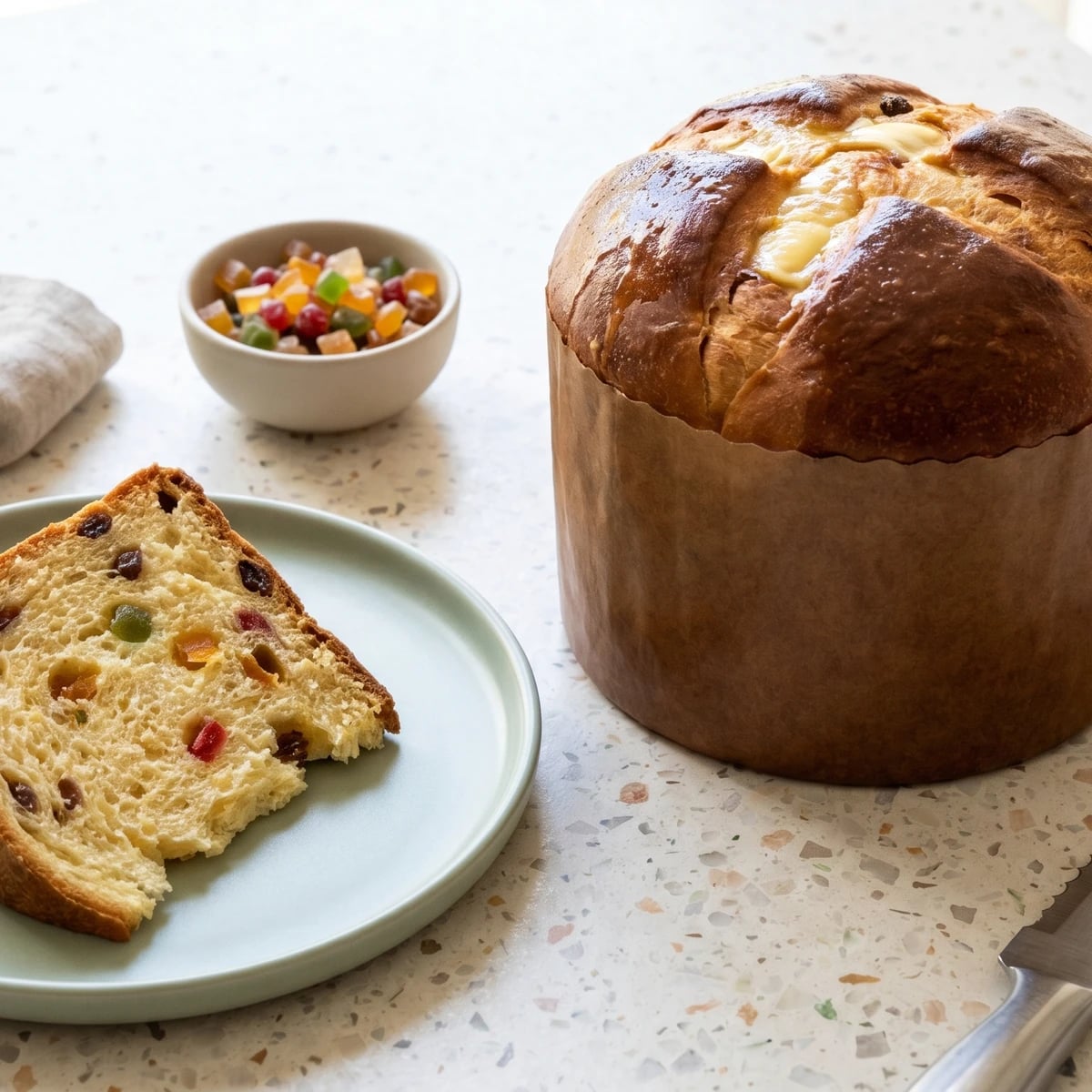
By the end you'll have a tall, tender loaf, golden on top, citrusy inside, dotted with frutas cristalizadas and raisins. It won't taste like the box. It'll taste like you learned something, which is much better.
Panettone began in Milan as an enriched Christmas bread, and it entered Brazil with Italian immigration, especially around São Paulo, from the late nineteenth century into the early twentieth. By the mid-twentieth century, large bakeries and supermarkets had turned boxed paper-mold panettones into a national December fixture; chocolate-filled Brazilian variations became common later in the twentieth century. That industrial success can hide the older fact: the bread is built from ordinary home ingredients, flour, eggs, butter, fruit, and time.
Quantity
1/2 cup
warm, 38 to 40 C (100 to 105 F)
Quantity
2 1/4 teaspoons
Quantity
1 tablespoon
Quantity
1/2 cup
Quantity
3 1/2 cups, plus 1 to 3 tablespoons only if needed
spooned and leveled
Quantity
1/2 cup
Quantity
1 teaspoon
Quantity
1 tablespoon
Quantity
1 teaspoon
Quantity
3 large
room temperature
Quantity
2 large
room temperature
Quantity
1 teaspoon
Quantity
1 tablespoon
Quantity
8 tablespoons softened, plus 1 tablespoon cold for the top
Quantity
1 cup
Quantity
1/2 cup
Quantity
1/3 cup
for soaking the fruit
Quantity
1 tablespoon
Quantity
1 teaspoon
for greasing hands and bowl
| Ingredient | Quantity |
|---|---|
| whole milkwarm, 38 to 40 C (100 to 105 F) | 1/2 cup |
| active dry yeast | 2 1/4 teaspoons |
| sugar for sponge | 1 tablespoon |
| bread flour or all-purpose flour for sponge | 1/2 cup |
| bread flour or all-purpose flour for doughspooned and leveled | 3 1/2 cups, plus 1 to 3 tablespoons only if needed |
| sugar for dough | 1/2 cup |
| fine salt | 1 teaspoon |
| orange zest | 1 tablespoon |
| lemon zest | 1 teaspoon |
| eggsroom temperature | 3 large |
| egg yolksroom temperature | 2 large |
| vanilla extract | 1 teaspoon |
| honey | 1 tablespoon |
| unsalted butter | 8 tablespoons softened, plus 1 tablespoon cold for the top |
| mixed candied fruit | 1 cup |
| raisins | 1/2 cup |
| orange juicefor soaking the fruit | 1/3 cup |
| cachaça or rum (optional) | 1 tablespoon |
| neutral oilfor greasing hands and bowl | 1 teaspoon |
Put the candied fruit and raisins in a small bowl with the orange juice and the cachaça or rum, if using. Stir and let them sit for 30 minutes while you start the dough. The fruit should look glossy and a little plumper. Dry fruit pulls water from the dough as it bakes, and then you get a tight crumb and blame yourself. Don't.
Stir the warm milk, yeast, 1 tablespoon sugar, and 1/2 cup flour in a large bowl or mixer bowl until you have a thick paste. Cover and leave it for 15 to 20 minutes, until it looks puffed and bubbly. This little sponge proves the yeast is alive before you spend the good butter and eggs. If it stays flat and silent, your yeast is tired. Start again with fresh yeast.
Add the 3 1/2 cups flour, 1/2 cup sugar, salt, orange zest, lemon zest, eggs, egg yolks, vanilla, and honey to the sponge. Mix until the flour disappears and the dough looks shaggy, sticky, and uneven, about 2 minutes. That's normal. Enriched dough starts messy because eggs and sugar need time to hydrate the flour.
Add the softened butter 1 tablespoon at a time, mixing well after each spoonful before adding the next. The dough will smear, resist, then pull itself back together. This is the part where people panic and throw in flour. Anota aí: don't. Butter needs time to join the dough, and extra flour now makes a dry panettone later.
Knead with a dough hook on medium-low for 10 to 12 minutes, or by hand for 18 to 20 minutes with lightly oiled hands. The dough should turn shiny, stretchy, and tacky, pulling into a thin sheet when you stretch a small piece. If it's still more like batter after a 10-minute rest, add flour 1 tablespoon at a time. The goal is soft and elastic, not stiff. Stiff dough gives you bread that eats like a sponge left in the sink.
Lightly oil a large bowl, tuck the dough into it, cover, and let it rise in a warm spot until doubled, 2 to 3 hours. Don't stare at the clock like it's the boss of you. Look at the dough. It should be puffy, rounded, and slower to spring back when you press it with a fingertip. Sugar, eggs, and butter slow yeast down, so this rise takes patience.
Drain the fruit well and pat it dry with a clean towel. Flatten the risen dough gently into a rectangle, scatter the fruit over it, and fold the dough over itself until the fruit is spread through. Work gently. Wet fruit skids around and tears the dough; dry fruit folds in cleanly and stays where you put it.
Shape the dough into a tight ball by tucking the edges underneath, then place it smooth side up in a 1kg panettone paper mold set on a baking tray. Cover loosely and let it rise until the dome sits about 1 inch below the rim, 1 1/2 to 2 1/2 hours. Underproofed dough bursts hard in the oven; overproofed dough sighs and collapses. You want a soft, proud dome that still has a little strength.
Heat the oven to 180 C (350 F). Cut a shallow cross on the top with a sharp knife or kitchen scissors, tuck the 1 tablespoon cold butter into the center, and bake for 10 minutes. Lower the oven to 160 C (325 F) and bake 35 to 45 minutes more, until the top is deep golden and an instant-read thermometer in the center reads 92 C (198 F). If the top browns too fast, lay foil loosely over it. The lower heat finishes the center without burning the crown.
Set up two tall pots or sturdy supports with a gap between them before the bread comes out. As soon as the panettone is baked, push two long skewers through the lower third of the paper mold, then turn it upside down and rest the skewers across the supports. Let it cool this way for at least 2 hours. The crumb is hot, soft, and fragile; cooling upside down keeps the tall loaf from sinking into itself. Skip it if you must, but know the cost: a flatter top.
1 serving (about 110g)
Culinary guides, cultural storytelling, and the editorial depth that makes cooking meaningful.
Discover Culinary Explorer
Chef Juliana
You already know more than you think. Make arroz soltinho, dress it for Christmas, and the holiday plate suddenly looks generous without turning dinner into theater.

Chef Juliana
You don't need a Christmas miracle. You need properly soaked bacalhau, tender potatoes, onion, olive oil, and the patience to layer things instead of panicking.

Chef Juliana
You don't need turkey courage for Christmas dinner. Season the bird the day before, roast it breast-down first, then turn it golden. Anota aí: this is method, not magic.

Chef Juliana
You don't need bakery magic. You need warm milk, patience, and dough that tells you when it's ready. Make this once and December starts smelling like your own kitchen.