
Chef Graziella
Civraxiu
The great round loaf of Sardinia, built from golden semolina and baked until the crust turns nearly black. Shepherds carried this bread into the hills because it kept for weeks without staling.
A cooking platform built around craft, culture, and the stories behind what we eat.
Created by
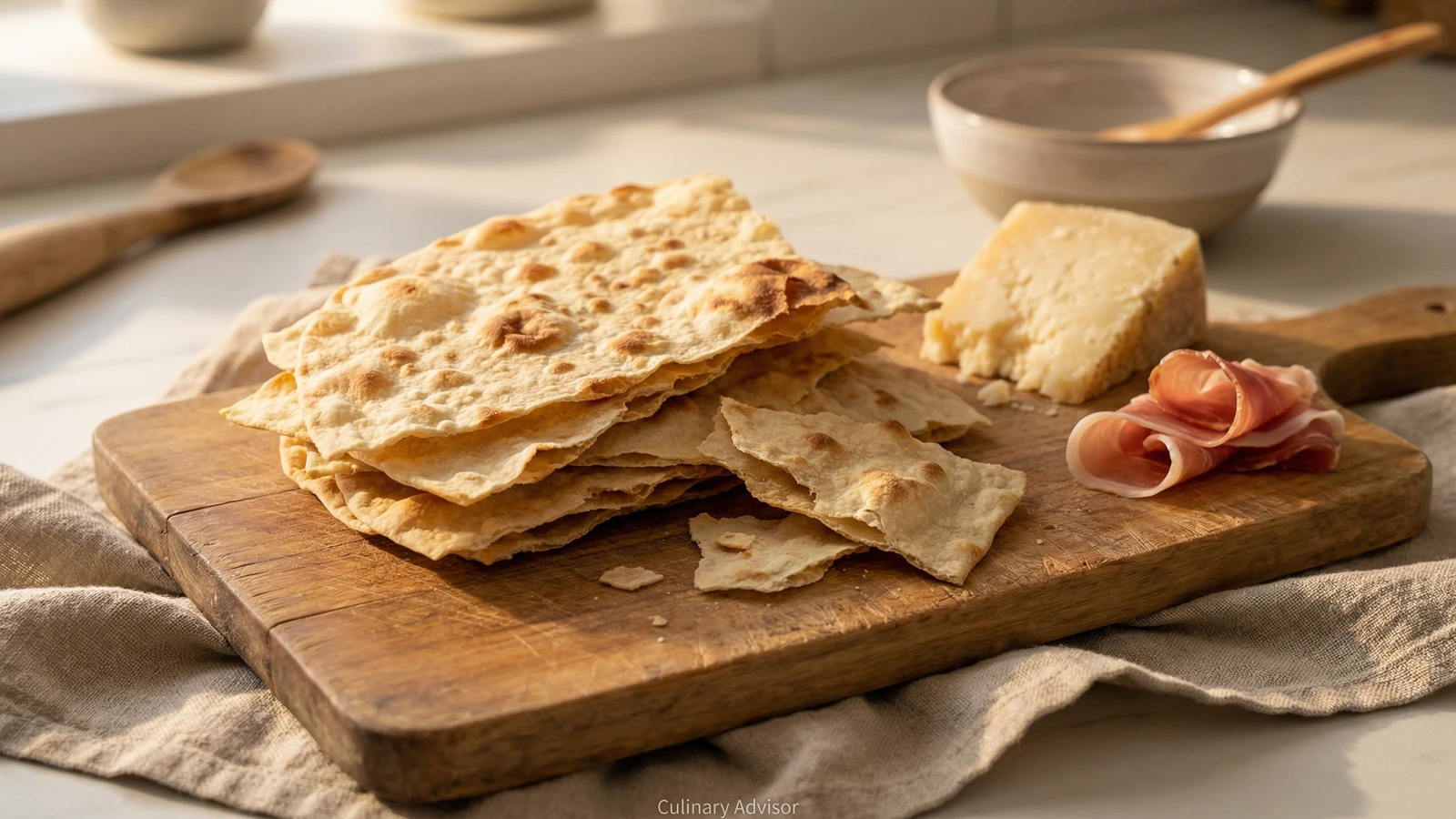
The ancient twice-baked bread of Sardinian shepherds, rolled impossibly thin and dried until it lasts for months. When you break a sheet, it sings.
Pane carasau is not a bread for people who want quick results. Sardinian shepherds needed bread that would survive weeks in the mountains while they tended their flocks. Their wives developed this: dough rolled thinner than paper, baked until it puffs into a balloon, split, and baked again until every trace of moisture has left. The result lasts for months without refrigeration.
They call it carta da musica, music paper, because of the sound it makes when broken. Hold a sheet to your ear and snap it. That crisp crack is how you know you have done it correctly. Any softness, any flexibility, means moisture remains and the bread will not keep.
This is demanding work. The dough must be kneaded until your arms ache. It must be rolled thinner than you think possible. Your oven must be searingly hot. But Sardinian women have made this for generations in wood-fired ovens far more difficult than yours. If they could manage it, so can you.
The bread is eaten as a cracker with cheese, with cured meats, with whatever the shepherds carried. It can be softened in broth and layered with sauce for pane frattau, a Sardinian specialty. However you use it, the bread itself comes first. Master this, and you have touched something ancient.
Pane carasau has been made in the mountainous interior of Sardinia for at least 1,000 years, predating written records. Archaeologists have found similar unleavened flatbreads in Sardinian nuraghi from the Bronze Age, suggesting the technique is far older. The bread became essential to pastoral life: compact, nearly weightless when dried, and capable of lasting through an entire season in the high pastures.
Quantity
500g
Quantity
300ml
105-110°F
Quantity
7g
Quantity
3g
| Ingredient | Quantity |
|---|---|
| semola rimacinata | 500g |
| warm water105-110°F | 300ml |
| fine sea salt | 7g |
| active dry yeast | 3g |
Dissolve the yeast in the warm water. The water should feel pleasantly warm on your wrist, never hot. Let it stand for five minutes until small bubbles appear on the surface. If nothing happens, your yeast is dead. Begin again with fresh yeast.
Place the semolina in a large bowl. Add the salt and mix with your fingers. Pour in the yeast mixture and stir with a wooden spoon until a shaggy mass forms. Turn it onto a clean work surface. The dough will seem dry. This is correct. Durum wheat absorbs water slowly.
Knead the dough for a full 15 minutes. Push with the heel of your hand, fold, turn, and repeat. The dough will transform from rough and resistant to smooth and elastic. When you press it with your finger, it should spring back slowly. If your arms tire, you are doing it correctly.
Shape the dough into a ball, place it in a lightly oiled bowl, and cover tightly with plastic wrap. Let it rise in a warm place until doubled, about one and a half hours. The timing depends on your kitchen. Watch the dough, not the clock.
Preheat your oven to its highest setting, at least 500°F. If you have a baking stone, place it on the lowest rack and let it heat for a full hour. Without a hot surface, the bread will not puff properly. Divide the risen dough into 16 equal pieces. Roll each into a ball, cover with a damp cloth, and let rest 15 minutes.
Working with one ball at a time, roll it into a circle as thin as you can manage. The dough should be nearly translucent. When you hold it up to the light, you should almost see through it. Dust with semolina as needed to prevent sticking. The circle should be roughly 10 inches across.
Slide the rolled dough onto the hot baking stone. Within 30 seconds to one minute, the dough will puff dramatically into a balloon. This is the moment you have been working toward. If it does not puff, your dough was too thick or your oven not hot enough. Remove immediately and let it deflate on a wire rack.
While the puffed bread is still warm and pliable, carefully split it horizontally into two sheets using a thin sharp knife. Work gently. Each round of dough becomes two sheets of pane carasau. Stack them between clean kitchen towels as you work.
Reduce oven temperature to 400°F. Lay the split sheets directly on the oven rack in a single layer. Bake until completely dry and beginning to turn golden at the edges, 2 to 4 minutes. Watch carefully. The difference between done and burned is seconds. The sheets should be rigid when cooled, snapping cleanly when broken.
Cool the sheets completely on wire racks. They will crisp further as they cool. Store in an airtight container at room temperature. Properly dried pane carasau keeps for several months. When you break a sheet, it should crackle sharply. This is the music of carta da musica.
1 serving (about 35g)
Culinary guides, cultural storytelling, and the editorial depth that makes cooking meaningful.
Discover Culinary ExplorerChef Graziella
The great round loaf of Sardinia, built from golden semolina and baked until the crust turns nearly black. Shepherds carried this bread into the hills because it kept for weeks without staling.

Chef Graziella
The shepherd's reward after weeks in the hills with his flock. Paper-thin Sardinian bread, transformed by olive oil and salt into something you cannot stop eating.

Chef Juliette
Pâte à brioche ordinaire teaches enriched dough properly: wake the leaven, build strength before the last egg, then work in pliable butter by stages and let one long fermentation do its quiet work.

Chef Juliette
Ordinary brioche takes one exact measure of butter and a patient rise in the mould, becoming so light and silken that it can cradle fruit without losing its tender crumb.