
Chef Lupita
Acambaritas de Acámbaro
Guanajuato's daily bread from Acámbaro, a small glazed roll built on pata, enriched with manteca de cerdo, and baked until the top shines lightly for merienda.
A cooking platform built around craft, culture, and the stories behind what we eat.
Created by
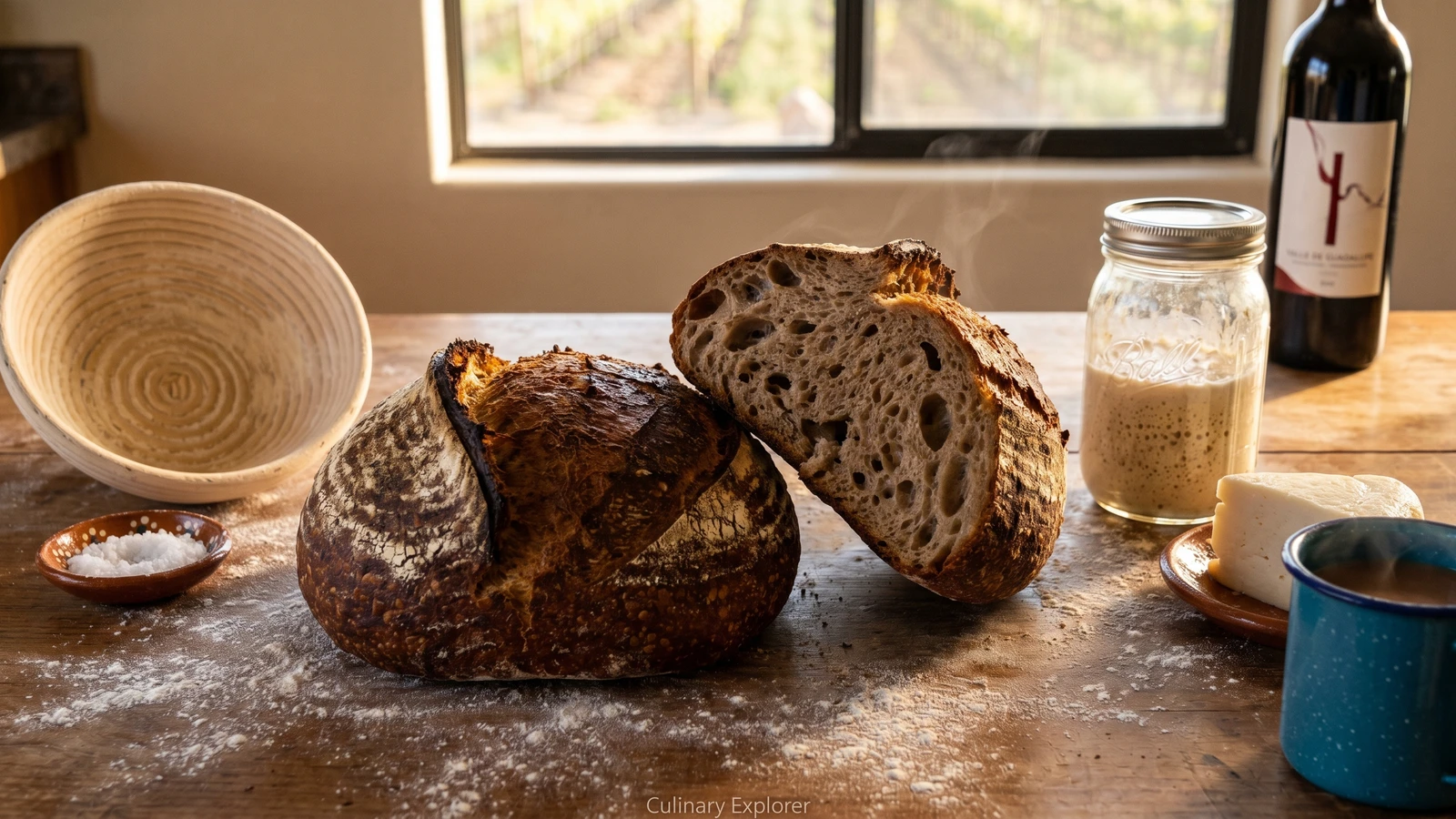
Baja California's wine country sourdough, built on a hundred-year-old Molokan tradition, Yaqui Valley wheat, and the long slow ferment that gives Valle de Guadalupe its honest bread.
This bread is from Baja California. From the Valle de Guadalupe specifically, the wine country north of Ensenada where the Russian Molokans settled in 1905 and brought with them a sourdough tradition that has now been Mexican for over a hundred years. Cada estado, su propia cocina, and the Noroeste's bread is wheat-based, long-fermented, and wood-fired. This is not corn country. This is wheat country, and the bakers here treat it with the seriousness it deserves.
The flour comes from the Yaqui Valley in Sonora. High-protein hard wheat grown in the irrigated desert south of Ciudad Obregon, the breadbasket of northwestern Mexico. If you can find harina from Sonora at a Mexican grocer, use it. The starter is masa madre, what the bakers in Francisco Zarco call pata, fed for generations on flour and water and occasionally laced with a splash of lime juice or beer to brighten the ferment. That is not a foreign trick. That is a Noroeste trick.
This is a two-day bread. The bulk ferment takes a long afternoon and the cold retard takes the whole night. If you are looking for a shortcut, this is not the recipe. The flavor lives in the time. The blistered crust, the open crumb, the faint tang that pairs with a Nebbiolo from a winery five kilometers away, all of it comes from patience and a starter that has been fed properly. Saber cocinar es saber vivir. The Molokan abuelas who taught their daughters this bread did not have stand mixers. They had hands, time, and a wood-fired oven. You can get there with less, but not with much less.
The Russian Molokans, a Christian dissenting sect persecuted by the Orthodox church and the tsarist state, emigrated to Mexico in 1905 and founded the colony of Francisco Zarco in the Valle de Guadalupe. They brought with them a Slavic sourdough tradition, leavened breads built on long-fed wild starters, that adapted to local Sonoran wheat and the wood-fired hornos de leña of northern Mexico. The fusion produced a distinct Baja Californian bread culture that predates the region's modern wine boom by half a century and that is now inseparable from Valle de Guadalupe's identity as Mexico's premier wine country. The Yaqui Valley wheat that defines the loaf comes from irrigation projects developed in the 1940s under Mexico's agricultural modernization, and the region remains the country's largest producer of hard wheat to this day.
Quantity
500 grams, plus more for dusting
Quantity
100 grams
stone-milled if possible
Quantity
50 grams
Quantity
150 grams
fed 8 hours before mixing
Quantity
475 grams
around 24°C / 75°F
Quantity
15 grams
Quantity
1 tablespoon
the Molokan touch
Quantity
for dusting the bannetons
Quantity
for the oven floor
| Ingredient | Quantity |
|---|---|
| Mexican bread flour from the Yaqui Valley | 500 grams, plus more for dusting |
| whole wheat flourstone-milled if possible | 100 grams |
| dark rye flour | 50 grams |
| active masa madre (sourdough starter)fed 8 hours before mixing | 150 grams |
| cool filtered wateraround 24°C / 75°F | 475 grams |
| fine sea salt from the Guerrero Negro flats | 15 grams |
| fresh lime juice (optional)the Molokan touch | 1 tablespoon |
| rice flour (optional) | for dusting the bannetons |
| cornmeal or semolina (optional) | for the oven floor |
Eight hours before you mix the dough, feed your starter. Combine 50 grams of mature masa madre with 50 grams of bread flour and 50 grams of cool water in a glass jar. Stir, cover loosely, and leave on the counter at about 22°C. It is ready when it has doubled, smells faintly of green apple and yogurt, and floats when you drop a teaspoon in water. A tired starter makes a tired bread. No me vengas con atajos.
In a large bowl, whisk together the bread flour, whole wheat, and rye. Add 450 grams of the water (hold the rest back) and mix by hand until no dry flour remains. The dough will be shaggy and rough. Cover with a damp cloth and let it sit for one hour. This is the autolyse. The flour hydrates, the gluten begins to organize itself, and the bread that comes out four hours later will be silkier for it. Yaqui Valley wheat is high in protein and drinks more water than you think. Trust the dough.
After the autolyse, pour the active masa madre on top of the dough along with the salt and the remaining 25 grams of water. If you are using the lime juice, add it now. The acid is a quiet trick the Molokan bakers in Francisco Zarco use to wake the dough and brighten the crumb. Pinch the starter into the dough with wet fingers until fully incorporated. The dough will tighten, then loosen again. This is normal. Cover and rest for 30 minutes.
Over the next four to five hours, perform four sets of stretch-and-folds spaced 30 minutes apart. Wet your hand, grab one side of the dough, pull it up, and fold it over the center. Rotate the bowl a quarter turn and repeat. Four folds per set. After the four sets, leave the dough alone for another two hours. By the end of bulk, it should have risen by about 50 percent, the surface domed and pillowy, with visible bubbles at the edges. La cocina no es decoracion, es trabajo. The dough tells you when it is ready, not the clock.
Turn the dough onto a lightly floured surface. Divide it in half with a bench scraper. Pre-shape each half into a loose round by tucking the edges underneath and dragging the dough across the counter to build tension. Cover with a cloth and let them rest for 30 minutes. The dough relaxes and becomes easier to shape tight.
Flip one round over so the smooth side is down. Stretch the dough into a rough rectangle. Fold the top down, the sides in, and roll it tight from the bottom toward you, sealing the seam with the heel of your hand. Place seam-side up in a rice-flour-dusted banneton or a clean towel-lined bowl. Repeat with the second loaf. The tension in the surface is what gives you the bold ear when you score and bake.
Cover the bannetons and refrigerate for 12 to 16 hours. This long, cold second rise is non-negotiable. It is where the flavor deepens, where the crust develops its blistered character, and where the crumb earns the complexity that makes a Valle de Guadalupe sourdough taste like Valle de Guadalupe. Skip the cold retard and you have made a fine bread. You have not made this bread.
If you have a wood-fired horno de leña, build a fire of oak or mesquite two hours before baking and let it burn down to embers. Sweep the embers to the side, brush the hearth clean, and let the temperature settle around 245°C / 475°F. For a home kitchen, place a Dutch oven or a heavy steel and a cast iron pan on the bottom rack and preheat at 250°C / 480°F for at least 45 minutes. The oven must be hot. Hot enough that you respect it.
Turn one cold loaf out onto a piece of parchment dusted with cornmeal. Score the top with a sharp blade, one decisive curve from edge to edge, about a centimeter deep. Lower the loaf into the hot Dutch oven, cover, and bake for 20 minutes. Remove the lid and bake another 20 to 25 minutes, until the crust is deep mahogany and the loaf sounds hollow when you tap the bottom. For a horno de leña, slide directly onto the hearth, mist the chamber once with water, and close the door. Bake 40 to 45 minutes total, rotating once. Repeat with the second loaf.
Transfer the loaves to a wire rack and let them cool for at least one hour before cutting. The bread is still cooking inside. Cut it warm and you collapse the crumb. Listen to the crust as it cools. It crackles. That is the sign of a long ferment and a hot oven doing what they are supposed to. Asi se hace y punto.
1 serving (about 550g)
Culinary guides, cultural storytelling, and the editorial depth that makes cooking meaningful.
Discover Culinary ExplorerChef Lupita
Guanajuato's daily bread from Acámbaro, a small glazed roll built on pata, enriched with manteca de cerdo, and baked until the top shines lightly for merienda.

Chef Lupita
Michoacan's Tinguindin aguacatas are flat, leaf-scored sweet breads made with harina de trigo, piloncillo, anise, and manteca de cerdo, shaped by hand for the wood oven.

Chef Lupita
From Ajijic on Lake Chapala, Pan Tachihual is a lightly sweet wedding loaf built with harina de trigo, harina de maiz, piloncillo, manteca, anise, and the old Guadalajara pata.

Chef Lupita
Comitán's pan de yema shaped into little pigs, birds, and rabbits, a Chiapas bakery bread rich with egg yolks, manteca de cerdo, and anís, baked golden on hoja de plátano.