
Chef Lupita
Acambaritas de Acámbaro
Guanajuato's daily bread from Acámbaro, a small glazed roll built on pata, enriched with manteca de cerdo, and baked until the top shines lightly for merienda.
A cooking platform built around craft, culture, and the stories behind what we eat.
Created by
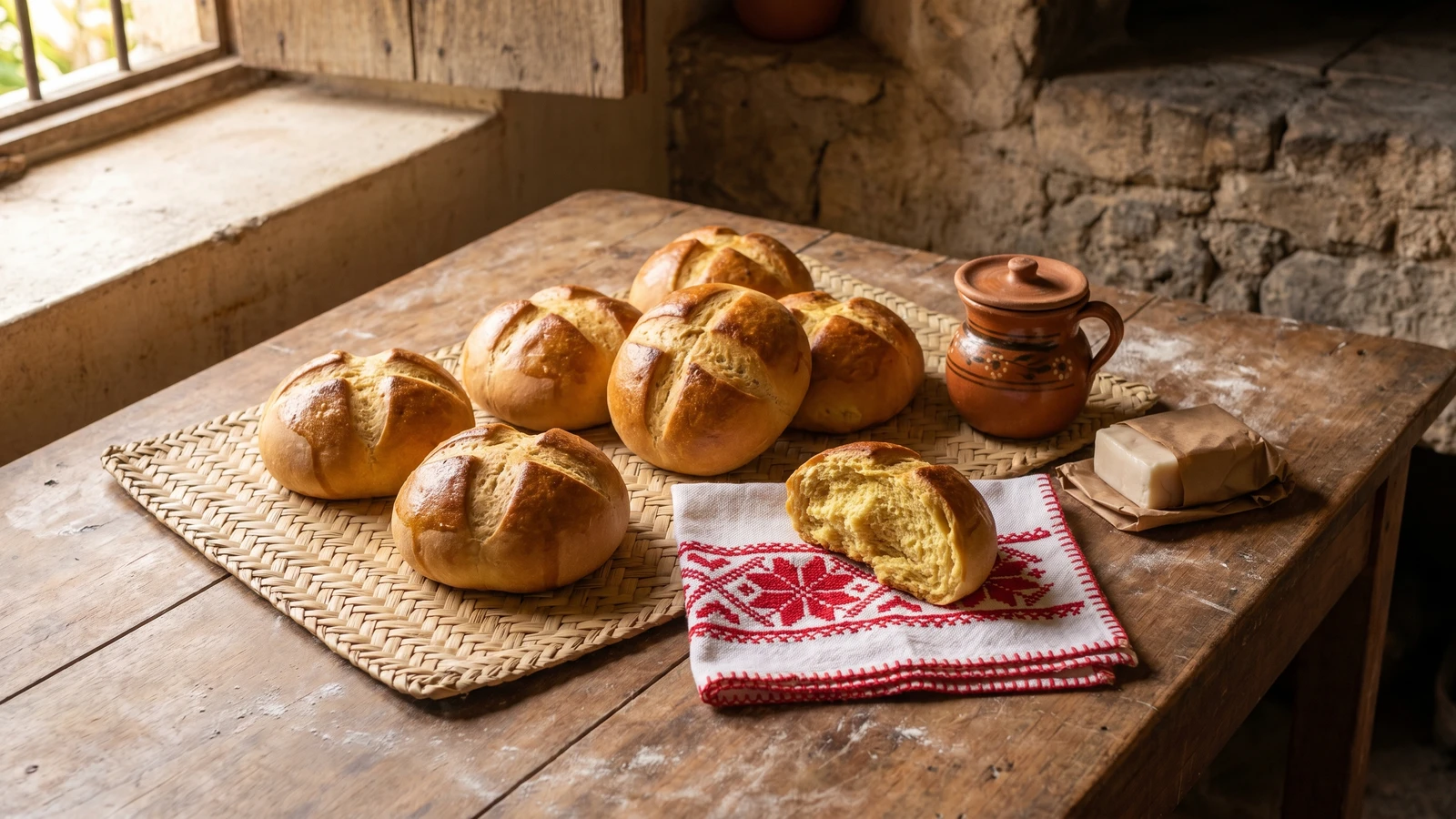
The small village loaf of Yucatán, mixed with manteca de cerdo and baked dark in wood-fired hornos, the bread of panaderías yucatecas that open before dawn and feed the same families for generations.
This is from Yucatán. Not from Mérida proper, but from the small towns that ring the city, Hunucmá, Tixkokob, Acanceh, where the panadería opens at four in the morning and the wood-fired horno has been burning since the night before. The pan de pueblo is what comes out at sunrise. Small round loaves, deep gold on top, weighted with manteca de cerdo, sold by the piece to women carrying them home in folded cotton servilletas yucatecas.
This bread is not pan francés and it is not pan dulce. It is the everyday loaf. The one that sits on the table for the morning coffee, soaks up the juice of the cochinita at midday, and gets torn into the caldo at night. The flour is darker than what you find in central Mexico. The Peninsula has its own wheat history and its panaderos work with a heavier hand. The lard is what makes it last. A loaf with manteca stays soft for three days. A loaf made with oil dries out by lunch. Cada estado, su propia cocina, and Yucatán's bread is built for the Peninsula's climate and the Peninsula's table.
My mother did not bake Yucatecan bread. She was from Jalisco. But on my second trip to the Peninsula, in a town I will not name because the panadería still belongs to the woman who taught me, I sat on a low stool for three mornings and watched a señora named Doña Petrona rub manteca into flour by hand, shape twenty loaves in the time it takes me to shape five, and feed them into a horno she had been working since she was twelve years old. She did not give me a recipe. She let me watch. The proportions in this version are what I worked out afterward, tested in my own oven in Ciudad de México, adjusted over a dozen batches. Recetas probadas y garantizadas. Saber cocinar es saber vivir.
Yucatán's bread tradition reflects the Peninsula's distinct colonial trajectory. Cut off from central Mexico by jungle and the Camino Real and tied more closely by sea to Cuba, New Orleans, and Europe than to the Valle de México, Mérida developed its own wheat economy and its own panadería culture by the late 18th century. The use of manteca de cerdo as the primary fat in everyday breads, rather than the butter of European traditions or the vegetable oils that later dominated industrial Mexican bakeries, was a practical adaptation to the Peninsula's heat and humidity: lard-enriched breads resist staling for several days longer in tropical conditions than their oil-based counterparts. The small village panaderías outside Mérida, most still fired by hardwood from the surrounding monte, are among the last commercial bakeries in Mexico to operate this way at scale.
Quantity
500 grams
plus more for shaping
Quantity
100 grams
Quantity
10 grams
Quantity
12 grams
Quantity
30 grams
Quantity
100 grams
softened, plus more for the bowl
Quantity
1
room temperature
Quantity
320 milliliters
Quantity
1 tablespoon
melted
Quantity
for the peel
| Ingredient | Quantity |
|---|---|
| bread flourplus more for shaping | 500 grams |
| whole wheat flour | 100 grams |
| instant yeast | 10 grams |
| fine sea salt | 12 grams |
| sugar | 30 grams |
| manteca de cerdo (pork lard)softened, plus more for the bowl | 100 grams |
| large eggroom temperature | 1 |
| warm water | 320 milliliters |
| manteca de cerdo for brushingmelted | 1 tablespoon |
| coarse cornmeal or extra flour (optional) | for the peel |
In a large bowl or the bowl of a stand mixer, whisk together the bread flour, whole wheat flour, instant yeast, salt, and sugar. The whole wheat is not a health concession. The panaderos in the small towns outside Mérida use a darker flour than central Mexico does. It gives the loaf its color and its slight bite. Use a soft pastry-quality whole wheat if you can find it, not the coarse stone-ground kind.
Add the softened manteca de cerdo to the dry ingredients. Rub it in with your fingers, the way a panadero does at five in the morning, until the flour looks like coarse, slightly damp sand. La manteca es el sabor and it is also what gives this bread its shelf life. A loaf made with vegetable oil goes stale in a day. A loaf made with manteca lasts three. That is why the panaderías yucatecas have used pork fat for generations.
Make a well in the center. Add the egg and the warm water. Mix with a wooden spoon until a shaggy dough forms, then turn it out onto an unfloured counter. Knead by hand for ten to twelve minutes, or on a stand mixer with the dough hook for seven minutes on medium. The dough is ready when it pulls cleanly off the counter, feels smooth and slightly tacky, and stretches into a thin window without tearing. If it is sticky, resist the urge to add more flour right away. Keep kneading. Most of the time the flour will catch up.
Grease a bowl with a little manteca. Shape the dough into a ball and turn it once to coat. Cover with a clean cotton servilleta, not plastic. The Peninsula is humid and the dough breathes better under cloth. Let it rise at warm room temperature for ninety minutes, or until doubled. In Mérida this happens fast. In a cooler kitchen, give it two hours and trust the dough, not the clock.
Turn the dough onto a lightly floured counter. Divide into six equal pieces, about 175 grams each. Round each piece into a tight ball by cupping your hand over it and dragging it across the counter in small circles. The surface should tighten under your palm. This is the shape they sell in the panaderías outside Mérida, small enough for one family meal, large enough to tear and share. Place the rounds on a parchment-lined sheet pan dusted with cornmeal or flour, leaving four fingers of space between each.
Cover the loaves with the same cotton servilleta and let them rise for forty-five minutes to an hour. They are ready when they have grown by half and the dough springs back slowly when poked with a fingertip. While they rise, heat the oven to 425F (220C) with a baking stone or heavy sheet pan on the middle rack. A village horno holds heat from the floor up. A home oven needs the stone to imitate it. No me vengas con atajos on this one. A pan placed on a cold rack will give you a pale bottom and a sad loaf.
With a sharp blade or razor, score a single shallow cross on top of each loaf. Brush the tops with the melted manteca. Slide the sheet pan onto the hot stone. Bake for thirty to thirty-five minutes, rotating once halfway through, until the loaves are deep golden brown and sound hollow when tapped on the bottom. The crust should be firm but not hard. The interior crumb should be tight and slightly yellow from the egg and the lard.
Transfer the loaves to a woven palm petate or a wire rack. Let them cool for at least twenty minutes before tearing. Cutting them hot will compress the crumb and you will think you did something wrong. You did not. The bread needs to set. Así se hace y punto.
1 serving (about 165g)
Culinary guides, cultural storytelling, and the editorial depth that makes cooking meaningful.
Discover Culinary ExplorerChef Lupita
Guanajuato's daily bread from Acámbaro, a small glazed roll built on pata, enriched with manteca de cerdo, and baked until the top shines lightly for merienda.

Chef Lupita
Michoacan's Tinguindin aguacatas are flat, leaf-scored sweet breads made with harina de trigo, piloncillo, anise, and manteca de cerdo, shaped by hand for the wood oven.

Chef Lupita
From Ajijic on Lake Chapala, Pan Tachihual is a lightly sweet wedding loaf built with harina de trigo, harina de maiz, piloncillo, manteca, anise, and the old Guadalajara pata.

Chef Lupita
Comitán's pan de yema shaped into little pigs, birds, and rabbits, a Chiapas bakery bread rich with egg yolks, manteca de cerdo, and anís, baked golden on hoja de plátano.