
Chef Lupita
Acambaritas de Acámbaro
Guanajuato's daily bread from Acámbaro, a small glazed roll built on pata, enriched with manteca de cerdo, and baked until the top shines lightly for merienda.
A cooking platform built around craft, culture, and the stories behind what we eat.
Created by
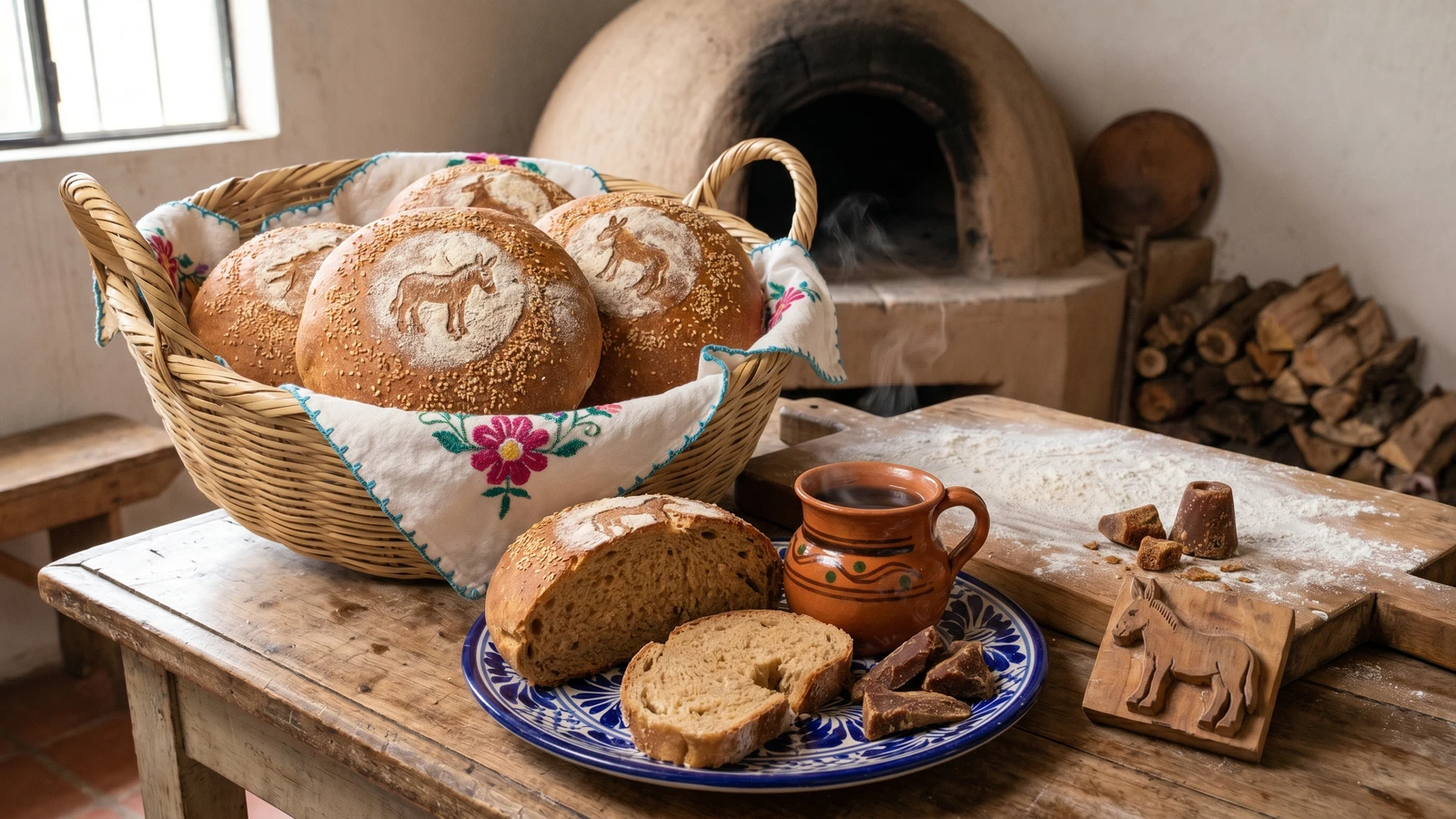
Puebla's Tehuacan valley bread, built from wheat flour, piloncillo, manteca de cerdo, and masa madre, stamped with a donkey so it can travel from San Jose Miahuatlan to the mercado.
Puebla, the Tehuacan valley, San Jose Miahuatlan. That is where this bread lives. Not in the display case of a city bakery trying to look old, but in the hands of panaderas who mix wheat flour, water, piloncillo, manteca de cerdo, and masa madre in wooden troughs, then bake the rounds in hornos de lena until the crust is firm enough to travel.
The donkey stamp is not decoration. It tells you what bread you are holding and where it comes from. Pan de burro was made to move, to go from Miahuatlan into Tehuacan, La Purisima market, nearby towns, and family tables where one loaf had to last. This is bread with a job. La cocina no es decoracion, es trabajo.
There are no chiles here. Let that teach you something. Not all Mexican food is chile and salsa. Puebla gives you mole poblano, chiles en nogada, cemitas, and this long-keeping sourdough. Cada estado, su propia cocina. The flavor comes from slow fermentation, piloncillo, lard, wood fire, and patience. No me vengas con atajos.
Pan de burro, also called pan redondo in parts of Puebla, is associated with San Jose Miahuatlan in the Tehuacan region and was already being commercialized by the late 1800s according to Puebla cultural records. Its name and stamped donkey image are tied to the way the bread traveled to nearby towns and markets, strong enough to survive transport and storage. Traditional production still depends on slow fermentation, hand shaping, and wood-fired ovens, though industrial versions have pushed many family bakers out of the trade.
Quantity
50 grams
active and bubbly
Quantity
125 grams
for feeding the starter
Quantity
125 grams
for feeding the starter
Quantity
120 grams
finely grated
Quantity
60 grams
Quantity
475 grams
divided
Quantity
875 grams, plus more for dusting
Quantity
80 grams
softened
Quantity
18 grams
Quantity
50 grams
for the tops
| Ingredient | Quantity |
|---|---|
| mature wheat sourdough starteractive and bubbly | 50 grams |
| room-temperature waterfor feeding the starter | 125 grams |
| bread flourfor feeding the starter | 125 grams |
| piloncillofinely grated | 120 grams |
| granulated sugar | 60 grams |
| warm waterdivided | 475 grams |
| bread flour | 875 grams, plus more for dusting |
| manteca de cerdosoftened | 80 grams |
| fine sea salt | 18 grams |
| sesame seeds (ajonjoli)for the tops | 50 grams |
The night before baking, mix the mature sourdough starter with 125 grams water and 125 grams bread flour. Cover loosely and let it stand 8 to 10 hours, until domed, bubbly, and fragrant. If it smells sharply alcoholic and has collapsed, feed it again. Weak masa madre gives weak bread. Asi se hace y punto.
Warm 200 grams of the dough water just enough to dissolve the grated piloncillo and granulated sugar. Stir until smooth, then add the remaining 275 grams water so the mixture is only lukewarm. Hot syrup kills your starter. The water should feel like a kitchen in Puebla at noon, warm but not punishing.
In a large bowl or wooden artesa, combine the 875 grams bread flour, all of the ripe starter, and the piloncillo water. Mix with your hand until no dry flour remains. The dough will be firm and a little sticky from the sugar. Cover and rest 30 minutes so the flour drinks properly before you ask it to behave.
Sprinkle the salt over the dough and smear the softened manteca de cerdo across the surface. Knead 12 to 15 minutes, folding and pressing until the lard disappears into the dough and the surface turns smoother. La manteca es el sabor. Vegetable shortening gives you a flatter mouthfeel and less keeping power. Use lard.
Place the dough in a lightly greased bowl or leave it in the artesa. Cover well and let it ferment 10 to 12 hours at cool room temperature, around 68 to 72F. Fold it once after the first hour. By morning it should look fuller, with small bubbles under the skin, but it does not need to double. This bread keeps its strength because the fermentation is slow.
Turn the dough onto a lightly floured board and divide it into 8 pieces, about 240 grams each. Shape each piece into a tight ball, then flatten into a thick round about 5 inches wide. Cover with a cloth and let the rounds rest 20 minutes. The surface should relax without spreading into a pancake.
Press a donkey stamp firmly into the top of each round. Brush the surface lightly with water and scatter with ajonjoli. Make one small cut in the center so the loaf opens cleanly instead of tearing wherever it wants. If you do not have the stamp, make the bread anyway, but understand what is missing. The mark belongs to Miahuatlan.
Set the rounds on floured boards or parchment-lined trays. Cover and proof 1 1/2 to 2 1/2 hours, until the loaves look puffy and a fingertip pressed near the edge leaves a mark that slowly returns. Do not overproof them. Pan de burro should stand proud, not sag.
For a home oven, place a baking stone or heavy sheet pan inside and preheat to 500F for 45 minutes. Slide in the loaves, lower the heat to 450F, and bake 25 to 30 minutes, rotating once, until the crust is deep tan, the bottoms sound hollow, and the stamped top stays visible. In a wood oven, bake as the floor heat falls from about 575F toward 500F. That hard first heat is what gives the bread its traveler's crust.
Cool the loaves completely on a rack or clean cloth before storing. Do not trap them hot in plastic or the crust will soften badly. Wrap in a cotton servilleta and keep in a basket at room temperature. The flavor is better the next day, when the piloncillo and masa madre settle into the crumb. Saber cocinar es saber vivir.
1 serving (about 210g)
Culinary guides, cultural storytelling, and the editorial depth that makes cooking meaningful.
Discover Culinary ExplorerChef Lupita
Guanajuato's daily bread from Acámbaro, a small glazed roll built on pata, enriched with manteca de cerdo, and baked until the top shines lightly for merienda.

Chef Lupita
Michoacan's Tinguindin aguacatas are flat, leaf-scored sweet breads made with harina de trigo, piloncillo, anise, and manteca de cerdo, shaped by hand for the wood oven.

Chef Lupita
From Ajijic on Lake Chapala, Pan Tachihual is a lightly sweet wedding loaf built with harina de trigo, harina de maiz, piloncillo, manteca, anise, and the old Guadalajara pata.

Chef Lupita
Comitán's pan de yema shaped into little pigs, birds, and rabbits, a Chiapas bakery bread rich with egg yolks, manteca de cerdo, and anís, baked golden on hoja de plátano.