Culinary Explorer

A cooking platform built around craft, culture, and the stories behind what we eat.
Discover Culinary Explorer
Pambazo Xalapeño

Pambazo Xalapeño

Created by

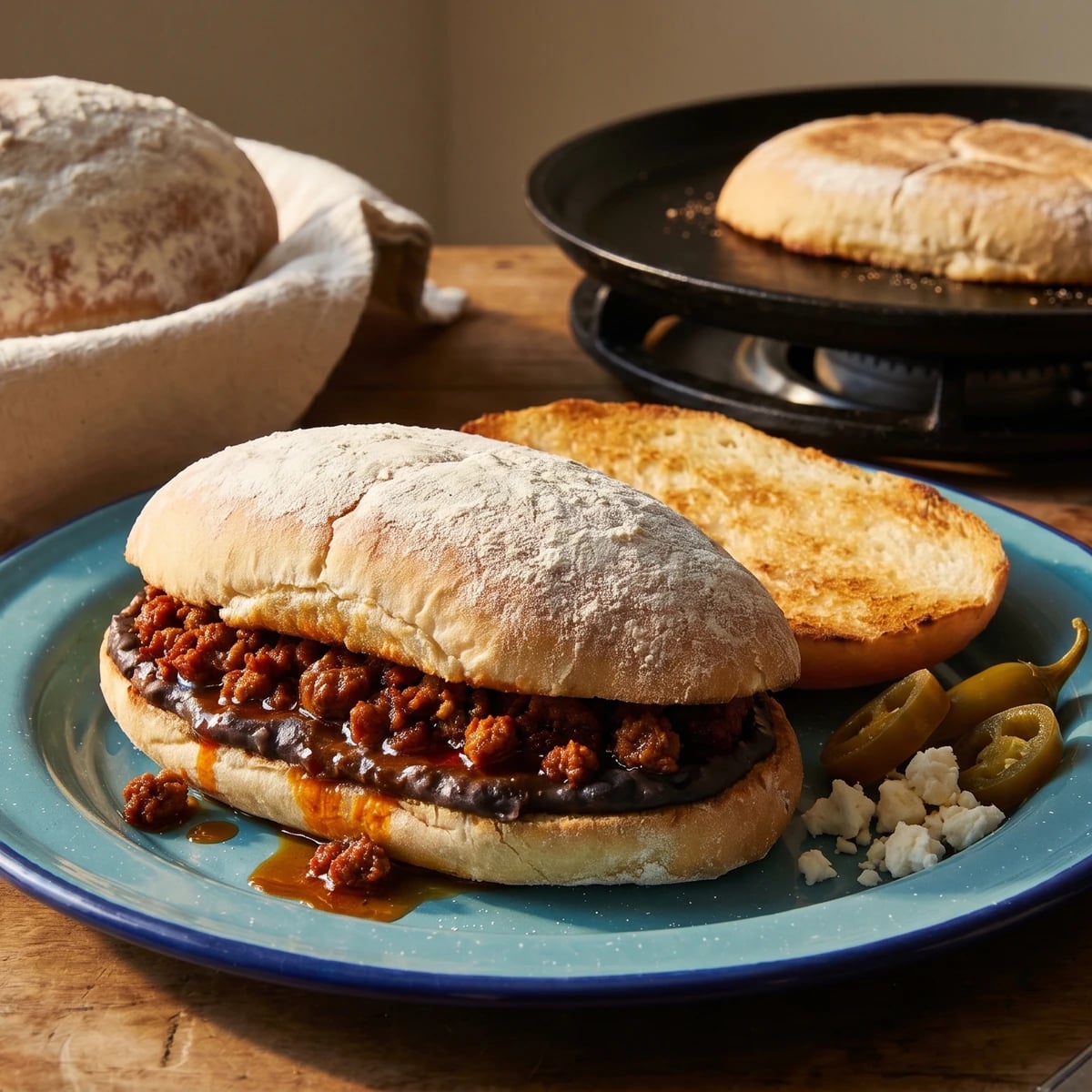
Veracruz's mountain capital claims the original pambazo: a soft, faintly sweet roll dusted in flour to mirror the snow on the Cofre de Perote, split warm and filled with refried black beans and chorizo.

Sandwiches & Wraps
Mexican
Quick Meal
Game Day
2 hr 45 min
Active Time
40 min cook3 hr 25 min total
Yield8 pambazos

This is Xalapa, the capital of Veracruz, up in the cloud forest where the mountain air stays cool and the volcano watches over the city. The pambazo is from here. I know Mexico City sells something it calls a pambazo, a roll dipped in red chile, fried, stuffed with potato. That is a fine antojito. It is not the original. The original is xalapeño, and it never touches a fryer.

Look at the bread. It is dusted white with flour, the flour sitting on a pale, soft crust, and that flour is not an accident. It is the snow on the Cofre de Perote and the Pico de Orizaba, the peaks you see from the city on a clear morning. The bread itself is soft, a little sweet, enriched with manteca and egg. You cannot buy a real pambazo xalapeño outside of Veracruz, so I am going to teach you to make the bread. The bread is the dish. Everything else is filling.

And the filling starts with beans. Frijoles negros, not pinto. In Veracruz the black bean rules the pot, cooked soft with a branch of epazote, then fried in manteca until it is thick enough to hold inside the bread. La manteca es el sabor. From there you choose: chorizo, sliced jamón, or a folded egg. This is Veracruz, La Tercera Raíz, the Spanish wheat and the Mesoamerican bean on one plate, and the cooks here do not need to dress it up.

My mother was from Jalisco, not Veracruz, so the pambazo was never hers. I learned it on the road, three mornings in a row at the same stand near the Mercado Jáuregui, watching a señora split the rolls and warm them on the comal before she filled them. She told me the whole secret was to never let the bread brown in the oven. Keep it pale, keep it floury, keep the snow on the mountain. Cada estado, su propia cocina, and this one belongs to Veracruz.

The name pambazo descends from the colonial Spanish 'pan bazo,' a coarse, brownish bread baked from second-grade flour and sold to the lower classes, set apart from the fine white 'pan floreado' reserved for the wealthy. In Xalapa the bread evolved into an enriched white roll finished with a heavy dusting of flour, popularly said to evoke the snow on the nearby Cofre de Perote and on the Pico de Orizaba, Mexico's highest peak. While the version eaten in the central highlands turned toward the chile-soaked, fried antojito of Mexico City, the xalapeño pambazo stayed closer to its bread origins and built its identity on the black bean of the Veracruz mountains.

The technique, the tradition, and the story behind every dish.

Discover Culinary Explorer

Ingredients

all-purpose flour

Quantity

4 cups (500 g)

plus more for dusting

active dry yeast

Quantity

2 1/4 teaspoons (1 packet)

granulated sugar

Quantity

1/4 cup

fine salt

Quantity

1 1/2 teaspoons

lard (manteca de cerdo)

Quantity

1/3 cup

softened, for the dough, plus more for the bowl

egg

Quantity

1 large

at room temperature

warm whole milk

Quantity

1 to 1 1/4 cups

cooked black beans (frijoles negros)

Quantity

3 cups

drained, 1 cup cooking liquid reserved

lard (manteca de cerdo)

Quantity

3 tablespoons

for the beans

white onion

Quantity

1/2

finely chopped

fresh epazote

Quantity

1 large sprig

salt

Quantity

to taste

Mexican chorizo

Quantity

1/2 pound

casing removed, for the chorizo version

cooked ham (jamón) (optional)

Quantity

4 slices

for the ham version

eggs (optional)

Quantity

4 large

beaten, for the egg version

pickled jalapeños in escabeche (optional)

Quantity

for serving

queso fresco (optional)

Quantity

for serving

crumbled

Equipment Needed

  • Large mixing bowl
  • Bench scraper for dividing the dough
  • Parchment-lined sheet pan
  • Cast iron comal or heavy skillet
  • Bean masher or sturdy wooden spoon

Instructions

  1. 1

    Bloom the yeast

    Warm the milk until it feels like bathwater, no hotter, or you will kill the yeast before it starts. Stir in a teaspoon of the sugar and all of the yeast. Let it sit for ten minutes, until it foams on top and smells faintly like beer. If nothing happens, your yeast is dead. Throw it out and start over with fresh yeast. There is no point building bread on a foundation that will not rise.

  2. 2

    Make the dough

    In a large bowl, whisk together the flour, the rest of the sugar, and the salt. Work the softened lard into the flour with your fingers until it looks like damp sand. Make a well, add the egg and the foamy yeast mixture, and bring it together into a shaggy dough. Turn it onto the counter and knead for ten to twelve minutes, until it is smooth, soft, and springs back when you press it. Add milk a splash at a time if it feels stiff. This is an enriched dough. It should feel alive under your hands.

    Manteca, not oil, not butter. The lard gives the crumb its softness and the bread its flavor. La manteca es el sabor.
  3. 3

    First rise

    Grease a clean bowl with a little lard, turn the dough to coat, and cover it with a cloth. Let it rise in a warm corner of the kitchen until doubled, about an hour and a half. In the cool mountain air of Xalapa it takes longer. In a hot kitchen, less. Watch the dough, not the clock.

  4. 4

    Shape the rolls

    Punch the dough down and turn it out. Divide it into eight equal pieces with a bench scraper. Roll each one into a tight ball, then cup your hand over it and roll it on the counter to seal the bottom and build a smooth, taut top. Shape them round or into short ovals, the way the panaderías around the Mercado Jáuregui do. Set them on a parchment-lined sheet with room between them.

  5. 5

    Dust and proof

    Now the snow. Dust the tops generously with flour, a thick, even coat. Cover loosely and let them rise again until puffy and nearly doubled, about forty-five minutes. Just before they go in the oven, dust them a second time. The double dusting is what keeps them pale and floury through the bake.

  6. 6

    Bake pale, not brown

    Heat the oven to 375°F (190°C). Bake the rolls for eighteen to twenty minutes, until they are cooked through and the bottoms are light gold, but the tops stay pale and floury. Do not let them brown on top. A browned pambazo is just a sweet bolillo. Keep the snow on the mountain. Let them cool until barely warm before you fill them.

    If your oven runs hot up top, move the rack to the lower third. The goal is a soft, white crust, not color.
  7. 7

    Refry the black beans

    Melt the three tablespoons of lard in a skillet over medium heat. Add the chopped onion and cook until soft and translucent. Add the black beans with a splash of their liquid and the sprig of epazote. Mash them with a bean masher or the back of a sturdy spoon as they cook, adding more liquid as needed, until you have a thick, smooth paste that holds its shape on the spoon. Salt to taste and pull out the epazote. The beans must be spreadable, not soupy. Soupy beans drown the bread.

    Frijoles negros, not pinto. In Veracruz the black bean rules the pot. Pinto beans here would taste like another state's breakfast.
  8. 8

    Cook your filling

    For chorizo: crumble it into a hot skillet and cook until it renders its fat and crisps at the edges, about eight minutes. For egg: pour the beaten eggs into a little of that chorizo fat, or into fresh lard, and scramble them soft, the way they make huevo con chorizo. For ham: warm the slices on a comal a few seconds a side. Choose one for each pambazo, or make a few of each. The beans are the constant. The protein is yours to pick.

  9. 9

    Build and serve

    Split each warm roll most of the way through, keeping a hinge so it folds like a book. Warm the cut sides face down on a comal or dry skillet for a few seconds, just to toast them lightly. Spread a thick layer of refried black beans on the bottom. Add the chorizo, ham, or egg. Close it, press gently, and serve right away with pickled jalapeños on the side and a little queso fresco if you like. Saber cocinar es saber vivir.

Chef Tips

  • If you are lucky enough to be in Xalapa, do not bake at all. Walk to the Mercado Jáuregui or any good panadería and buy the pambazos warm in the morning. The bread is a daily craft there. Outside Veracruz you bake, because what gets sold as a pambazo elsewhere is a different animal entirely.
  • Cook your own black beans if you have the time, with onion and epazote, and save the broth. Canned black beans will get you through in a hurry, but rinse off the can liquid, fry them down hard with the epazote, and season them like you mean it. A substitution is a compromise, not an upgrade.
  • The Veracruz table runs hotter than the bread lets on. A salsa of chiltepín, the little wild chile of the region, or a spoon of chipotle adobado on the side is how the highlands cut the richness. Set it out and let each person build their own plate.
  • The one mistake that ruins this bread is color. The moment the tops turn golden you have made a sweet bolillo, not a pambazo. Bake pale, dust twice, keep the snow on the volcano. Así se hace y punto.

Advance Preparation

  • The refried black beans can be made up to three days ahead and keep well in the refrigerator. Loosen them with a splash of water or broth and warm them through before filling the bread.
  • The dough can take a slow first rise in the refrigerator overnight. Bring it back to room temperature before shaping. The cold ferment deepens the flavor of the crumb.
  • The bread is best the day it is baked. If you must get ahead, freeze the cooled rolls in a bag and refresh them in a 300°F oven for a few minutes, then dust with fresh flour to bring the snow back.

Frequently Asked Questions

Nutrition Information

1 serving (about 260g)

Calories
690 calories
Total Fat
32 g
Saturated Fat
13 g
Trans Fat
0 g
Unsaturated Fat
17 g
Cholesterol
75 mg
Sodium
1700 mg
Total Carbohydrates
76 g
Dietary Fiber
9 g
Sugars
10 g
Protein
25 g

Note: Chef personas and recipes are created with AI assistance. Cook with care: follow safe food-handling practices, check doneness with a thermometer when needed, and adapt for allergies and your kitchen.

Where cooking meets culture.

Culinary guides, cultural storytelling, and the editorial depth that makes cooking meaningful.

Discover Culinary Explorer

More from Veracruz Tacos, Tostadas & Handhelds

Browse the full collection