
Chef Lupita
Birria Tacos with Consome
Jalisco's goat birria, born around Cocula and carried into Guadalajara's markets, slow-braised in ancho, guajillo, cascabel, and chile de arbol, then tucked into corn tortillas crisped in its own red fat.
A cooking platform built around craft, culture, and the stories behind what we eat.
Created by
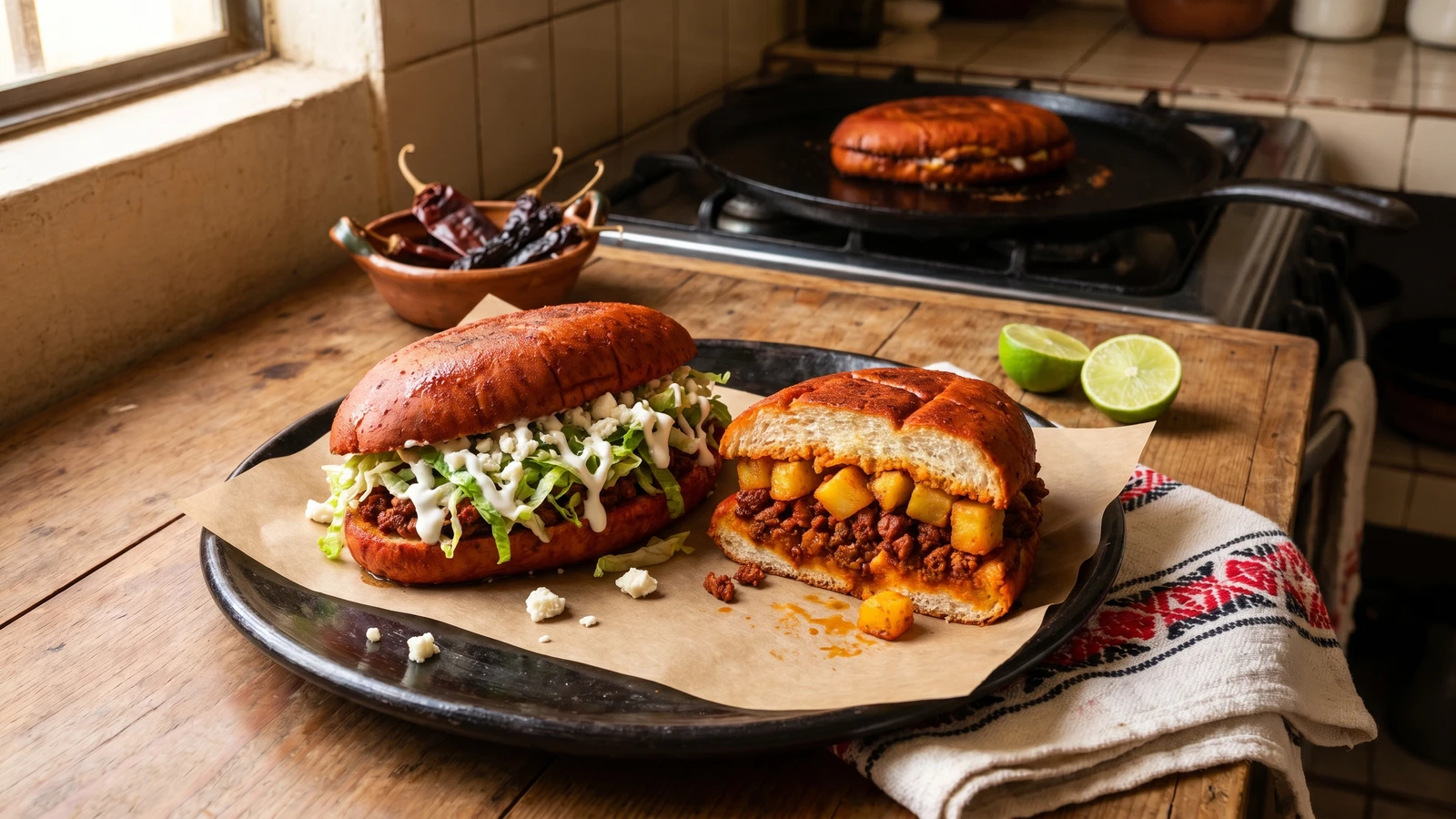
Bolillo bathed in a guajillo and pasilla oaxaqueño sauce, fried on a comal until the crust turns brick-red and crisp, then stuffed with chorizo oaxaqueño and potatoes fried in lard. A street-cart sandwich from Oaxaca, not salon food.
This is Oaxaca's pambazo. The pambazo exists across central Mexico, from the capital to Puebla to Veracruz, but when Oaxaca makes it, the chorizo changes everything. Chorizo oaxaqueño is not the greasy red paste from Toluca. It is drier, smokier, built on pasilla oaxaqueño and a vinegar cure that gives it a tartness you will not find anywhere else in the country. That chorizo is the reason this pambazo belongs to Oaxaca.
The bread is a bolillo, the same everyday roll you find at any panaderia. You split it, dunk it in a guajillo chile sauce until the crust soaks through, then fry it on a comal slicked with lard until the outside turns brick-red and slightly crisp. The sauce stains the bread and gives it a second skin. Skip the frying and you have a soggy roll. Skip the sauce and you have a torta, not a pambazo. These are two different things. No me vengas con atajos.
The filling is straightforward. Chorizo crumbled and fried with diced potatoes until the potatoes pick up the fat and the chile color from the meat. You stuff the fried bread, pile on shredded lettuce, a thread of crema, crumbled queso fresco, and eat it standing at a street cart in the mercado or sitting at your kitchen table. Either way, it is the same sandwich.
I collected this version from a senora who runs a pambazo cart outside the Mercado de Abastos in Oaxaca City. She fries forty bolillos before noon. Her guajillo sauce has pasilla oaxaqueño in it for depth, and she told me that was her mother's addition. My mother never made pambazos. She was Jalisciense and had her own antojitos. But she would have recognized the principle: good bread, good chile, good fat, no pretension. Recetas probadas y garantizadas.
The pambazo takes its name from 'pan basso,' a colonial-era term for bread made from coarse, lower-grade wheat flour, darker and denser than the refined bolillo. The practice of bathing the bread in chile sauce before frying likely emerged in 19th-century Mexico City as a way to revive day-old rolls and add flavor to otherwise plain bread, a technique rooted in the economic necessity of working-class kitchens. In Oaxaca, the dish acquired its regional character through the use of chorizo oaxaqueño, a sausage whose preparation with pasilla oaxaqueño chiles, black pepper, and vinegar distinguishes it from the Toluca-style chorizo dominant in the capital and makes the Oaxacan pambazo a different sandwich entirely.
Quantity
6
stemmed and seeded
Quantity
2
stemmed and seeded
Quantity
2
unpeeled
Quantity
1/4 medium
Quantity
1/2 teaspoon, plus more to taste
Quantity
12 ounces
casings removed
Quantity
1 pound
peeled and diced into 1/2-inch cubes
Quantity
1 tablespoon
Quantity
6
split lengthwise without cutting all the way through
Quantity
2 tablespoons
Quantity
for serving
Quantity
for serving
Quantity
for serving
crumbled
| Ingredient | Quantity |
|---|---|
| dried chile guajillostemmed and seeded | 6 |
| dried pasilla oaxaqueñostemmed and seeded | 2 |
| garlic clovesunpeeled | 2 |
| white onion | 1/4 medium |
| kosher salt | 1/2 teaspoon, plus more to taste |
| chorizo oaxaqueñocasings removed | 12 ounces |
| waxy potatoes (such as Yukon Gold)peeled and diced into 1/2-inch cubes | 1 pound |
| lard (manteca de cerdo) for the filling | 1 tablespoon |
| bolillossplit lengthwise without cutting all the way through | 6 |
| lard (manteca de cerdo) for the comal | 2 tablespoons |
| shredded romaine lettuce (optional) | for serving |
| Mexican crema (optional) | for serving |
| queso fresco (optional)crumbled | for serving |
Heat a dry comal or heavy skillet over medium. Toast the guajillo and pasilla oaxaqueño chiles one or two at a time, pressing them flat with a spatula, about 30 seconds per side. They should puff, darken slightly, and fill the kitchen with a smoky, earthy scent. The pasilla oaxaqueño smells different from other pasillas: deeper, almost like chipotle but rounder. That is the smoke from Oaxaca's drying process. Transfer the toasted chiles to a heatproof bowl, cover with hot water (not boiling), and soak for 15 minutes until soft and pliable.
On the same comal, place the unpeeled garlic cloves and the quarter onion. Roast, turning occasionally, until the garlic is soft inside its papery skin and the onion is charred on both flat sides, about 8 to 10 minutes. The char is not a mistake. It adds a bittersweet depth to the sauce that raw garlic and onion cannot give you. Peel the garlic when cool enough to handle.
Drain the chiles, reserving half a cup of the soaking liquid. Transfer the softened chiles to a blender with the roasted garlic, roasted onion, salt, and the reserved soaking liquid. Blend on high until completely smooth. Strain through a fine-mesh sieve into a wide shallow bowl or baking dish, pressing hard on the solids with the back of a spoon. Discard the skins. The sauce should be thick enough to coat the bread but pourable. Add a splash more soaking liquid if it is too thick to dip in. This sauce is the pambazo. Everything else is filling.
Place the diced potatoes in a small pot and cover with cold salted water. Bring to a boil over high heat, then reduce to a steady simmer. Cook until just tender when pierced with a knife, about 8 to 10 minutes. Do not overcook them. You want them to hold their shape in the skillet. Soft potatoes will turn to mush when you fry them with the chorizo. Drain well.
Heat one tablespoon of lard in a large skillet over medium. Crumble the chorizo into the pan and fry, breaking it apart with a wooden spoon, until the fat renders and the meat is cooked through and starting to crisp at the edges, about 8 minutes. The kitchen will smell like pasilla oaxaqueño and vinegar. That is right. Add the drained potatoes and stir to combine. The potatoes should absorb the red-orange fat from the chorizo and pick up its color. Cook together for another 3 to 4 minutes until the potatoes have a light golden crust on their edges. Season with salt if needed. Set aside and keep warm.
Open each split bolillo like a book. One at a time, lay each bolillo into the guajillo sauce, pressing gently so the bread absorbs the sauce on the outside and along the cut surfaces. Turn it to coat all sides. Let the excess drip off for a moment over the dish. The bread should be thoroughly stained brick-red from the chile but not so saturated that it falls apart in your hand. Work with confidence. Hesitate and the bread soaks too long and tears.
Heat your comal or a wide heavy skillet over medium and add a thin film of lard. Place the sauce-bathed bolillos cut-side down first. Fry for 2 to 3 minutes until the surface develops a light crust and darkens from the chile. Flip and fry the other side for another 2 minutes. You want a slight crispness forming where the chile sauce met the heat. That crust is the architecture of the sandwich. It holds everything together. Without it, you have a wet roll. Work in batches if your comal is not wide enough for all six.
Open each fried bolillo and stuff generously with the chorizo and potato mixture. Pile on a handful of shredded lettuce, a drizzle of Mexican crema, and a scatter of crumbled queso fresco. Press the top of the bolillo down gently. Serve the moment it is assembled. A pambazo does not wait. The bread softens as it sits and the structure fails. Eat it while the outside is still warm, faintly crisp, and stained the color of the guajillo that made it. Asi se hace y punto.
1 serving (about 250g)
Culinary guides, cultural storytelling, and the editorial depth that makes cooking meaningful.
Discover Culinary ExplorerChef Lupita
Jalisco's goat birria, born around Cocula and carried into Guadalajara's markets, slow-braised in ancho, guajillo, cascabel, and chile de arbol, then tucked into corn tortillas crisped in its own red fat.

Chef Lupita
Sonora's working morning burrito: chicharrón de cáscara stewed in chile colorado with diced potato, rolled tight in a paper-thin tortilla sobaquera and eaten standing up at the carreta.

Chef Lupita
Mocorito's pork chilorio, shredded and confited in lard with chile ancho and pasilla, rolled into a thin handmade flour tortilla. The burrito Sinaloa sends out into the world.

Chef Lupita
Sonora's morning burrito of mashed pinto frijoles puercos and melted queso asadero, wrapped in a paper-thin sobaquera and seared on the comal until the cheese pulls in long strings.