
Chef Lupita
Almendrados Conventuales Poblanos
Puebla's convent almond cookies, made from blanched almonds, sugar syrup, egg yolks, canela, and patient hands, the kind of sweet that belongs beside coffee in talavera, not in a plastic bakery box.
A cooking platform built around craft, culture, and the stories behind what we eat.
Created by
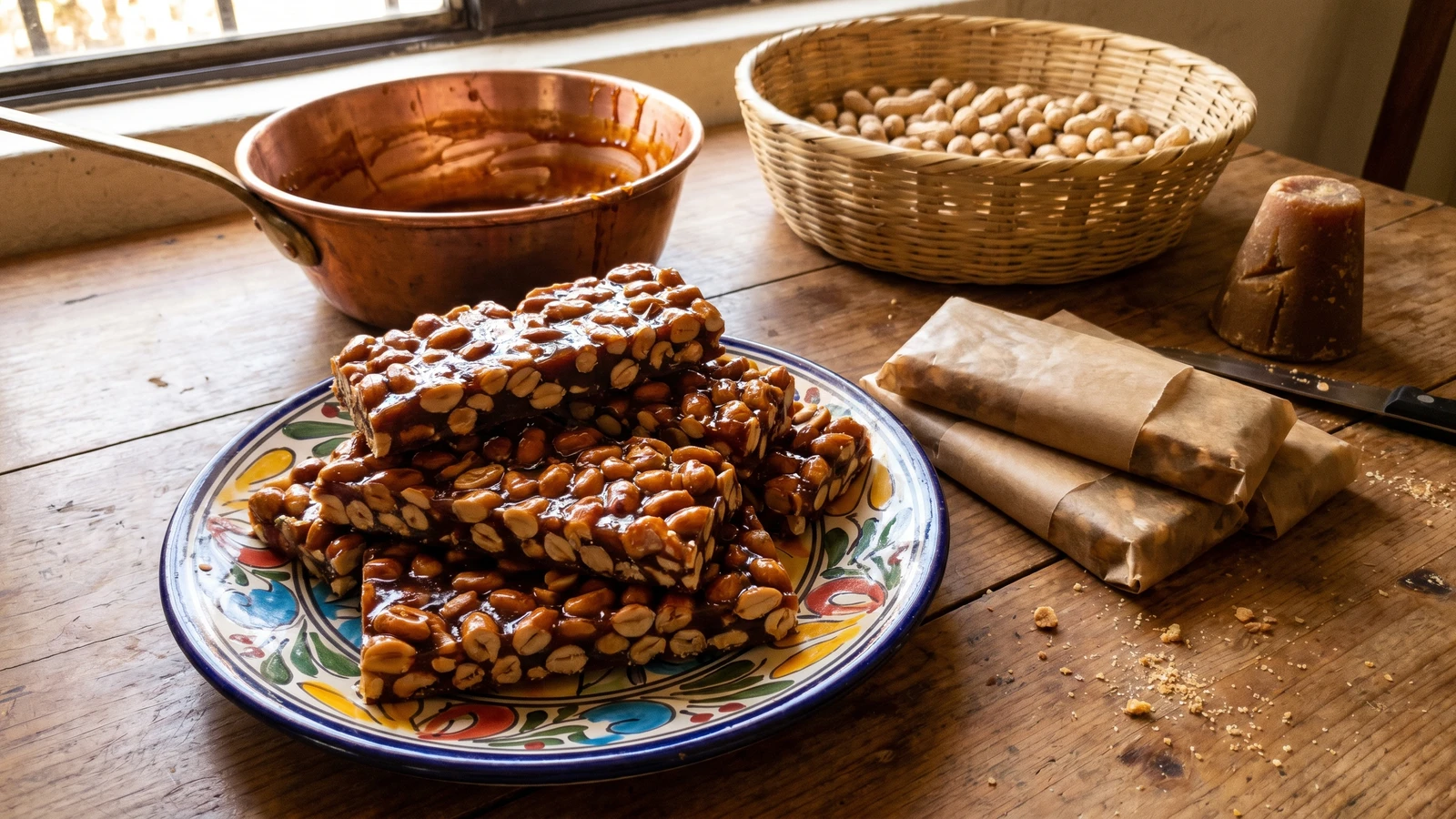
Jalisco's market palanqueta is whole roasted cacahuate locked into dark piloncillo caramel, cut into sturdy bars made for holidays, bus rides, school lunches, and hungry workers.
Jalisco keeps these palanquetas in the mercado, not behind glass like a delicate pastry. In Guadalajara's Mercado Libertad, in Tlaquepaque sweet stalls, and at town fiestas through Los Altos and the Valles, you see them stacked in clear paper: whole peanuts held together by dark piloncillo caramel. Cheap, sturdy, generous. That is their dignity.
The ingredient that matters is piloncillo, the cone of unrefined cane sugar with its mineral, dark sweetness. White sugar alone makes a sharp candy. Piloncillo gives the bar its Jalisco market flavor, the kind that tastes like a copper cazo, roasted peanuts, and hands that know when syrup is ready without staring at a thermometer.
The women who make good palanquetas do not stir nervously. They roast the cacahuate until it smells warm and nutty, cook the syrup until a drop snaps in cold water, then move fast. Once the caramel is ready, it gives you no time for indecision. Grease the table, have the peanuts ready, pour, press, cut. Así se hace y punto.
My mother kept palanquetas in a tin for days when money was tight. She said a child with peanuts and piloncillo in the pocket could make it through the afternoon. Saber cocinar es saber vivir.
Palanquetas belong to Mexico's colonial candy tradition, when cane sugar and piloncillo production spread through New Spain and cooks adapted older seed-and-honey sweets into hard sugar candies. Peanuts originated in South America and moved through trade into Mesoamerica long before industrial candy made them cheap and common. In Jalisco, palanquetas became practical market sweets because they travel well, keep for days, and use ingredients sold by weight in every mercado.
Quantity
3 cups
Quantity
1 pound
chopped
Quantity
1/2 cup
Quantity
1/2 cup
Quantity
1 tablespoon
Quantity
1/2 teaspoon
Quantity
1 teaspoon
for greasing the pan
| Ingredient | Quantity |
|---|---|
| raw skin-on peanuts | 3 cups |
| piloncillochopped | 1 pound |
| granulated sugar | 1/2 cup |
| water | 1/2 cup |
| fresh lime juice | 1 tablespoon |
| kosher salt | 1/2 teaspoon |
| unsalted butter or neutral oilfor greasing the pan | 1 teaspoon |
Grease a rimmed baking sheet or marble slab with the butter or oil. Set a greased spatula, a sharp knife, and a lightly oiled rolling pin nearby. Once the caramel is ready, you will not have time to search for tools. No me vengas con atajos.
Heat a comal or wide heavy skillet over medium. Add the peanuts and roast for 8 to 10 minutes, stirring constantly, until the skins darken in patches and the peanuts smell warm and toasted. Do not walk away. Burned cacahuate makes the whole batch taste tired.
Transfer the roasted peanuts to a low oven, about 200F, or keep them in a covered warm bowl near the stove. Warm peanuts fold into the caramel cleanly. Cold peanuts seize the syrup and make the bars uneven.
Combine the chopped piloncillo, granulated sugar, water, lime juice, and salt in a heavy saucepan or copper cazo. Cook over medium heat, stirring only until the piloncillo dissolves. After that, stop stirring and let the syrup boil steadily. The lime juice helps keep the sugar from crystallizing. That is not decoration, it is control.
Cook the syrup until it reaches 300F on a candy thermometer, the hard-crack stage. If you have no thermometer, drop a little syrup into a cup of cold water. It should harden immediately and snap cleanly between your teeth. If it bends, cook longer. If it smells burned, you went too far and must start again.
Remove the pan from the heat and immediately stir in the warm roasted peanuts. Work quickly and firmly until every peanut is coated in dark glossy caramel. The mixture will thicken fast. This is why the señoras at the mercado have strong wrists.
Scrape the mixture onto the greased sheet. Press it into an even rectangle about 1/2 inch thick with the greased spatula or rolling pin. Do not press it paper-thin. A Jalisco palanqueta should feel like a bar, not a fragile shard.
Let the slab cool for 5 to 7 minutes, just until it holds its shape but is still warm enough to cut. Score into 16 bars with the oiled knife, then cut all the way through. If you wait until it is fully cold, it will break where it wants, not where you tell it.
Let the palanquetas cool completely until hard and glossy. Wrap each bar in wax paper or store between layers of parchment in an airtight tin. Keep them away from humidity. Sugar listens to the weather, and in the rainy season it softens faster.
1 serving (about 62g)
Culinary guides, cultural storytelling, and the editorial depth that makes cooking meaningful.
Discover Culinary ExplorerChef Lupita
Puebla's convent almond cookies, made from blanched almonds, sugar syrup, egg yolks, canela, and patient hands, the kind of sweet that belongs beside coffee in talavera, not in a plastic bakery box.

Chef Lupita
Ciudad de Mexico's panaderia banderillas are long sticks of hojaldre pressed with sugar, baked until amber, and finished with a hard glaze for coffee at the kitchen table.

Chef Lupita
Mérida's pale egg-yolk-and-vanilla kisses, tiny cookies built on eight yolks and a perfume of orange blossom, sandwiched with guava paste and dusted heavy with powdered sugar.

Chef Lupita
Hidalgo's bisquet de nata carries Pachuca's mining history into the breakfast table: a Cornish-style bread softened by Mexican nata, split warm and eaten with café de olla.