
Chef Fai
Dry Egg Noodles (Ba Mee Haeng)
The four pillars live at the bottom of the bowl before the noodles ever touch it: nam pla for salt, sugar for sweet, vinegar for sour, chili for heat. Every noodle cart in Bangkok runs on this principle.
A cooking platform built around craft, culture, and the stories behind what we eat.
Created by
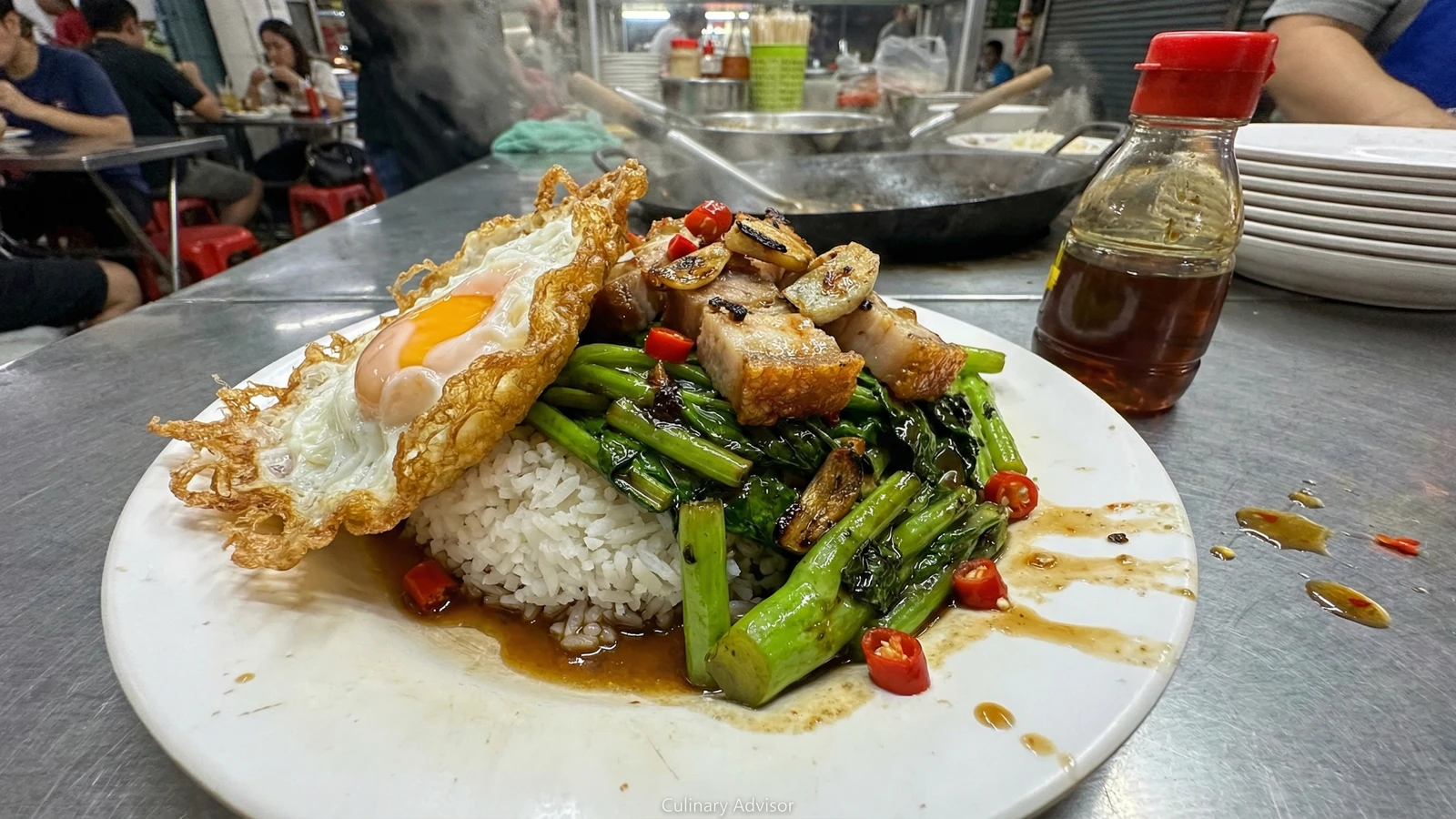
Crispy pork belly meets wok-charred Chinese broccoli in a sauce built on oyster sauce for body, nam pla for salt, and palm sugar for balance. The wok does the rest. Bangkok's lunch hour in a single plate.
Not every Thai dish starts in the mortar. Some start in the wok. And when a dish starts in the wok, the wok has to be the hottest thing in the room.
Ajarn always said the mortar is your most important tool. The wok is your second. Pad ka na moo krob is a wok dish, pure and simple. No kreung tam, no pounded paste. Just a screaming-hot wok, garlic hitting oil, and Chinese broccoli (ka na) charring against steel until it picks up that smoky, slightly bitter edge that only violent heat can give. That's wok hei. The breath of the wok. It's not a garnish. It's the technique itself.
The sauce framework here is textbook Central Thai stir-fry: oyster sauce for body and gloss, fish sauce (nam pla) for salt, a touch of palm sugar (nam tan pip) to round the edges. No lime. No sour. This isn't a four-pillar dish. It's a three-pillar dish, and that's fine. The system is flexible. Not every dish needs all four. What it needs is balance within the pillars it uses, and this one is perfectly calibrated: savory-sweet with a kick of heat from sliced chilies.
The moo krob (crispy pork belly) is the star. It arrives already cooked, already golden, already shatteringly crisp from a low-and-slow deep fry that puffs the skin into something between a cracker and a cloud. You don't cook it in the wok. You add it at the end, tossed just long enough to coat in sauce but not long enough to lose that crunch. The second the skin goes soft, you've lost the dish. Timing is everything. This is the kind of plate you eat at noon on a plastic stool somewhere in Yaowarat or Silom, rice underneath, fried egg on top, the vendor working three woks at once. It's fast, it's loud, and it's perfect.
Pad ka na moo krob sits at the intersection of Thai and Chinese culinary traditions, a product of Bangkok's large Teochew Chinese community that shaped Central Thai street food from the late 19th century onward. Moo krob (crispy pork belly) derives from Chinese roast meat traditions adapted with Thai seasonings, while the stir-fry technique and the use of ka na (Chinese broccoli, Brassica oleracea var. alboglabra) are direct Chinese imports. The oyster-sauce-based stir-fry became a Bangkok lunch staple in the mid-20th century as made-to-order street stalls (ร้านอาหารตามสั่ง) proliferated across the city.
Quantity
250g
sliced into bite-sized pieces
Quantity
300g
cut into 3-inch pieces, stems and leaves separated
Quantity
5 cloves
roughly smashed
Quantity
3
sliced on the bias
Quantity
2 tablespoons
Quantity
1 tablespoon
Quantity
1 teaspoon
Quantity
1 tablespoon
Quantity
2 tablespoons
Quantity
2 tablespoons
Quantity
for serving
Quantity
for serving
| Ingredient | Quantity |
|---|---|
| crispy pork belly (moo krob)sliced into bite-sized pieces | 250g |
| Chinese broccoli (ka na)cut into 3-inch pieces, stems and leaves separated | 300g |
| garlicroughly smashed | 5 cloves |
| bird's eye chilies (prik khi nu)sliced on the bias | 3 |
| oyster sauce | 2 tablespoons |
| fish sauce (nam pla) | 1 tablespoon |
| palm sugar (nam tan pip) | 1 teaspoon |
| dark soy sauce (si ew dam) | 1 tablespoon |
| vegetable oil | 2 tablespoons |
| water or stock | 2 tablespoons |
| steamed jasmine rice | for serving |
| fried eggs (optional) | for serving |
Separate the Chinese broccoli stems from the leaves. The stems take longer to cook than the leaves, so they go into the wok first. Cut the stems on a bias into 3-inch pieces about the thickness of your finger. If the stems are fat, split them lengthwise. The leaves get torn or cut into similar lengths. Keep them in two separate piles. This isn't fussiness. It's timing.
Get your wok screaming hot over the highest heat your stove can produce. Wait longer than you think. When you see a faint haze of smoke rising from the dry surface, add the oil. It should shimmer and ripple within two seconds. If it just sits there looking calm, your wok isn't hot enough. Start over.
Garlic hits the oil first. Always. Slam the smashed garlic cloves and sliced chilies into the hot oil. You'll get an immediate sizzle and a hit of aroma that fills the kitchen. Toss them once, twice. The garlic should be golden at the edges within five seconds. If it's still pale, your wok is too cold. If it's already brown, you waited too long. Move to the next step now.
Add the ka na stems immediately. Spread them against the wok surface so they make contact with the metal. Don't stir for ten seconds. Let them char. You want color, you want those dark spots where the vegetable hits the hot steel. That's wok hei building. After ten seconds, toss once and let them sit again. Total stem time: about 45 seconds to a minute. They should be bright green with char marks and still have crunch.
Push the stems to the side and pour the oyster sauce, fish sauce, dark soy sauce, and palm sugar directly onto the exposed wok surface. Let the sauces hit the hot metal and bubble for a few seconds before tossing everything together. Add the splash of water or stock. This creates the glossy sauce that coats everything. The water also generates a burst of heat that helps wilt the leaves in the next step. Toss to combine.
Throw in the ka na leaves and toss. They wilt in about fifteen seconds. The moment they go limp but are still bright green, add the sliced crispy pork belly. Toss twice to coat the pork in sauce. That's it. Two tosses. Stop. Every second the pork stays in the wok, the skin absorbs moisture and loses its crunch. You're coating it, not cooking it. It's already cooked. Pull the wok off the heat.
Slide everything onto a plate over jasmine rice. The pork should be on top where it stays dry and crisp. Sauce pools around the rice. Fried egg on top if you're doing it right, and you should be. Eat immediately. This dish has a two-minute window between perfect and sad. The crunch waits for no one.
1 serving (about 500g)
Culinary guides, cultural storytelling, and the editorial depth that makes cooking meaningful.
Discover Culinary ExplorerChef Fai
The four pillars live at the bottom of the bowl before the noodles ever touch it: nam pla for salt, sugar for sweet, vinegar for sour, chili for heat. Every noodle cart in Bangkok runs on this principle.

Chef Fai
The kreung tam fried in cracked coconut cream until the oil bleeds red. That's the technique. Concentrated, semi-dry, spooned thick over crispy fish. This is what happens when the four pillars meet restraint.

Chef Fai
Isan foraging in a bowl: wild taro stems stripped of their sting, simmered in padaek broth with a pounded chili paste and yanang leaf extract. The land feeds you if you know the rules.

Chef Fai
Lanna's kreung tam breaks from Central Thai rules: ginger over galangal, cumin and coriander from Burmese spice routes, tamarind for sour instead of lime. The North has its own system, and this curry is its crown.