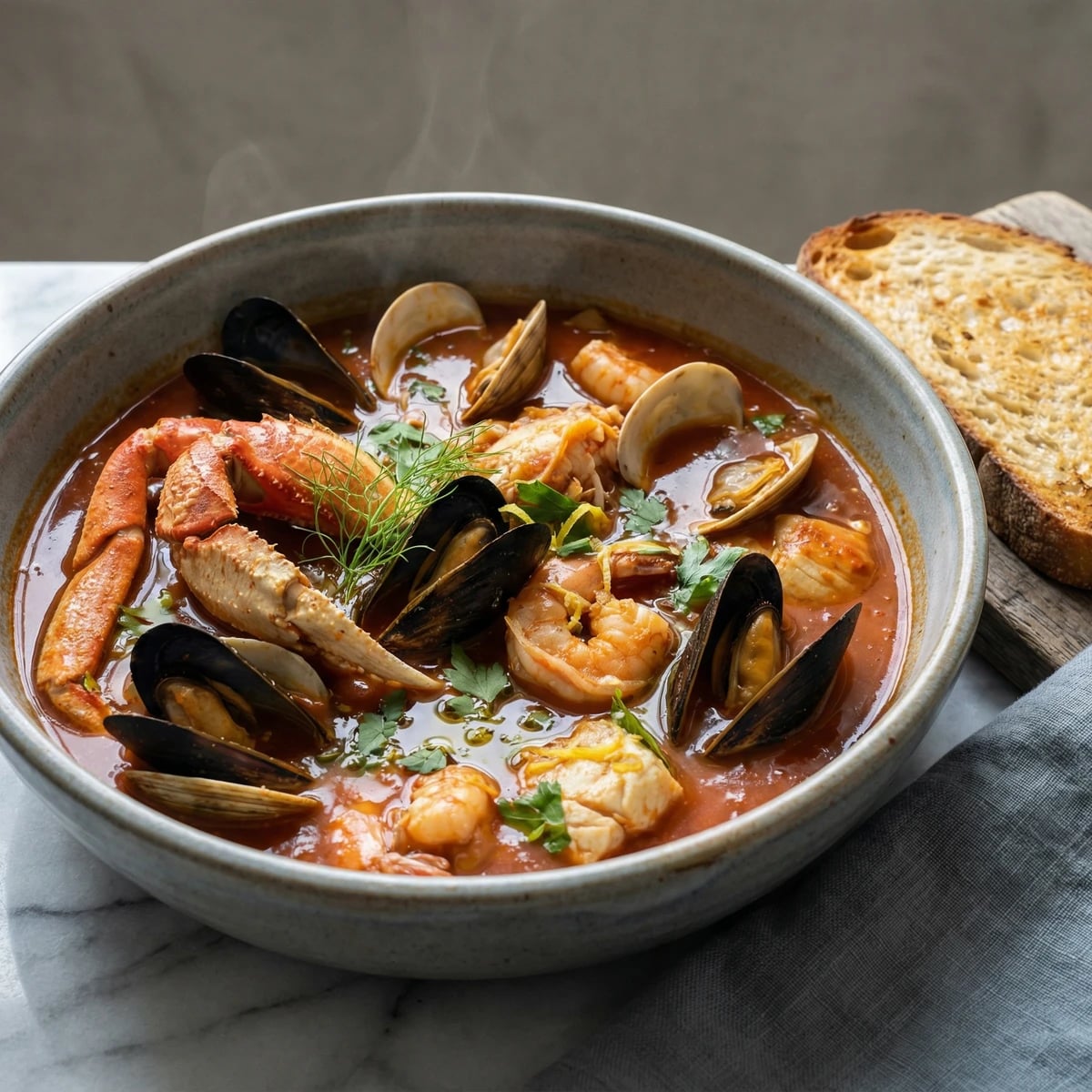
A thundering pot of Dungeness crab, briny clams, plump mussels, and tender fish swimming in a garlicky tomato broth that demands crusty sourdough and a stack of napkins. This is Pacific coastal cooking at its most generous.
Soups & Stews
Italian
Dinner Party
Celebration
45 min
Active Time
45 min cook•1 hr 30 min total
Yield6 servings
Cioppino belongs to the fishermen. Italian immigrants working the waters around San Francisco created this stew in the late 1800s, tossing whatever the day's catch yielded into a communal pot. The name likely comes from ciuppin, a Ligurian fish stew, though some say it derives from the fishermen calling out to chip in their portion. Either way, the dish tells a story of immigrants adapting Old World traditions to New World abundance.
In the Pacific Northwest, we've inherited this tradition and made it our own. Our waters run cold and clean. They yield Dungeness crab with meat so sweet it needs nothing but heat to shine. Clams and mussels filter these pristine currents, developing a salinity that Europeans cross oceans to taste. The salmon runs that sustained Native peoples for millennia still return each year, though we must now be thoughtful stewards of what we take.
This version honors the regional bounty while respecting the Italian soul of the dish. The broth builds on a soffritto of onion, fennel, and celery. San Marzano tomatoes provide body without overwhelming the seafood. A healthy pour of dry white wine cuts the richness. The cooking itself takes barely an hour, but the eating should stretch much longer. Put the pot in the center of the table. Give everyone a bowl, a spoon, and permission to make a mess.
I've served this at dinner parties where conversation stopped entirely, replaced by the sounds of shells cracking and bread sopping up broth. That's the highest compliment a cook can receive.
The technique, the tradition, and the story behind every dish.
whole Dungeness crab, cooked and cleanedcracked into pieces
1 (about 2 lbs)
Manila clamsscrubbed
1 lb
musselsscrubbed and debearded
1 lb
firm white fish (halibut or lingcod)cut into 2-inch pieces
1 lb
spot prawns or large shrimp, shell-on
1/2 lb
extra-virgin olive oil
1/4 cup
yellow oniondiced
1 large
fennel bulbcored and diced, fronds reserved
1
celery stalksdiced
3
garlicminced
8 cloves
red pepper flakes
1 teaspoon
dry white wine
1 cup
San Marzano whole tomatoescrushed by hand
1 can (28 oz)
fish stock or clam juice
4 cups
bay leaf
1
dried oregano
1 teaspoon
fennel seedslightly crushed
1/2 teaspoon
tomato paste
1 tablespoon
lemon zest
from 1 lemon
fresh Italian parsleyroughly chopped
1/4 cup
fresh basiltorn
2 tablespoons
kosher salt
to taste
freshly ground black pepper
to taste
crusty sourdough bread
for serving
Equipment Needed
•Large Dutch oven or heavy-bottomed pot (7-quart minimum)
•Wooden spoon
•Sheet pan for seafood prep
•Crab crackers and picks for serving
•Wide, shallow serving bowls
Instructions
1
Prepare seafood
Lay out all your seafood on a sheet pan and inspect it. Tap any open clams or mussels sharply against the counter. If they don't close within a few seconds, they're dead. Discard them. Pull the beards from your mussels with a firm tug toward the hinge end. Rinse the fish pieces and pat them dry. Season lightly with salt. The shellfish will contribute plenty of salinity, so restraint serves you here.
Buy your seafood the day you cook it. A good fishmonger will clean and crack your Dungeness crab if you ask. The shells should smell like the ocean, not like fish.
2
Build the soffritto
Set a large Dutch oven or heavy-bottomed pot over medium heat. Add the olive oil and let it warm until it shimmers and flows easily when you tilt the pan. Add the onion, fennel, and celery. Season with a pinch of salt to draw out moisture. Cook, stirring occasionally, until the vegetables soften and turn translucent, about 10 minutes. You're not looking for color here. You want them to melt into sweetness.
The fennel does double duty. Its anise notes complement seafood beautifully, and its structure mirrors the celery for even cooking.
3
Add aromatics
Push the vegetables to the sides of the pot and add the garlic to the center where the oil pools. Let it sizzle for 30 seconds until fragrant but not browned. Stir in the red pepper flakes, fennel seeds, and oregano. Toast the spices in the oil for another 30 seconds. The kitchen should smell like a reason to stay home.
Blooming spices in fat releases their essential oils. This step transforms a good broth into a great one.
4
Deglaze with wine
Pour in the white wine. It will hiss and sputter against the hot pot. Use a wooden spoon to scrape up any bits stuck to the bottom. These fond deposits carry concentrated flavor. Let the wine reduce by half, about 3 minutes. The sharp alcohol smell should give way to something rounder and more inviting.
5
Build the broth
Stir in the tomato paste until it coats the vegetables, then add the crushed tomatoes with their juices. Pour in the fish stock. Tuck in the bay leaf. Bring the liquid to a simmer and let it cook uncovered for 20 minutes. The broth should reduce slightly and deepen in color from bright red to a richer brick tone. Taste it now. Adjust the salt. The seafood will release its own brine, so err on the side of under-seasoning.
Crush the tomatoes by hand over the pot. You'll feel for any tough core pieces and the texture stays more interesting than machine-processed puree.
6
Add clams and mussels
Nestle the clams into the broth first. They take longest to open. Cover the pot and cook for 4 minutes. Then add the mussels, tucking them among the clams. Cover again and cook until the shells begin to gape, another 4 to 5 minutes. As each one opens, it releases a small gift of liquor into the broth. The pot now smells unmistakably of the sea.
7
Add remaining seafood
Gently lower the fish pieces and prawns into the broth, spacing them so they cook evenly. Lay the cracked Dungeness crab pieces on top. The crab is already cooked, so it only needs to heat through and absorb the broth's flavors. Cover and simmer gently for 5 to 6 minutes. The fish should turn opaque and flake easily when prodded. The prawns curl and turn pink. Don't stir aggressively or you'll break the fish apart.
If any clams or mussels haven't opened after 10 minutes of cooking, discard them. They were likely dead before cooking and aren't safe to eat.
8
Finish and serve
Remove the pot from heat. Discard the bay leaf. Scatter the lemon zest, parsley, and torn basil over the surface. Give it one final taste. The broth should be bright with tomato, briny from the shellfish, fragrant with garlic and herbs. Ladle generous portions into wide, shallow bowls, making sure everyone gets a piece of crab, some clams, mussels, fish, and prawns. Garnish with the reserved fennel fronds. Set the sourdough in the center of the table with a cruel amount of good butter. Provide empty bowls for shells and more napkins than you think necessary.
Chef Tips
•Seek out a fishmonger who can tell you where your seafood comes from. Dungeness crab season runs November through June on the West Coast. Manila clams and Penn Cove mussels from Washington State are sustainably farmed and available year-round. Wild-caught halibut peaks in summer, while lingcod shows up in winter markets.
•The Scandinavian fishermen who settled the Pacific Northwest brought a respect for cold-water seafood that shaped regional cooking. The Asian communities, particularly Japanese and Chinese immigrants, contributed techniques for handling fresh fish with care. This cioppino carries those influences even as it honors its Italian roots.
•Make the broth base through step 5 up to two days ahead. Refrigerate it, then bring it to a simmer before adding the seafood. This actually improves the broth's depth while keeping the seafood perfectly fresh.
•Pair this with a crisp, mineral-driven white wine. An Oregon Pinot Gris or a Washington State Sauvignon Blanc will stand up to the broth's acidity without competing with the delicate seafood.
•Save those shells. Roasted Dungeness crab shells make an extraordinary stock for risotto or pasta. Freeze them if you can't use them within a day.
Advance Preparation
•Tomato broth can be made through step 5 up to 2 days ahead and refrigerated. Reheat to a simmer before proceeding.
•Clams and mussels can be scrubbed and refrigerated in a bowl covered with a damp towel up to 24 hours ahead.
•Fish can be cut and refrigerated up to 1 day ahead. Bring to cool room temperature 15 minutes before cooking.
Frequently Asked Questions
Nutrition Information
1 serving (about 460g)
Calories
330 calories
Total Fat
13 g
Saturated Fat
2 g
Trans Fat
0 g
Unsaturated Fat
11 g
Cholesterol
185 mg
Sodium
335 mg
Total Carbohydrates
10 g
Dietary Fiber
2 g
Sugars
3 g
Protein
34 g
Where cooking meets culture.
Culinary guides, cultural storytelling, and the editorial depth that makes cooking meaningful.