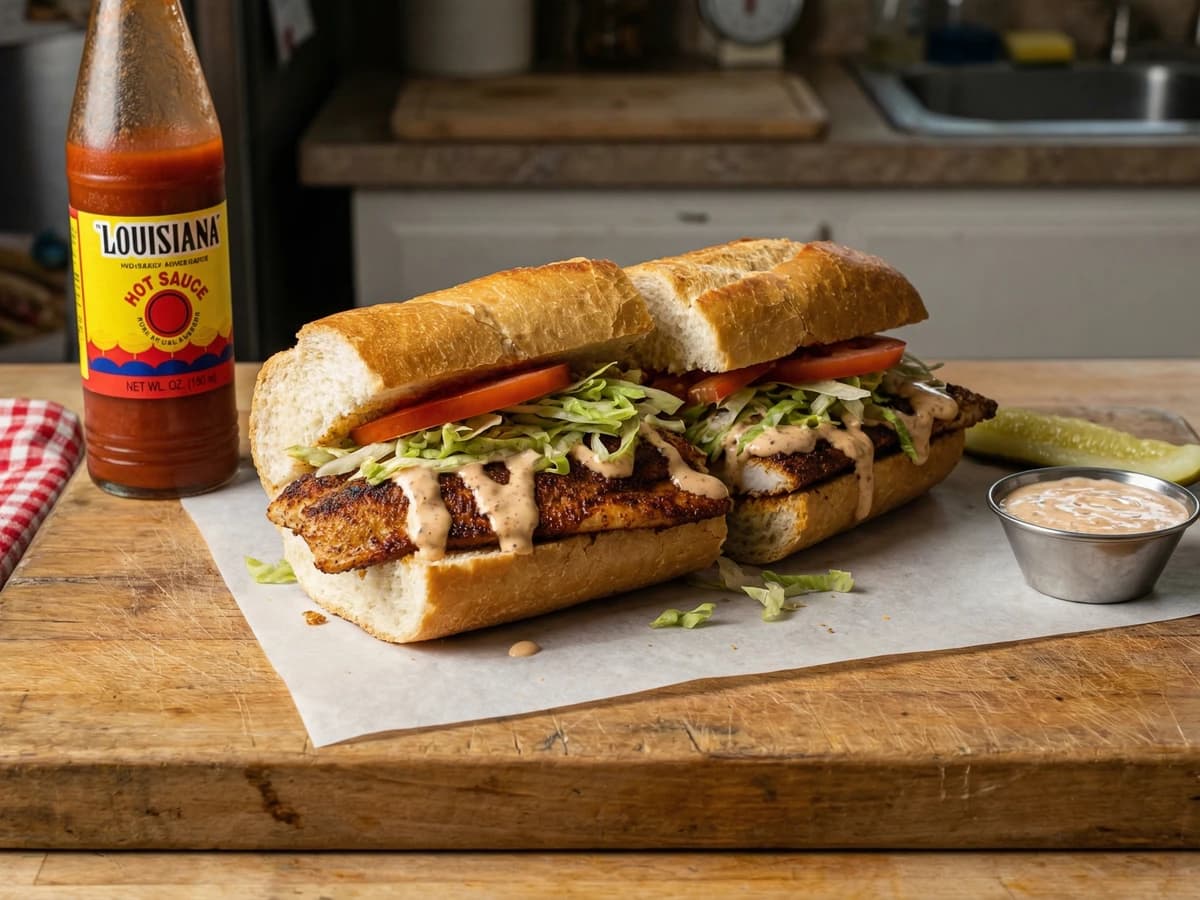
Golden-crusted Pacific oysters tucked into a crackling baguette, dressed with cool shredded lettuce, ripe tomato, and a remoulade that carries just enough heat to remind you this sandwich has Louisiana in its bones.
Sandwiches & Wraps
Cajun
Weeknight
30 min
Active Time
15 min cook•45 min total
Yield4 sandwiches
The po'boy was born in New Orleans during the 1929 streetcar strike, when the Martin brothers fed striking workers free sandwiches from their French Market coffee stand. 'Here comes another poor boy,' they'd say. The name stuck. The sandwich became legend.
What I'm giving you here honors that tradition while drawing from Pacific Northwest waters. Our oysters run smaller than Gulf specimens, more delicate, with a clean brininess that speaks of cold tides and rocky shores. The Shoalwater Bay tribe harvested these same beds for thousands of years before European contact. Japanese immigrants brought cultivation techniques in the early 1900s that transformed the industry. When you shuck a Pacific oyster, you're holding history.
The technique remains pure New Orleans. A cornmeal and flour crust, seasoned properly, fried until it crackles. The bread matters as much as the filling. You need something with a shattering crust and a soft interior that yields when you bite down. The remoulade brings the heat, the lettuce provides cool crunch, and the tomato offers acid to cut through the richness. This is architecture as much as cooking.
Don't let anyone tell you a sandwich can't be serious food. The po'boy fed working people through hard times. It deserves your full attention.
The technique, the tradition, and the story behind every dish.
Combine the mayonnaise, Creole mustard, horseradish, hot sauce, capers, green onion, garlic, lemon juice, and smoked paprika in a bowl. Whisk until smooth. The color should be pale pink with visible flecks of green from the onion and capers. Taste it. Adjust the heat with more hot sauce if you want. Refrigerate while you prepare everything else. The flavors need at least 15 minutes to come together.
If you can't find Creole mustard, whole grain Dijon works. The texture matters as much as the flavor.
2
Prepare the oysters
Drain your shucked oysters and pat them dry with paper towels. Really dry. Any moisture clinging to the surface will spatter when it hits hot oil and prevent the coating from adhering. Inspect each oyster as you work. Remove any shell fragments. A good fishmonger does this, but always check.
Fresh oysters should smell like clean seawater. Any ammonia or strong fishy odor means they've turned. Trust your nose.
3
Set up breading station
Pour the buttermilk into a shallow bowl. In a separate shallow dish, whisk together the flour, cornmeal, cayenne, smoked paprika, garlic powder, onion powder, salt, and black pepper. The mixture should look evenly golden with visible red flecks from the spices. Arrange your bowls in order: oysters, buttermilk, seasoned flour, then a clean plate for the breaded oysters.
4
Bread the oysters
Working in batches of six, drop oysters into the buttermilk and turn to coat. Lift each one, let excess drip off for two seconds, then transfer to the flour mixture. Toss to coat completely, pressing the coating gently so it adheres. Shake off excess and place on the clean plate. Don't stack them. The coating will get soggy where they touch.
Keep one hand for wet ingredients, one for dry. This prevents your fingers from becoming breaded along with the oysters.
5
Heat the oil
Pour vegetable oil into a large heavy pot or Dutch oven to a depth of about 2 inches. Heat over medium-high until a deep-fry thermometer reads 375°F. This takes longer than you expect. Eight to ten minutes for most stovetops. Don't rush it. Oil that isn't hot enough produces greasy, soggy results. Oil that's too hot burns the coating before the oyster cooks through.
6
Fry the oysters
Carefully lower 6 to 8 oysters into the hot oil using a slotted spoon. Don't crowd the pot. The oysters should have room to float freely. Fry for 2 to 3 minutes, turning once halfway through, until the coating is deep golden brown and crispy. The sound will shift from aggressive bubbling to a gentler crackle as moisture escapes. Remove to a wire rack set over a sheet pan. Season immediately with a pinch of salt while still glistening. Continue with remaining oysters, letting the oil return to 375°F between batches.
7
Toast the bread
Split the baguettes lengthwise without cutting all the way through. Spread the cut surfaces with softened butter. Place cut-side down in a large dry skillet over medium heat, or under a broiler, until golden and crisp. About 2 minutes. The bread should crackle when you tap it but remain soft and yielding inside.
8
Assemble the po'boys
Spread remoulade generously on both cut surfaces of each toasted baguette. Be liberal. This isn't the time for restraint. Layer shredded lettuce on the bottom half, then tomato slices. Arrange 6 fried oysters in a single layer, overlapping slightly if needed. The oysters should still be warm, the bread should still be crisp, and the lettuce should be cold. That contrast matters. Close the sandwich gently. Serve immediately with pickle spears on the side.
Chef Tips
•Source your oysters from sustainable farms. Willapa Bay, Hood Canal, and Samish Bay operations follow responsible cultivation practices that actually improve water quality. Ask your fishmonger where their oysters come from.
•Pacific oysters are at their best from November through April when waters are coldest. The old rule about months containing 'R' holds true. Summer oysters spawn and turn soft and milky.
•If you can't find proper po'boy rolls, look for a soft French baguette with a thin crust. Sourdough is too chewy. Ciabatta works in a pinch. The bread must yield to your bite without fighting back.
•Leftover remoulade keeps refrigerated for a week. Use it on crab cakes, grilled fish, or as a dipping sauce for fried anything.
•A cold Pilsner or dry Riesling complements the briny oysters and cuts through the richness of the fried coating.
Advance Preparation
•Remoulade improves after 24 hours refrigerated. Make it a day ahead if time allows.
•Oysters can be breaded up to 30 minutes before frying. Longer than that and the coating gets soggy.
•The fried oysters do not hold well. Serve within 5 minutes of frying for best texture.
Frequently Asked Questions
Nutrition Information
1 sandwich (about 245g)
Calories
1085 calories
Total Fat
75 g
Saturated Fat
14 g
Trans Fat
1 g
Unsaturated Fat
55 g
Cholesterol
192 mg
Sodium
800 mg
Total Carbohydrates
65 g
Dietary Fiber
2 g
Sugars
2 g
Protein
20 g
Where cooking meets culture.
Culinary guides, cultural storytelling, and the editorial depth that makes cooking meaningful.