
Chef Margarida
Caracóis à Portuguesa
Há caracóis! The signs appear in May and all of Lisbon knows summer has arrived. Tiny snails in spiced broth, sucked from shells at plastic tables, washed down with imperial after imperial.
A cooking platform built around craft, culture, and the stories behind what we eat.

Created by
The stuffed eggs of every Portuguese celebration, where humble ingredients become something festive. Tuna, mayonnaise, mustard, a dust of colorau. Simple, satisfying, and gone from the platter before you can blink.
Every Portuguese celebration has a platter of these somewhere on the table. Easter, Christmas, baptisms, first communions, or just Sunday lunch when someone felt like making something nice. Ovos recheados are the great equalizer of Portuguese cooking: everybody's grandmother made them, everybody has an opinion about them, and everybody reaches for seconds.
Avó Leonor made hers with tuna from a can she kept in the cupboard for exactly these occasions. Nothing fancy. Good Portuguese tuna in olive oil, the kind that comes in those beautiful tins with pictures of fishing boats. She'd mash everything together with a fork, fill the eggs with a small spoon, dust them with colorau, and that was it. No piping bags. No elaborate presentations. Just honest food made with care.
The secret, if there is one, is in the eggs themselves. Overcooked eggs with that grey-green ring around the yolk will ruin everything before you start. Ten minutes in hot water, not boiling. Then straight into ice water. This is the difference between eggs that look amateur and eggs that look like you know what you're doing.
At my Mesa da Avó dinners, I serve these as people arrive, alongside olives and cheese and bread. They disappear within minutes. Every time. Something about a stuffed egg brings people together, gets them talking, gets them reaching across the table. This is petisco culture at its purest: simple food meant for sharing.
Stuffed eggs appear in Portuguese cookbooks dating back to the 18th century, though they likely existed long before that in home kitchens. The tuna version became especially popular in the 20th century as Portugal's conserva industry flourished, producing some of the world's finest canned fish. Today, ovos recheados remain essential to festive tables from the Minho to the Algarve, with regional variations that spark friendly debates at every family gathering.
Quantity
6 large
at room temperature
Quantity
1 can (120g)
drained
Quantity
3 tablespoons
Quantity
1 teaspoon
Quantity
1 tablespoon
finely minced
Quantity
1 teaspoon
drained and minced
Quantity
1 tablespoon, plus more for garnish
finely chopped
Quantity
1 teaspoon
Quantity
to taste
Quantity
to taste
Quantity
for dusting
Quantity
for drizzling
| Ingredient | Quantity |
|---|---|
| eggsat room temperature | 6 large |
| Portuguese tuna in olive oildrained | 1 can (120g) |
| mayonnaise | 3 tablespoons |
| Dijon mustard | 1 teaspoon |
| cornichões or picklesfinely minced | 1 tablespoon |
| capersdrained and minced | 1 teaspoon |
| fresh flat-leaf parsleyfinely chopped | 1 tablespoon, plus more for garnish |
| fresh lemon juice | 1 teaspoon |
| fine sea salt | to taste |
| white pepper | to taste |
| sweet paprika (colorau) | for dusting |
| extra virgin olive oil | for drizzling |
Place the eggs in a single layer in a pot and cover with cold water by about 3 centimeters. Set over high heat and bring just to a boil. The moment you see a rolling boil, remove from heat, cover the pot, and let sit for exactly 10 minutes. Not 8. Not 12. Ten minutes gives you a yolk that's fully set but still golden, no grey-green ring of shame.
Transfer the eggs immediately to a bowl of ice water. Let them sit for at least 5 minutes. This stops the cooking and makes peeling infinitely easier. Tap each egg gently all over to crack the shell, then peel under a thin stream of running water. The shells should slip right off. If you've ever struggled with peeling eggs, this is the answer.
Cut each egg in half lengthwise with a sharp knife. Wipe the blade between cuts for clean edges. Gently pop the yolks into a mixing bowl, keeping the whites intact. Arrange the whites on your serving platter, cut side up. If they wobble, slice a tiny bit off the bottom to create a flat base. They need to sit steady.
Mash the yolks with a fork until no lumps remain. Add the drained tuna and break it up, mixing it into the yolks. Add the mayonnaise, mustard, cornichões, capers, parsley, and lemon juice. Mix until everything is well combined but not pasty. You want some texture. Taste and adjust with salt and white pepper. Go easy on the salt; the tuna and capers bring their own.
Spoon the filling generously into each egg white half, mounding it slightly. For a fancier presentation, you can pipe it through a large star tip, but Avó Leonor would have laughed at that. A spoon works perfectly. These are meant to look homemade. That's the whole point.
Dust each stuffed egg with a pinch of colorau, that sweet paprika that turns everything beautiful. Scatter a few parsley leaves over the platter. Drizzle just a thread of good olive oil across the tops. Cover loosely and refrigerate for at least 30 minutes before serving to let the flavors settle. Bring out 15 minutes before eating so they're not ice cold.
1 serving (about 40g)
Culinary guides, cultural storytelling, and the editorial depth that makes cooking meaningful.
Discover Culinary ExplorerChef Margarida
Há caracóis! The signs appear in May and all of Lisbon knows summer has arrived. Tiny snails in spiced broth, sucked from shells at plastic tables, washed down with imperial after imperial.

Chef Margarida
Crispy triangles of spiced meat wrapped in golden pastry, carrying the flavors of Goa across the ocean to every Portuguese tasca and family gathering. Colonial history you can eat.
Chef Margarida
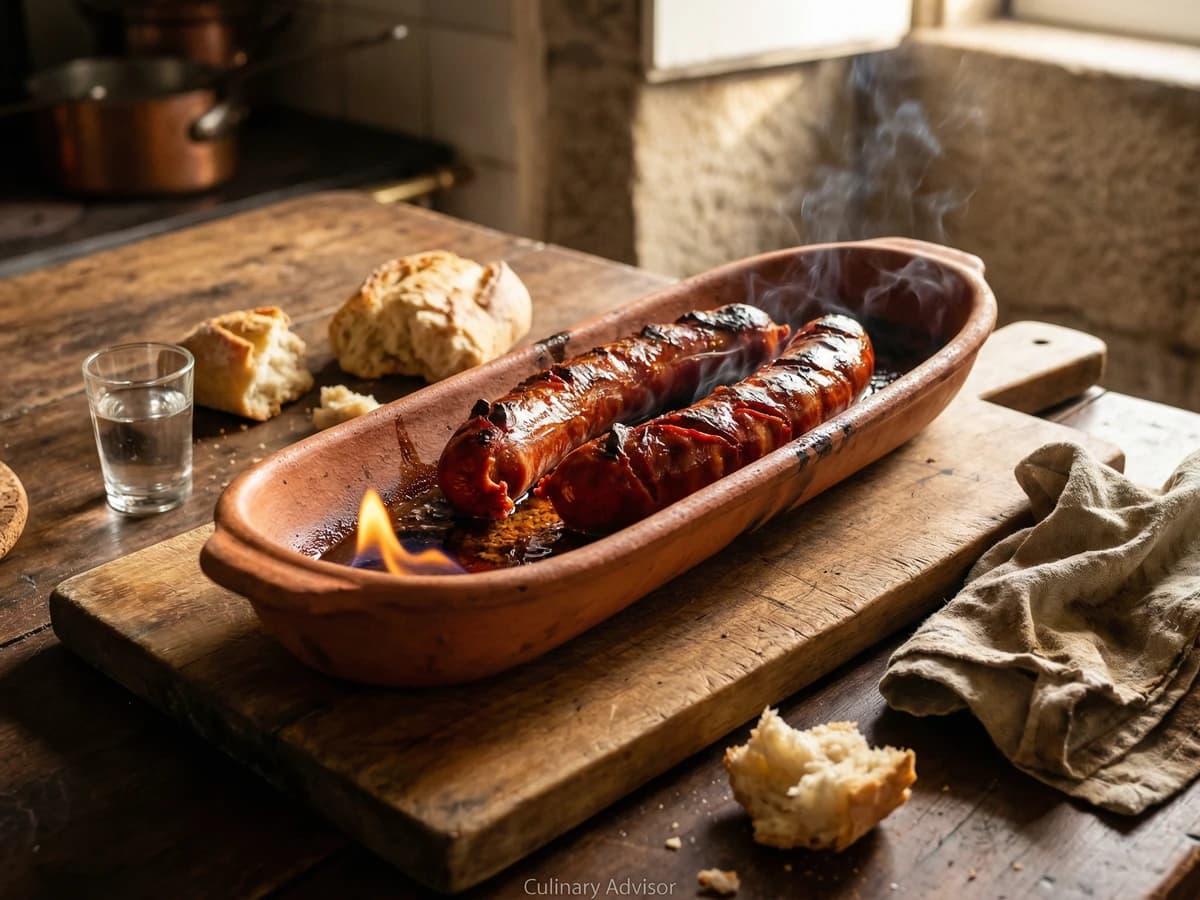
The theater of the tasca: chouriço set ablaze in its clay vessel, aguardente flames dancing blue and orange until the casing splits and the smoky fat runs. This is how we gather.

Chef Margarida
Mushrooms stuffed with chouriço and baked until the cheese bubbles and browns, the kind of petisco that disappears from the table before you've finished pouring the wine. Tasca food for your home.