
Chef Klaus
Ähzezupp (Kölsche Erbsensuppe)
The Cologne pea pot earns its depth from soaked peas and cured pork bone, simmered slowly until the soup thickens itself and the meat falls clean from the knuckle.
A cooking platform built around craft, culture, and the stories behind what we eat.
Created by
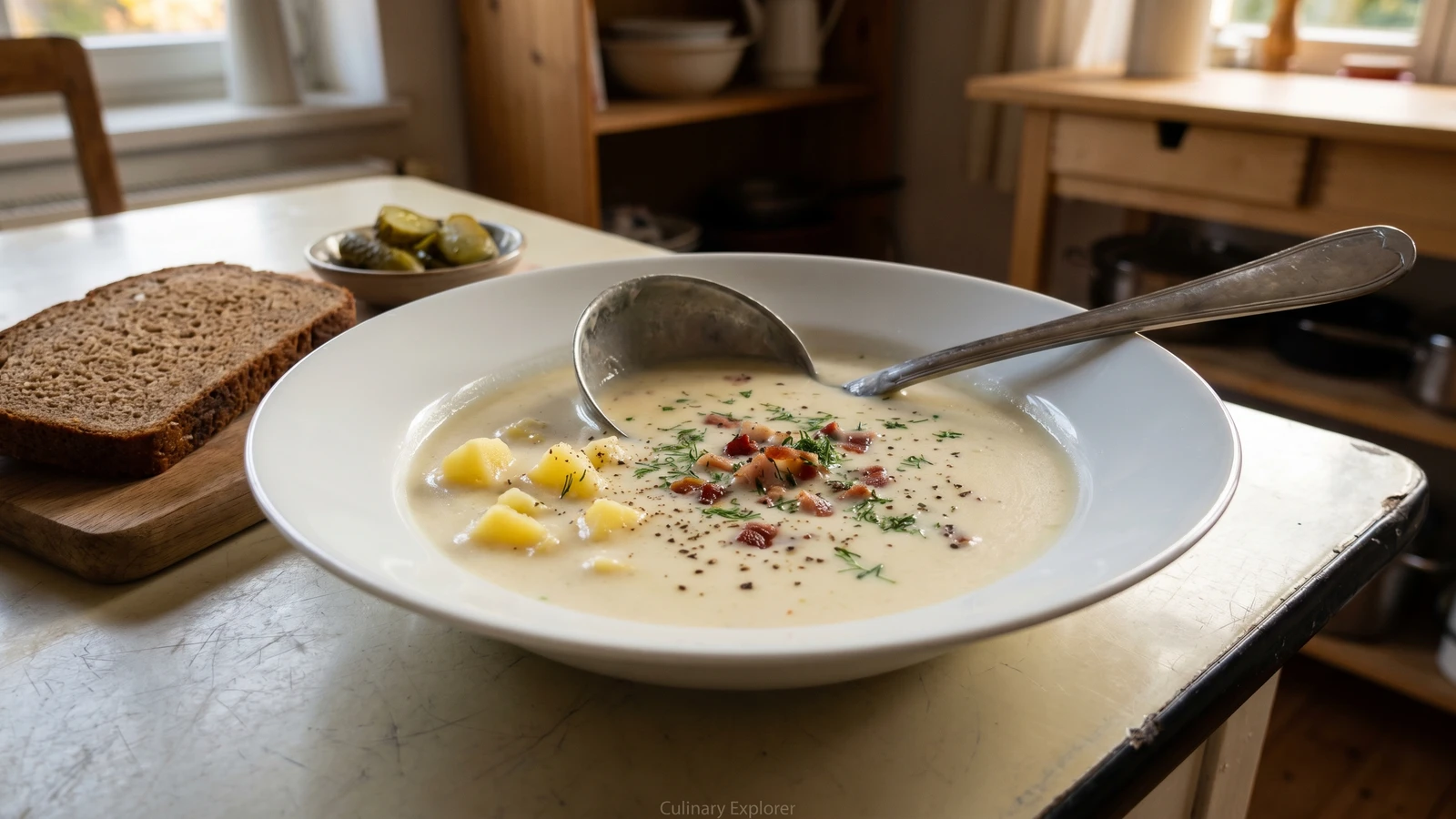
An East Prussian farm-kitchen soup, sharp with Schmand, carried by good broth and potato, and finished gently so the egg yolk binds instead of scrambling.
Ostpreußische Schmandsuppe belongs to the old eastern table, where a pot of broth, a few potatoes, a piece of bacon rind, and sour dairy could make supper without pretending to be poor. This is weeknight food when the stock is already in the house, and Sunday food when the bones were boiled after the roast. Weggeworfen wird nichts, the bone and rind do the work before anyone reaches for cream.
The regions split on sourness. East Prussia liked the tang of Schmand, soured cream, and often a little vinegar or cucumber brine in the pot; further south a cream soup tends to go milder, thicker, and more flour-bound. Im Norden anders, im Süden anders. This one should taste bright, not heavy, with potato for body and smoked bacon for the quiet background.
The whole dish is decided at the end. Beat Schmand with egg yolk, loosen it with hot broth, then stir it back off the boil. Boil it hard and the yolk tightens into threads while the Schmand splits into grains. Keep the heat gentle and it turns the broth satin-smooth. Erst verstehen, dann kochen.
East Prussian cooking grew from German, Baltic, Polish, and Lithuanian border kitchens, with sour dairy, potatoes, smoked pork, dill, and pickled vegetables used as ordinary larder tools rather than decoration. After 1945, when most German East Prussians were expelled or fled west, dishes like Schmandsuppe survived largely through family notebooks and refugee cookbooks, which is why versions differ sharply from house to house. The potato in the bowl also points to the 18th century: Prussian rulers, especially Frederick II, pushed potato cultivation hard after the 1740s to guard against grain failures.
Quantity
1 tablespoon
Quantity
100g
finely diced, rind kept if present
Quantity
1 medium
finely diced
Quantity
700g
peeled and cut into small cubes
Quantity
1.2 litres
Quantity
1
Quantity
4
lightly crushed
Quantity
1 teaspoon
Quantity
200g
Quantity
2
Quantity
1 tablespoon, plus more to taste
Quantity
to taste
Quantity
2 tablespoons
chopped
| Ingredient | Quantity |
|---|---|
| butter or lard | 1 tablespoon |
| smoked baconfinely diced, rind kept if present | 100g |
| onionfinely diced | 1 medium |
| floury potatoespeeled and cut into small cubes | 700g |
| good beef, pork, or chicken broth | 1.2 litres |
| bay leaf | 1 |
| allspice berrieslightly crushed | 4 |
| dried marjoram | 1 teaspoon |
| Schmand or full-fat sour cream | 200g |
| egg yolks | 2 |
| white wine vinegar or cucumber brine | 1 tablespoon, plus more to taste |
| salt and black pepper | to taste |
| dill or chiveschopped | 2 tablespoons |
Warm the butter or lard in a heavy pot and cook the bacon slowly until the fat runs clear and the edges turn golden. Keep the rind in the pot if you have it; it gives the broth body, and Weggeworfen wird nichts. Do not brown the onion hard after you add it, because burnt onion turns a pale sour soup muddy and bitter.
Add the onion and cook it gently until it goes glassy, about 6 minutes. The onion should sweeten in the bacon fat, not fry crisp; crisp onion fights the soft potato and makes the soup taste of the pan instead of the broth.
Add the potatoes, broth, bay leaf, allspice, and marjoram. Bring it just to a boil, then runter mit der Temperatur, down with the temperature, and simmer until the potatoes are tender, 20 to 25 minutes. Floury potatoes are right here because their edges break down and give the broth body without a spoon of flour.
Fish out the bay leaf, allspice, and bacon rind. Crush a few potato cubes against the side of the pot with a spoon and stir them back in. Leave most of the potatoes whole, because this is a broth soup with body, not mashed potato in disguise.
Whisk the Schmand and egg yolks together in a bowl until smooth, then whisk in two ladles of hot broth a little at a time. This tempering warms the yolk slowly, so it thickens the soup instead of scrambling. Take the pot off the heat before the mixture goes back in; boiling is where Schmand breaks.
Stir the tempered Schmand mixture into the pot off the heat, then set it over the lowest flame for 2 to 3 minutes until the soup looks smooth and lightly thickened. Do not let it boil. Season with vinegar or cucumber brine, salt, and black pepper at the end, because sourness and salt sharpen as the broth reduces. Würzen, Fett, Salz zum Schluss. Ladle into bowls and finish with dill or chives.
1 serving (about 570g)
Culinary guides, cultural storytelling, and the editorial depth that makes cooking meaningful.
Discover Culinary ExplorerChef Klaus
The Cologne pea pot earns its depth from soaked peas and cured pork bone, simmered slowly until the soup thickens itself and the meat falls clean from the knuckle.

Chef Klaus
The Allgäu's Alpine cheese soup works only if the Bergkäse melts gently off the heat, where it turns smooth instead of stringy.

Chef Klaus
A firm egg dough, grated into tiny crumbs and cooked in clear broth: Allgäu kitchen thrift, warm in the bowl, and finished only when the Riebele keep their bite.

Chef Klaus
The Altmark wedding broth is a clear soup with no tricks: bones for depth, patient skimming for clarity, and small semolina dumplings that make it festive.