
Chef Jeong-sun
Agwi-jjim (Braised Monkfish with Bean Sprouts)
Firm monkfish buried under crisp soybean sprouts, minari, and a red gochugaru sauce thickened at the end; Masan's market dish asks for heat, timing, and a steady hand.
A cooking platform built around craft, culture, and the stories behind what we eat.
Created by
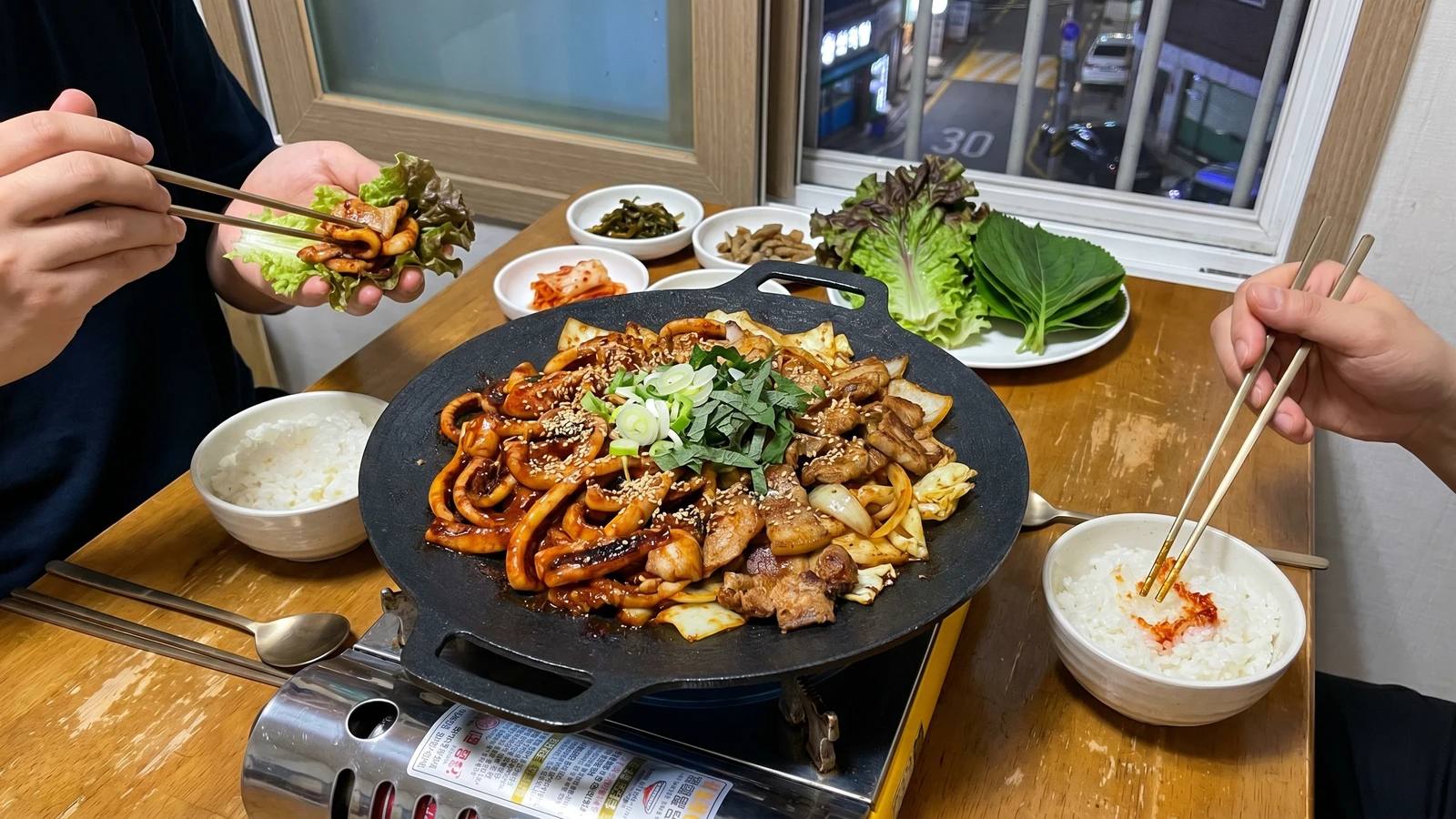
Chewy squid and rendered pork belly under one red sauce, cooked in the right order so the pork browns, the squid stays tender, and the rice bowl gets its due.
Notebook 52 has only four underlined words for this dish: pork first, squid last. That is not my severity showing off. Pork belly needs time to give up its fat and brown at the edges. Squid needs the opposite, a hot pan, a short stay, and no pity. Put them in together and the pork stays pale or the squid turns tight. Usually the squid suffers.
Osam-bulgogi is weeknight food with a drinking-table spirit, the kind of pan that lands in the center with rice, lettuce, perilla leaves, and something cool on the side. The sauce is red, yes, but it should not erase the squid. My teacher would taste the pan before reaching for more gochujang, then look at me as if the spoon itself had behaved badly. Let it taste like itself: squid, pork fat, onion, chili, sesame.
Tonight it asks for knife work and attention. Score the squid, slice the pork no thicker than 5 mm, mix the sauce before the pan gets hot, and cook in order. 손맛 is real; I measure it anyway, because a dish that moves this fast leaves no time for guessing.
Osam-bulgogi is a modern Korean name built from 오징어 (ojingeo, squid) and 삼겹살 (samgyeopsal, pork belly); the abbreviation itself tells you it belongs to restaurant and home-menu language, not old court records. It is often associated with Gangwon-do's east coast, especially Gangneung and Jumunjin, where squid comes through the market, and it spread with late twentieth-century samgyeopsal culture and red gochujang stir-fries. Its history is plain and useful: inexpensive seafood, fatty pork, and one pan set in the middle of a table.
Quantity
450g
sliced 5 mm thick and cut into 5 cm pieces
Quantity
400g
bodies split, inside scored, cut into 5 by 2.5 cm pieces, tentacles separated
Quantity
1 medium (about 200g)
sliced 1 cm thick
Quantity
2 cups (about 160g)
cut into 3 cm pieces
Quantity
1 small (about 80g)
cut into thin half-moons
Quantity
3
cut into 5 cm lengths, whites and greens separated
Quantity
1
sliced on the diagonal
Quantity
8
torn
Quantity
3 tablespoons
Quantity
1 1/2 tablespoons
Quantity
2 tablespoons
Quantity
1 tablespoon
Quantity
1 tablespoon
Quantity
2 teaspoons
Quantity
1 tablespoon, about 3 cloves
minced
Quantity
1 teaspoon
grated
Quantity
1/4 teaspoon
Quantity
2 tablespoons
Quantity
2 teaspoons
Quantity
1 teaspoon
Quantity
to serve
| Ingredient | Quantity |
|---|---|
| skinless pork belly (samgyeopsal)sliced 5 mm thick and cut into 5 cm pieces | 450g |
| cleaned squidbodies split, inside scored, cut into 5 by 2.5 cm pieces, tentacles separated | 400g |
| onionsliced 1 cm thick | 1 medium (about 200g) |
| napa cabbage or green cabbagecut into 3 cm pieces | 2 cups (about 160g) |
| carrotcut into thin half-moons | 1 small (about 80g) |
| scallionscut into 5 cm lengths, whites and greens separated | 3 |
| green chili (optional)sliced on the diagonal | 1 |
| perilla leaves (kkaennip) (optional)torn | 8 |
| gochujang (Korean chili paste) | 3 tablespoons |
| gochugaru (Korean chili flakes) | 1 1/2 tablespoons |
| soy sauce | 2 tablespoons |
| maesil-cheong (Korean green plum syrup) or rice syrup | 1 tablespoon |
| mirin or rice wine | 1 tablespoon |
| sugar | 2 teaspoons |
| garlicminced | 1 tablespoon, about 3 cloves |
| gingergrated | 1 teaspoon |
| freshly ground black pepper | 1/4 teaspoon |
| water | 2 tablespoons |
| toasted sesame oil | 2 teaspoons |
| toasted sesame seeds | 1 teaspoon |
| cooked short-grain rice, lettuce leaves, and extra perilla leaves (optional) | to serve |
Pat the squid very dry. Lay each body inside-up and score shallow diagonal lines about 5 mm apart, then score the other direction to make a diamond pattern without cutting through. Cut the bodies into 5 by 2.5 cm pieces and separate the tentacles into small clusters. The scoring is not decoration; it makes the squid curl evenly, cook quickly, and hold the sauce instead of sliding around the pan.
Stir together the gochujang, gochugaru, soy sauce, maesil-cheong or rice syrup, mirin, sugar, garlic, ginger, black pepper, and water. Taste it before it touches the pan. It should be salty, warm with chili, and only lightly sweet. Gochujang already carries sweetness, so the two teaspoons of sugar are enough.
Lay the pork belly in a wide cold skillet or tabletop griddle, then set it over medium-high heat. Cook 5 to 7 minutes, turning once or twice, until the fat renders, the edges brown, and no raw pink remains. Spoon off excess fat, leaving about 2 tablespoons in the pan. More than that makes the sauce greasy; less than that and the gochujang catches before it can gloss the meat.
Add the onion, cabbage, carrot, and scallion whites to the pork. Stir-fry 2 minutes, just until the onion begins to bend and the cabbage edges soften. These vegetables go in before the sauce because they need direct contact with the pork fat, and because their sweetness will loosen what browned on the pan.
Pour in the sauce and stir hard for 1 minute, scraping the pan so the sauce darkens and clings to the pork and vegetables. This short frying wakes up the gochujang and takes away the raw paste taste. If the pan looks dry before the squid goes in, add 1 tablespoon water, not more.
Raise the heat to high. Add the squid, green chili, and scallion greens, then toss constantly for 90 seconds to 2 minutes. Stop when the squid turns opaque, the scored pieces curl, and the tentacles firm up. Pork can wait for you. Squid cannot. Cook it past this point and it tightens into rubber.
Turn off the heat. Drizzle with the sesame oil, scatter over the sesame seeds, and fold in the torn perilla leaves if using. Serve at once with rice, lettuce, and extra perilla leaves for wrapping. The bottom of the pan should have a spoonable red sauce, not a soup. That last spoonful over rice is part of the dish.
1 serving (about 470g)
Culinary guides, cultural storytelling, and the editorial depth that makes cooking meaningful.
Discover Culinary ExplorerChef Jeong-sun
Firm monkfish buried under crisp soybean sprouts, minari, and a red gochugaru sauce thickened at the end; Masan's market dish asks for heat, timing, and a steady hand.

Chef Jeong-sun
A quick Korean rice bowl built on contrast: warm rice, cold popping flying-fish roe, chopped vegetables, gim, sesame oil, and the crisp rice bottom a hot stone bowl gives you.
Chef Jeong-sun
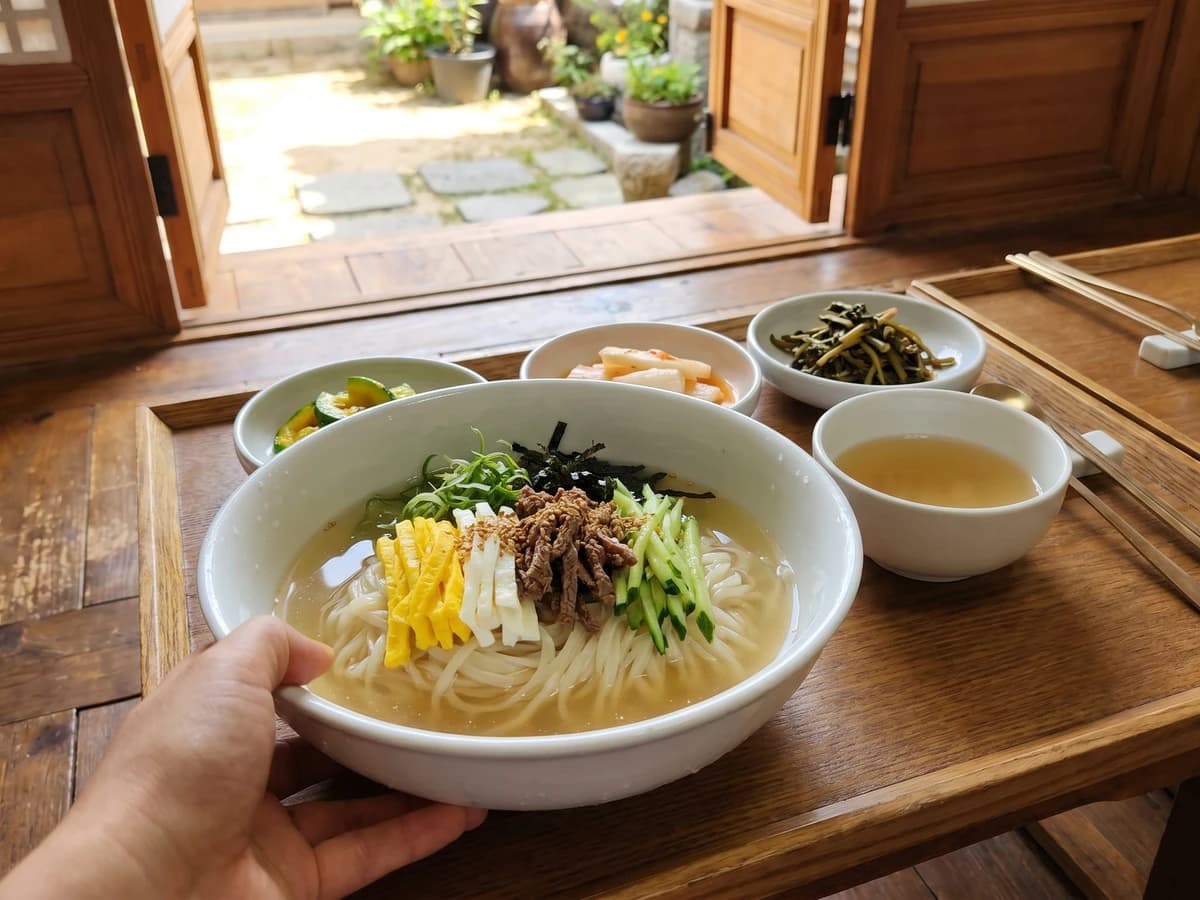
Andong's guest noodles, wheat and roasted soybean flour rolled thin, boiled and rinsed cold, then set in a clear chilled anchovy broth with careful strips of beef, egg, and cucumber.

Chef Jeong-sun
Andong's ritual-table rice served on an ordinary day: separate soy-sesame namul, warm rice, and clear radish soup, mixed without gochujang so every vegetable keeps its own voice.