
Chef Klaus
Aachener Printen
Aachen's Advent biscuit is dark, hard, and spiced, with beet syrup doing the deep work and a closed tin finishing what the oven only starts.
A cooking platform built around craft, culture, and the stories behind what we eat.
Created by
Nürnberg's finest lebkuchen sits on Oblaten, not flour. Nuts and honey carry the crumb, and a patient rest turns the spice into Christmas baking.
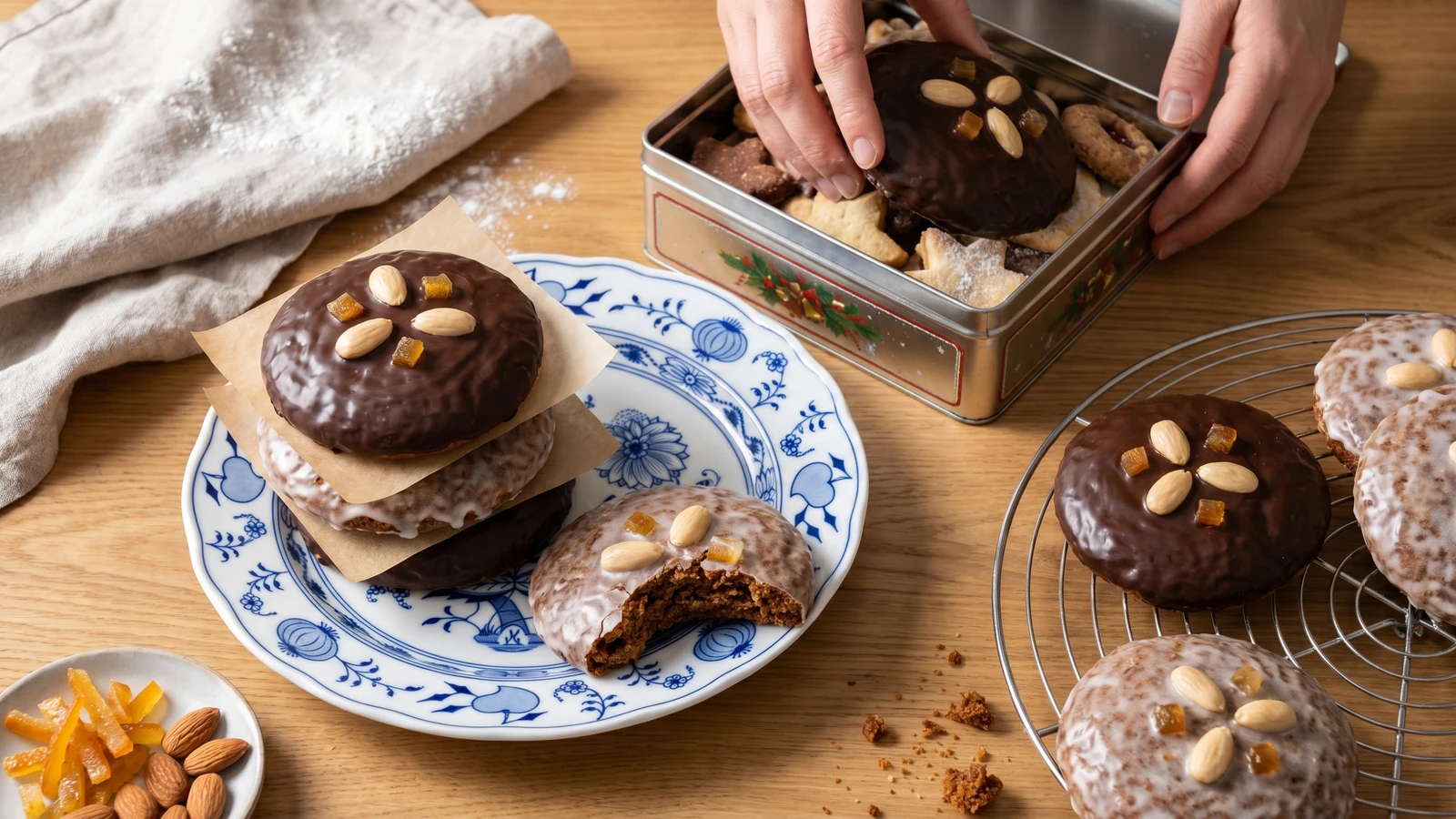
Elisenlebkuchen belongs to Nürnberg and to Advent, when the tins start filling and the house smells of honey, citrus peel, cinnamon, cloves, cardamom, and anise. This is the deep mark of Christmas baking on the German table, not a quick Plätzchen, a Christmas cookie, cut from short pastry and gone by evening. It waits. Das braucht seine Zeit.
Nürnberg makes the nut-rich Oblatenlebkuchen, baked on thin Oblaten, baking wafers, so the soft batter has a floor and stays moist. Aachen has its Printen, firmer and darker. The north bakes peppery Pfeffernüsse and lets them age in a tin until they soften. Im Norden anders, im Süden anders. Here in Franconia, the argument is simple: the best Elisenlebkuchen is carried by almonds, hazelnuts, honey, and candied peel, not wheat.
The technique that decides it is the paste. Grind the candied orange and lemon peel fine with part of the nuts, then rest the batter cold at least overnight, better two days. The peel disappears into the mass instead of chewing like hard bits, the nuts drink the egg and honey, and the spices settle instead of shouting from the surface. Bake it low enough that the edges set while the middle stays tender. Runter mit der Temperatur.
Nicht aus dem Glas, and not from a supermarket tin if you want to know the dish. Make the nut paste, spread it on the Oblaten with a wet knife, glaze some white with sugar and some dark with chocolate. Then pack them in a tin and leave them alone a few days. The tin is not storage. It is part of the recipe.
Nürnberg became a lebkuchen city because it sat on medieval trade routes that brought spices north and beside the Reichswald, whose beekeepers supplied the honey before cheap cane sugar changed European baking. Lebküchner, specialist gingerbread bakers, are documented in Nürnberg by the late Middle Ages, and the city's lebkuchen trade was organised under strict guild rules by the 17th century. Nürnberger Lebkuchen has been protected in the European Union as a geographical indication since 1996, tying the name to production in Nürnberg while Elisenlebkuchen names the richest, nut-heavy style.
Quantity
200g
Quantity
200g
toasted and cooled
Quantity
120g
Quantity
80g
Quantity
4
Quantity
180g
Quantity
80g
Quantity
2 tablespoons
Quantity
2 teaspoons
Quantity
1 teaspoon
Quantity
1/2 teaspoon
Quantity
1/2 teaspoon
Quantity
1/2 teaspoon
Quantity
1/4 teaspoon
Quantity
1/2 teaspoon
Quantity
24
70mm diameter
Quantity
150g
chopped
Quantity
120g
Quantity
2 to 3 tablespoons
Quantity
24
for decorating
| Ingredient | Quantity |
|---|---|
| whole blanched almonds | 200g |
| hazelnutstoasted and cooled | 200g |
| candied orange peel | 120g |
| candied lemon peel | 80g |
| large eggs | 4 |
| light brown sugar | 180g |
| honey | 80g |
| dark rum or apple juice | 2 tablespoons |
| ground cinnamon | 2 teaspoons |
| ground ginger | 1 teaspoon |
| ground cloves | 1/2 teaspoon |
| ground cardamom | 1/2 teaspoon |
| ground anise | 1/2 teaspoon |
| ground nutmeg | 1/4 teaspoon |
| fine salt | 1/2 teaspoon |
| round Oblaten wafers70mm diameter | 24 |
| dark chocolatechopped | 150g |
| icing sugar | 120g |
| hot water | 2 to 3 tablespoons |
| whole blanched almonds (optional)for decorating | 24 |
Pulse the almonds and hazelnuts until finely ground, stopping before they turn oily. A little texture is good, paste is not; the nuts have to hold the batter like flour would, and once you grind out the oil, the lebkuchen bakes heavy.
Pulse the candied orange peel and candied lemon peel with a handful of the ground nuts until the peel is chopped very fine and sticky. This is the difference between Elisenlebkuchen and a mouthful of hard citrus cubes. The peel should season the whole cake, not fight your teeth.
Beat the eggs, brown sugar, honey, and salt for 4 to 5 minutes, until thick and lighter in colour. You are dissolving the sugar and trapping enough air to lighten a flourless batter; skip this and the nuts sit dense on the wafer.
Fold in the ground nuts, the peel paste, the rum or apple juice, cinnamon, ginger, cloves, cardamom, anise, and nutmeg. Fold slowly until no dry pockets remain. The batter should be thick, sticky, and spoonable, not pourable, because the Oblaten carry it but cannot hold a runny mass.
Cover the bowl and refrigerate the batter at least overnight, better 24 to 48 hours. The rest is not decoration. The nuts drink the moisture, the honey loosens into the spice, and the batter firms enough to mound neatly on the Oblaten instead of spreading flat.
Heat the oven to 160C. Line two baking sheets with parchment and lay out the Oblaten. Spoon a heaped tablespoon of batter onto each wafer and smooth it with a wet knife into a low dome, leaving a narrow rim visible. The rim matters because the batter expands slightly, and covering the edge makes the lebkuchen crawl off its base.
Bake for 18 to 22 minutes, rotating the sheets once, until the tops are set, the edges are just firm, and the centres still give slightly under a fingertip. Do not bake them dry for colour. Elisenlebkuchen should stay moist, and the colour will deepen as they rest.
Cool the lebkuchen completely before glazing, because warm cakes melt the finish and turn it dull. Melt the chocolate gently and brush it over half the lebkuchen. Stir the icing sugar with hot water to a thick, smooth glaze and brush it over the rest. Press a whole almond into the centre while the glaze is still wet if you want the old Nürnberg look.
Let the glaze set, then pack the lebkuchen in a tin with parchment between layers and leave them 2 to 5 days before serving. They soften and round out in the tin, the way Pfeffernüsse do. A fresh one is good. A rested one is the point. Schön ist, was schmeckt.
1 serving (about 58g)
Culinary guides, cultural storytelling, and the editorial depth that makes cooking meaningful.
Discover Culinary ExplorerChef Klaus
Aachen's Advent biscuit is dark, hard, and spiced, with beet syrup doing the deep work and a closed tin finishing what the oven only starts.

Chef Klaus
The Baden-Wuerttemberg apple fritter that lives between weeknight dessert and Sunday coffee, built on tart rings, a light batter, and oil kept steady.

Chef Klaus
The Carnival doughnut lives by proofing and fat temperature: a light yeast round floats high, cooks through with one pale belt, then takes its jam without turning greasy.

Chef Klaus
A cold Mürbeteig ball, one clean hollow, and a spoon of tart jelly: Engelsaugen are Advent cookies that fail only when the dough gets warm.