Culinary Explorer

A cooking platform built around craft, culture, and the stories behind what we eat.
Discover Culinary Explorer
North Dakota Chokecherry Pie

North Dakota Chokecherry Pie

Created by

A double-crusted tribute to the northern prairie, where wild chokecherries yield their ruby juice to become the most distinctive pie in American regional baking. Tart, sweet, and hauntingly complex.

Pastries & Cookies
American
Potluck, Special Occasion
1 hr
Active Time
55 min cook2 hr 30 min total
YieldOne 9-inch double-crust pie (8 servings)

The chokecherry grows wild across the Dakotas, a stubborn little fruit that survives winters that would kill lesser plants. Eat one raw and you'll understand the name. Your mouth puckers, your tongue protests, your body wonders what you've done wrong. But boil those same berries with sugar, strain them through cheesecloth, and something remarkable emerges: a juice the color of garnets with a flavor unlike anything cultivated.

German-Russian immigrants settling the northern plains in the 1880s discovered what Native Americans had known for centuries. The chokecherry, properly handled, becomes extraordinary. Grandmothers taught daughters to pick in late August, to watch for the clusters hanging heavy and nearly black. They cooked vats of berries in summer kitchens, filled Mason jars with syrup that would see families through harsh winters.

This pie appears at county fairs from Minot to Bismarck every August, competing for blue ribbons that matter more than city folks might understand. The crust uses lard, as prairie cooks have always used lard, because it produces the flakiest, most honest pastry. The filling balances the chokecherry's natural tartness against enough sugar to make it palatable without erasing what makes it distinctive. You'll taste something ancient in each bite.

If you've never encountered chokecherries, seek them out. They grow in hedgerows and shelterbelts across the northern states, free for the picking. Failing that, chokecherry syrup can be ordered from North Dakota producers who've kept the tradition alive. This is a pie worth hunting for.

The technique, the tradition, and the story behind every dish.

Discover Culinary Explorer

Ingredients

all-purpose flour

Quantity

2 1/2 cups (310g)

fine sea salt (for crust)

Quantity

1 teaspoon

granulated sugar (for crust)

Quantity

1 tablespoon

cold lard

Quantity

1/2 cup (115g)

cut into 1/2-inch pieces

cold unsalted butter (for crust)

Quantity

1/2 cup (1 stick/113g)

cut into 1/2-inch pieces

ice water

Quantity

6 to 8 tablespoons

fresh chokecherries

Quantity

4 cups

stems removed

granulated sugar (for filling)

Quantity

1 1/4 cups

cornstarch

Quantity

1/4 cup

fine sea salt (for filling)

Quantity

1/4 teaspoon

almond extract

Quantity

1/4 teaspoon

cold unsalted butter (for filling)

Quantity

2 tablespoons

cut into small pieces

large egg

Quantity

1

for egg wash

heavy cream

Quantity

1 tablespoon

for egg wash

coarse sugar

Quantity

for sprinkling

Equipment Needed

  • 9-inch pie plate (glass or ceramic shows the filling beautifully)
  • Pastry blender or cold fingers
  • Rolling pin
  • Fine-mesh sieve and cheesecloth
  • Rimmed baking sheet
  • Pastry brush

Instructions

  1. 1

    Make the pastry

    Whisk together flour, salt, and sugar in a large bowl. Add the cold lard and butter pieces. Work the fats into the flour using a pastry blender or your fingertips, pressing and smearing until the mixture resembles coarse meal with some pea-sized pieces remaining. Those larger pieces will create the flaky layers. Drizzle ice water over the mixture one tablespoon at a time, tossing with a fork after each addition, until the dough just holds together when pressed. You may not need all the water.

    The combination of lard and butter is traditional to prairie baking. Lard provides extraordinary flakiness; butter contributes flavor. If you can source leaf lard from a butcher, it's worth the effort.
  2. 2

    Rest the dough

    Divide dough into two portions, one slightly larger than the other. Flatten each into a disk about one inch thick, wrap tightly in plastic, and refrigerate for at least one hour or overnight. Cold dough rolls more easily and produces a flakier crust. The gluten needs time to relax.

  3. 3

    Prepare the chokecherry juice

    If using fresh chokecherries, place them in a large saucepan with one cup of water. Bring to a simmer over medium heat, then reduce heat and cook, stirring occasionally and pressing berries against the side of the pot, for twenty to twenty-five minutes until berries have burst and released their juice. The kitchen will smell wild and slightly medicinal. Strain through a fine-mesh sieve lined with cheesecloth into a bowl, pressing firmly on the solids to extract every drop of ruby liquid. You should have about two cups. Discard the pulp and pits.

    Never crush or grind chokecherry pits. They contain compounds that release cyanide. Cooking and straining is the traditional, safe method that generations of prairie cooks have used.
  4. 4

    Cook the filling

    In a medium saucepan, whisk together the sugar, cornstarch, and salt. Gradually whisk in the chokecherry juice until smooth. Cook over medium heat, stirring constantly, until the mixture thickens and turns glossy, about five to seven minutes. It should coat a spoon heavily. Remove from heat and stir in the almond extract. The almond note is traditional; it amplifies the stone-fruit quality hiding in chokecherries. Let the filling cool to room temperature while you roll the crust.

  5. 5

    Roll the bottom crust

    Remove the larger dough disk from the refrigerator. On a lightly floured surface, roll from center outward, rotating the dough quarter-turns, until you have a circle about twelve inches across and one-eighth inch thick. Transfer to a nine-inch pie plate, pressing gently into the corners without stretching. Let the excess hang over the edge. Refrigerate while you roll the top.

  6. 6

    Roll the top crust

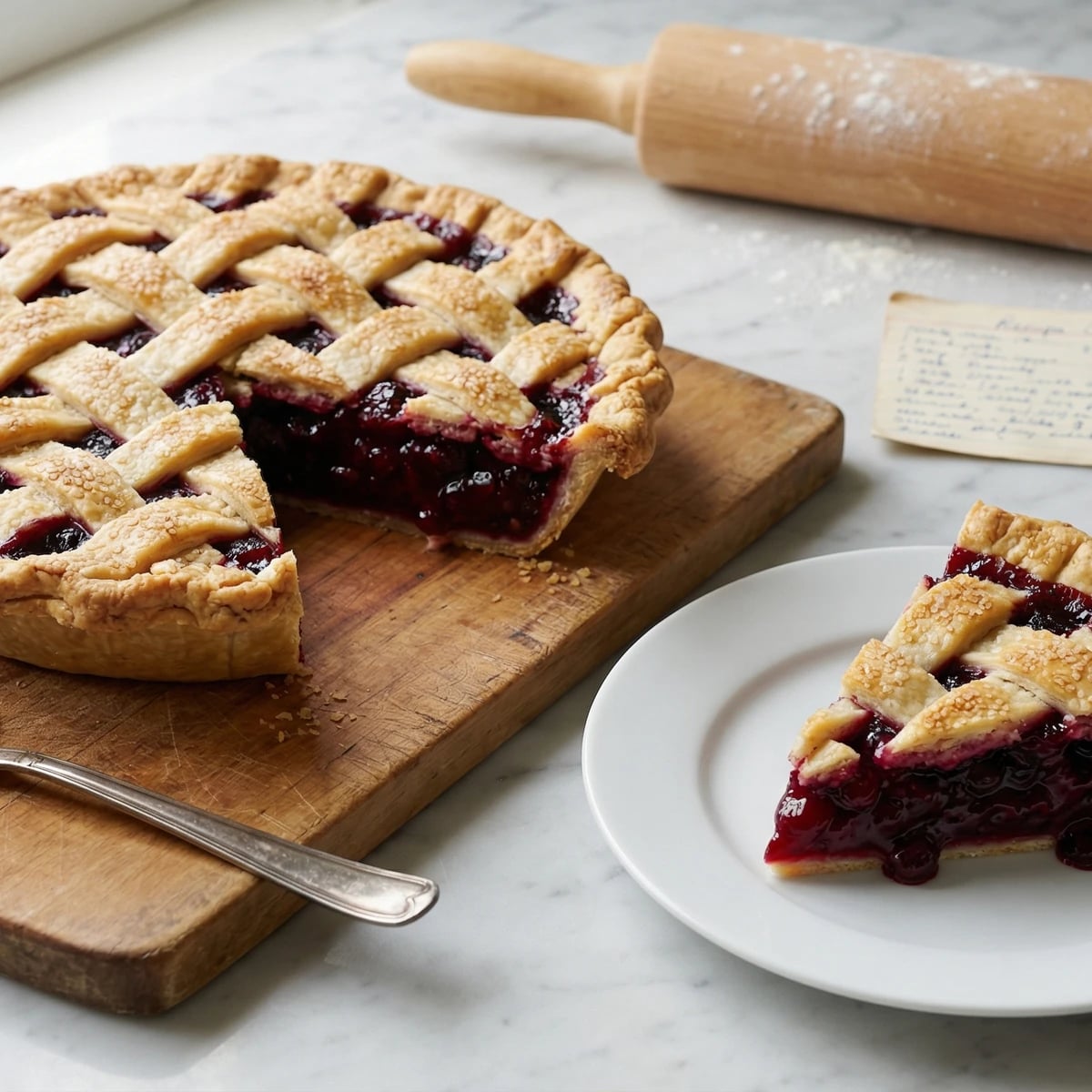
    Roll the smaller disk to about eleven inches across. You can leave it whole for a traditional top, or cut into strips for a lattice. A lattice shows off that extraordinary ruby color, and county fair judges seem to favor them.

  7. 7

    Fill and assemble

    Pour the cooled filling into the prepared bottom crust. Dot the surface with the small pieces of cold butter. These will melt during baking and enrich the filling. If using a solid top, drape it over the filling. If making a lattice, weave strips over and under. Either way, trim the overhang to about half an inch, fold the edge under, and crimp decoratively. Cut three or four vents in a solid top to let steam escape.

  8. 8

    Apply egg wash

    Beat the egg with the cream until smooth. Brush this wash over the entire top crust, getting into the crimped edges. This gives the baked pie its golden sheen. Sprinkle generously with coarse sugar. The sugar crystals catch light and crunch pleasantly against the tender crust.

  9. 9

    Bake the pie

    Position a rack in the lower third of your oven and preheat to 425°F. Place the pie on a rimmed baking sheet to catch any drips. Bake for twenty minutes until the crust begins to turn golden. Reduce heat to 375°F and continue baking thirty to thirty-five minutes more, until the crust is deeply golden and the filling bubbles visibly through the vents or lattice. If the edges brown too quickly, shield them with foil.

    The filling must bubble to properly set. Don't pull the pie early just because the crust looks done. Patience rewards.
  10. 10

    Cool completely

    Transfer the pie to a wire rack and let cool for at least three hours before slicing. I know this is difficult. The filling needs time to set, and a warm pie will run all over the plate. The waiting is part of the ritual. The pie is worth the patience.

Chef Tips

  • If fresh chokecherries are unavailable, pure chokecherry syrup from North Dakota producers makes an acceptable substitute. Use two cups of syrup in place of the juice and reduce the sugar to three-quarters cup.
  • Chokecherries ripen in late August across the northern plains. Look for clusters that have turned from red to nearly black. The darker the berry, the sweeter the juice. Wear old clothes when picking; the stain is permanent.
  • The pie tastes even better on the second day. The flavors meld and the filling sets more firmly. Store loosely covered at room temperature.
  • Serve with a scoop of good vanilla ice cream or a pour of fresh cream. North Dakota tradition favors the cream, poured into a small pitcher and passed at the table.

Advance Preparation

  • Pie dough can be made three days ahead and refrigerated, or frozen for up to three months. Thaw overnight in refrigerator before rolling.
  • Chokecherry juice can be prepared weeks ahead and frozen. Thaw before using in the filling.
  • The fully baked pie keeps at room temperature for three days, loosely covered. It can be refrigerated for up to five days; bring to room temperature before serving for best texture.

Frequently Asked Questions

Nutrition Information

1 serving (about 210g)

Calories
590 calories
Total Fat
28 g
Saturated Fat
16 g
Trans Fat
0 g
Unsaturated Fat
12 g
Cholesterol
160 mg
Sodium
375 mg
Total Carbohydrates
74 g
Dietary Fiber
1 g
Sugars
33 g
Protein
5 g

Note: Chef personas and recipes are created with AI assistance. Cook with care: follow safe food-handling practices, check doneness with a thermometer when needed, and adapt for allergies and your kitchen.

Where cooking meets culture.

Culinary guides, cultural storytelling, and the editorial depth that makes cooking meaningful.

Discover Culinary Explorer

More from Fifty States, Fifty Pies

Browse the full collection