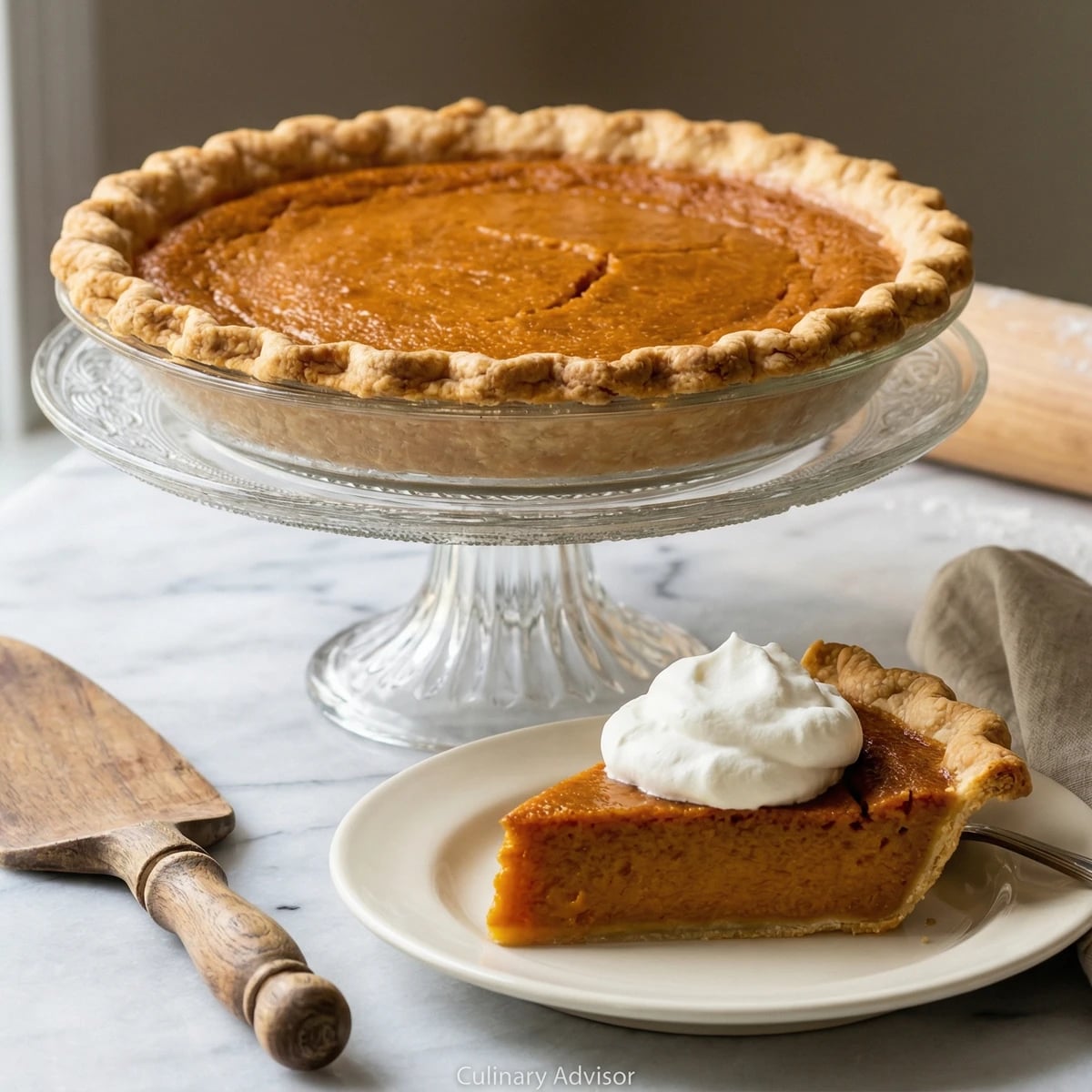
A velvety Carolina custard pie with deep amber color and gentle spice, its buttery crust shattering into the silken filling that has graced Southern tables since before the Civil War. This is the pie your grandmother's grandmother knew by heart.
Pastries & Cookies
American
Thanksgiving, Holiday, Comfort Food
45 min
Active Time
1 hr 30 min cook•2 hr 15 min total
YieldOne 9-inch pie (8 servings)
Sweet potato pie is older than this nation. West African cooks brought the technique of mashing starchy tubers with spices and baking them in pastry, adapting their traditions to what grew in Carolina soil. By the time Thomas Jefferson was taking notes on Virginia agriculture, sweet potato pie was already a fixture on Southern tables. It belongs to Black American culinary heritage as surely as gumbo belongs to New Orleans.
North Carolina grows more sweet potatoes than any other state. Drive through Nash County or Johnston County in autumn and you'll see the harvest in every farm stand, the earth still clinging to orange flesh. The Beauregard and Covington varieties that thrive here have exactly the right moisture content and natural sweetness for pie. No wonder Carolina cooks perfected this recipe.
The filling should be silky, not grainy. This requires baking your sweet potatoes rather than boiling them. Boiling waterlogged the flesh and dilutes the flavor. Baking concentrates the sugars and keeps the texture smooth. I learned this the hard way, serving lumpy pies at church suppers until an elder woman pulled me aside and set me straight. The oven does the work. Trust it.
Don't let pie crust intimidate you. Cold butter, cold water, confident hands. Work quickly and handle the dough as little as possible. If the crust cracks when you roll it, press it back together. The filling forgives imperfection. What matters is the flavor, that perfect balance of sweet potato earthiness and warm spice that makes this pie worth the effort.
The technique, the tradition, and the story behind every dish.
cold unsalted butter (for crust)cut into 1/2-inch cubes
1/2 cup (1 stick/113g)
ice water
4 to 5 tablespoons
granulated sugar
3/4 cup (150g)
light brown sugarpacked
1/4 cup (55g)
ground cinnamon
1/2 teaspoon
nutmegfreshly grated
1/2 teaspoon
ground ginger
1/4 teaspoon
fine sea salt (for filling)
1/4 teaspoon
large eggsat room temperature
3
evaporated milk
1/2 cup (120ml)
unsalted butter (for filling)melted and slightly cooled
4 tablespoons (57g)
pure vanilla extract
1 teaspoon
lightly sweetened whipped cream (optional)
for serving
Equipment Needed
•9-inch pie plate (glass or ceramic preferred for even browning)
•Pastry cutter or two butter knives
•Rolling pin
•Fine-mesh strainer
•Wire cooling rack
•Baking sheet
Instructions
1
Bake the sweet potatoes
Heat your oven to 400°F. Scrub the sweet potatoes clean and prick each one deeply with a fork in six or seven places. Set them on a foil-lined baking sheet to catch the sugary syrup that will leak out. Bake until completely tender when pierced with a knife, 50 to 70 minutes depending on size. The skins will be wrinkled and caramelized, the flesh yielding without resistance. This is the foundation of your pie.
Choose sweet potatoes of similar size so they cook evenly. The orange-fleshed varieties labeled Beauregard, Covington, or garnet have the best texture for pie.
2
Make the pie dough
While potatoes bake, prepare your crust. Whisk the flour and salt together in a large bowl. Add the cold butter cubes and work them into the flour using a pastry cutter or your fingertips, pressing and flattening each piece until the mixture resembles coarse meal with some pea-sized butter pieces remaining. These irregular bits create flaky layers. Drizzle four tablespoons of ice water over the flour and stir with a fork until the dough begins to clump. If dry spots remain, add more water, one teaspoon at a time.
Your hands are warm. If using your fingers, work quickly and wash your hands in cold water first. The butter must stay cold or your crust will be tough.
3
Chill the dough
Turn the shaggy dough onto a clean surface and gather it into a rough ball. Press it into a thick disk about five inches across, wrap tightly in plastic, and refrigerate for at least 30 minutes. The dough can rest up to three days. Cold dough rolls easier and bakes flakier.
4
Prepare the sweet potato flesh
When the sweet potatoes are tender, split them open and let steam escape for five minutes. The flesh should be soft enough to mash with a fork. Scoop it into a bowl, discarding the skins. You need two cups of mashed flesh, packed loosely. Mash thoroughly with a fork or potato masher until smooth, or press through a fine-mesh strainer for the silkiest texture. Let cool to warm room temperature.
5
Roll and fit the crust
On a lightly floured surface, roll the chilled dough into a 12-inch circle, rotating it a quarter turn after each pass to prevent sticking. Transfer to a 9-inch pie plate by rolling it loosely around your pin and unrolling it over the dish. Gently ease the dough into the corners without stretching. Trim edges to leave a one-inch overhang, then fold under and crimp decoratively. Refrigerate while you prepare the filling.
If the dough cracks, don't panic. Wet your finger with cold water and press the pieces back together. The filling will hide any repairs.
6
Mix the filling
Reduce oven temperature to 350°F. In a large bowl, whisk together both sugars, the cinnamon, nutmeg, ginger, and salt. Add the eggs one at a time, whisking well after each. The mixture should turn smooth and slightly lighter in color. Whisk in the evaporated milk, melted butter, and vanilla until combined. Add the mashed sweet potato and whisk vigorously until the filling is completely uniform, no streaks of orange remaining.
7
Strain for silk
Pour the filling through a fine-mesh strainer into a clean bowl, pressing with a spatula to push it through. This removes any fibrous bits and ensures the custard bakes perfectly smooth. Discard the solids caught in the strainer. The filling should pour like heavy cream.
Straining is optional but makes the difference between a good pie and a great one. The extra minute of work yields a texture that melts on the tongue.
8
Fill and bake
Pour the strained filling into the chilled crust. Set the pie on a baking sheet to catch any drips and transfer to the center rack of your oven. Bake until the edges are set but the center still wobbles slightly when you tap the pan, 50 to 60 minutes. The filling will continue cooking as it cools. A knife inserted two inches from the edge should come out clean while the very center still jiggles.
9
Cool completely
Let the pie cool on a wire rack for at least two hours before slicing. This is difficult. The kitchen will smell of warm spice and caramelized sugar. But custard pies slice cleanly only when fully set. Cutting too soon yields a soupy mess. The wait is worth it. The filling will firm into sliceable silk.
This pie improves overnight. Make it the day before your gathering and store at room temperature, loosely covered. The spices meld and the texture perfects itself.
10
Serve with whipped cream
Slice into eight wedges using a sharp thin-bladed knife wiped clean between cuts. Serve at room temperature or slightly chilled with a generous dollop of lightly sweetened whipped cream. Some Carolina cooks would insist on nothing but the naked pie. Others want that cool cloud of cream against the spiced custard. Both traditions are worthy of respect.
Chef Tips
•If you have access to lard from a good butcher, consider using half lard and half butter in your crust. This is the traditional Carolina method. Lard creates an exceptionally flaky texture that butter alone cannot match. Pure butter is perfectly acceptable for modern cooks uncomfortable with lard.
•The evaporated milk is not negotiable. Its concentrated richness and slight caramel undertone are essential to the filling's character. Sweetened condensed milk is not a substitute. Neither is regular milk.
•Grate your nutmeg fresh from whole seeds. The difference between pre-ground nutmeg and freshly grated is the difference between a good pie and one that people remember. A single whole nutmeg will last you a year of baking.
•Leftover pie keeps beautifully for three days at cool room temperature or five days refrigerated. The crust softens slightly after day two, but the flavor remains excellent. Let refrigerated slices warm for thirty minutes before serving.
•In Carolina tradition, sweet potato pie often appears alongside pecan pie and pound cake at holiday gatherings. A thin slice of each is considered proper dessert etiquette, not gluttony.
Advance Preparation
•Pie dough can be made up to 3 days ahead and refrigerated, or frozen for 3 months. Thaw overnight in the refrigerator before rolling.
•Sweet potatoes can be baked and mashed up to 2 days ahead, stored covered in the refrigerator. Bring to room temperature before adding to the filling.
•The finished pie improves overnight. Bake the day before serving, store loosely covered at room temperature, and slice just before your guests arrive.
Frequently Asked Questions
Nutrition Information
1 serving (about 210g)
Calories
470 calories
Total Fat
21 g
Saturated Fat
12 g
Trans Fat
0 g
Unsaturated Fat
9 g
Cholesterol
116 mg
Sodium
290 mg
Total Carbohydrates
65 g
Dietary Fiber
4 g
Sugars
30 g
Protein
7 g
Where cooking meets culture.
Culinary guides, cultural storytelling, and the editorial depth that makes cooking meaningful.