
Chef Jeong-sun
Changnan-jeot (Salted Pollack Tripe)
A bracing Korean jeotgal of pollack intestines, cleaned with coarse salt, fermented cold until firm and savory, then dressed lightly with gochugaru, garlic, sesame, and scallion for rice.
A cooking platform built around craft, culture, and the stories behind what we eat.
Created by
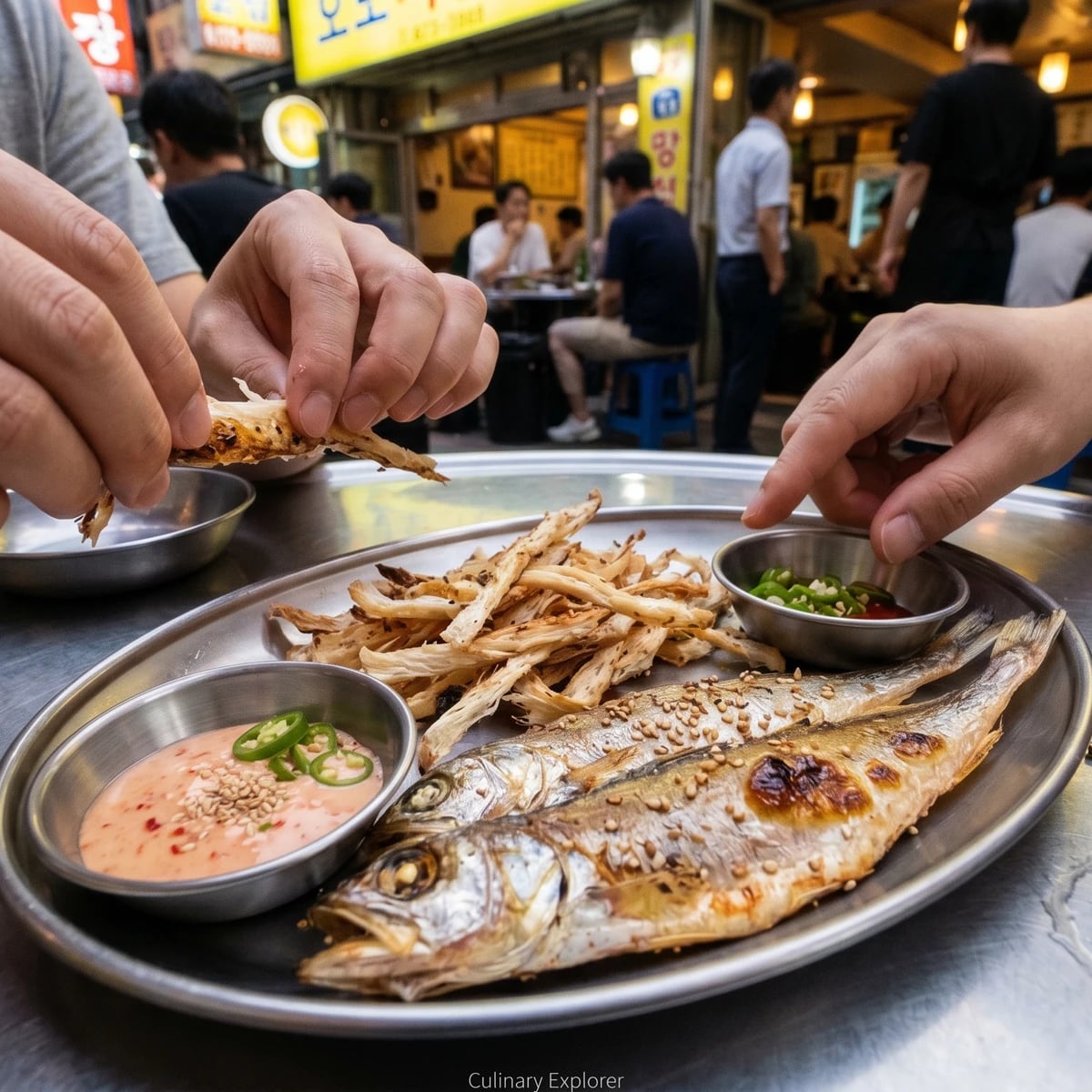
The late-night dried pollack snack that asks for almost no cooking, only careful roasting, patient tearing, and a chili-mayo dip kept sharp enough not to bury the fish.
Nogari belongs to the hour when dinner is finished but the table is not ready to let people go. In old beer houses, one dried little pollack could sit between three friends with cold beer and a dish of chili-mayo, and nobody felt cheated. A snack is still a dish. It deserves a notebook too.
The whole thing lives or dies by heat. Roast nogari too hard and it becomes a board. Leave it too pale and it stays dry in the jaw. You want the skin to blister in small spots, the flesh to puff and loosen, and the tail to bend when you press it. Then you tear it along the grain, not across it, so the chew stays clean.
The sauce must know its place. Mayonnaise softens the salt, gochujang gives color and a little depth, vinegar wakes it up, and garlic should be a whisper. Let it taste like dried pollack. 손맛 is real; I measure it anyway, so the next plate comes out the same.
Koreans have long given pollack, myeongtae (명태), different names according to age and processing: saengtae for fresh, dongtae for frozen, bugeo or hwangtae for fully dried fish, and nogari for the young dried pollack eaten as an anju (drinking snack). Nogari became especially tied to Seoul's hof beer culture in the late twentieth century, with Euljiro's beer-and-nogari alley growing around printers, office workers, and small pubs. Its history is not palace food; it is wage-work, cheap beer, and a dried fish made generous by sharing.
Quantity
3 fish, about 25 to 35g each
Quantity
1 teaspoon
for rubbing the pan or fish
Quantity
3 tablespoons
Quantity
1 teaspoon
Quantity
1/2 teaspoon
Quantity
1/2 teaspoon
Quantity
1/4 teaspoon
Quantity
1/4 teaspoon
Quantity
1/4 small clove
finely grated
Quantity
1/2 teaspoon
Quantity
1 small
thinly sliced
| Ingredient | Quantity |
|---|---|
| dried baby pollack (nogari) | 3 fish, about 25 to 35g each |
| neutral oilfor rubbing the pan or fish | 1 teaspoon |
| mayonnaise | 3 tablespoons |
| gochujang (Korean chili paste) | 1 teaspoon |
| rice vinegar | 1/2 teaspoon |
| corn syrup or honey | 1/2 teaspoon |
| soy sauce | 1/4 teaspoon |
| toasted sesame oil | 1/4 teaspoon |
| garlic (optional)finely grated | 1/4 small clove |
| toasted sesame seeds (optional) | 1/2 teaspoon |
| green chili (optional)thinly sliced | 1 small |
Look over the nogari and brush away loose scales or dust with a dry towel. If the fish feels very hard, wrap it in a barely damp towel for 5 minutes only. Do not soak it. Soaking washes away the salt and dried-fish savor you came for.
Stir together the mayonnaise, gochujang, rice vinegar, corn syrup or honey, soy sauce, sesame oil, and grated garlic if using. Taste it. It should be creamy, lightly red, a little sharp, and not sweet enough to cover the fish. Scatter sesame seeds and sliced green chili over the top if you want them.
Heat a dry skillet or grill pan over medium-low heat for 2 minutes, then rub it with the teaspoon of oil. Medium-low is the important part. Nogari is already cooked by drying; you are waking it up, not frying it.
Lay the nogari in the pan and press lightly with tongs. Roast 1 1/2 to 2 minutes per side, turning once or twice, until the skin shows small toasted spots and the body bends instead of snapping. If the fins darken too fast, lower the heat. Burnt dried fish tastes harsh for the rest of the night.
Move the nogari to a board and let it sit 1 minute, just until your fingers can handle it. Pull off the head if attached, split the body open, and tear the flesh into long strips along the grain. Serve at once with the chili-mayo. People can tear their own at the table too; that is half the pleasure.
1 serving (about 55g)
Culinary guides, cultural storytelling, and the editorial depth that makes cooking meaningful.
Discover Culinary Explorer
Chef Jeong-sun
A bracing Korean jeotgal of pollack intestines, cleaned with coarse salt, fermented cold until firm and savory, then dressed lightly with gochugaru, garlic, sesame, and scallion for rice.

Chef Jeong-sun
Soft strips of broth kelp cured in soy, vinegar, and a little sweetness, a quiet make-ahead banchan that teaches the stock pot not to waste what still has flavor.

Chef Jeong-sun
Mountain bellroot pounded flat, dried until tacky, then buried in a restrained gochujang cure; scrape away the old paste, dress with sesame, and serve a few aromatic strips with rice.

Chef Jeong-sun
A make-ahead bellflower root pickle with a clean bitter edge, cured until chewy and seasoned with restraint so the doraji still tastes like itself.