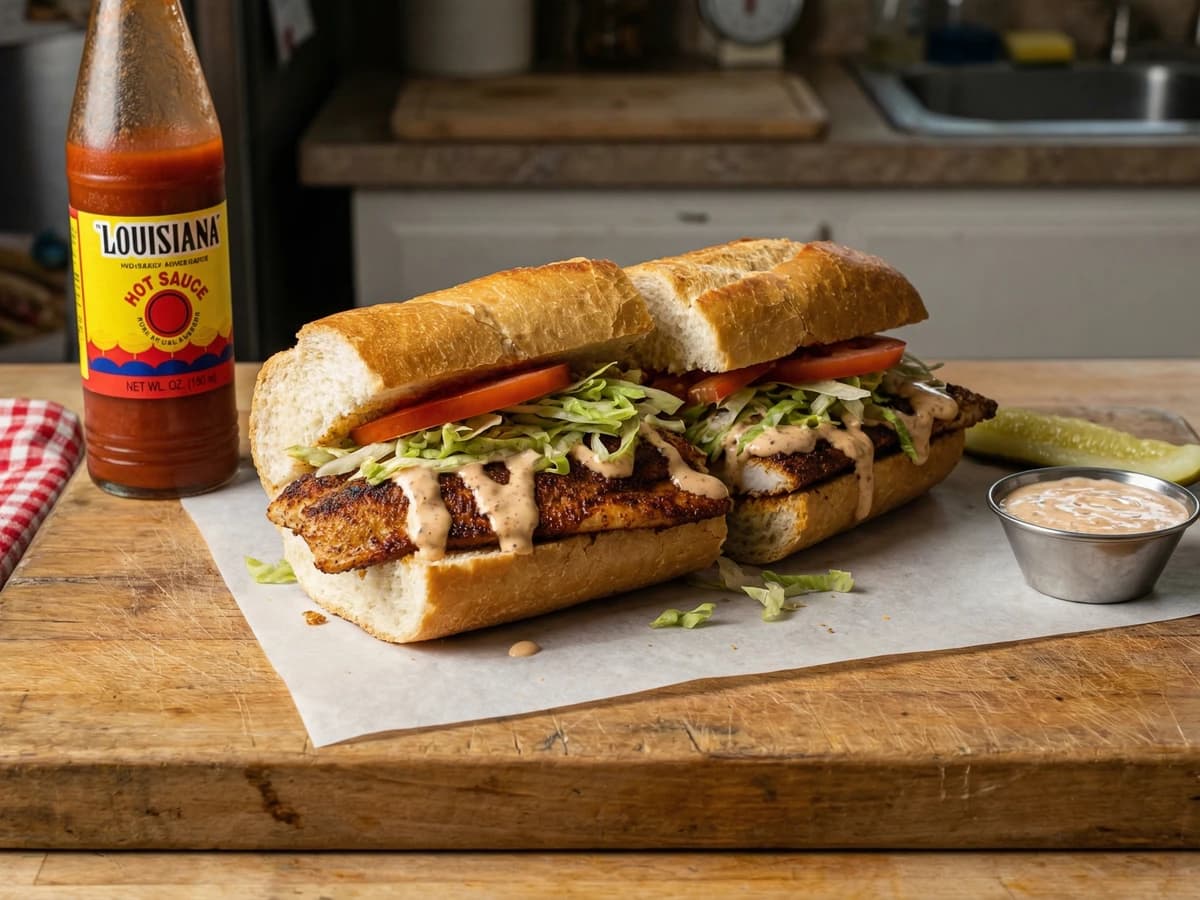
Golden-fried Gulf shrimp shatter through their cornmeal crust, nestled in crusty French bread and dressed with a bold Cajun remoulade that carries the soul of New Orleans in every bite.
Sandwiches & Wraps
Cajun
Outdoor Dining
30 min
Active Time
20 min cook•50 min total
Yield4 sandwiches
The po'boy was born from generosity. During the 1929 streetcar strike in New Orleans, Benny and Clovis Martin served free sandwiches to striking workers from their French Market restaurant. "Here comes another poor boy," they'd call out. The name stuck. The sandwich became a symbol of feeding people well without charging them dearly.
What makes a proper shrimp po'boy isn't complicated, but it demands attention. The shrimp must be Gulf-caught if you can find them, their natural sweetness intensified by a cornmeal crust that shatters audibly when you bite down. The bread matters enormously. New Orleans French bread has a crackling crust and cotton-soft interior that no baguette can replicate. If you can't find it, look for a loaf with similar architecture: crisp outside, pillowy within.
The remoulade is where Louisiana announces itself. This isn't the pink cocktail sauce some restaurants pass off under the name. True Cajun remoulade carries heat from cayenne, pungency from whole-grain mustard, brightness from lemon and capers. It should wake you up, not lull you to sleep. Make it ahead. It improves overnight as the flavors marry.
I've eaten po'boys at Domilise's, at Parkway, at places with no name on the door. The best ones share one quality: abundance. The shrimp threaten to escape the bread. The lettuce cascades. The remoulade drips onto newspaper if you're lucky enough to have it served that way. This is not a sandwich for the timid.
The technique, the tradition, and the story behind every dish.
•Large Dutch oven or heavy-bottomed pot (at least 5-quart capacity)
•Deep-fry or candy thermometer
•Spider skimmer or slotted spoon
•Wire cooling racks
•Sheet pans
Instructions
1
Make the Cajun remoulade
Combine the mayonnaise, Creole mustard, horseradish, capers, green onions, garlic, lemon juice, Worcestershire, and cayenne in a bowl. Whisk until smooth and unified. The color should be pale with flecks of green from the onions and capers. Taste it. The horseradish should announce itself, the mustard should linger, and the cayenne should leave a gentle warmth at the back of your throat. Adjust any element to your preference. Cover and refrigerate while you prepare the shrimp.
This remoulade improves dramatically after 4 hours in the refrigerator. Make it the night before if possible.
2
Marinate the shrimp
Place the shrimp in a shallow bowl. Pour the buttermilk over them and add the teaspoon of hot sauce. Stir to coat every shrimp. Let them sit for 15 minutes while you prepare the breading. The buttermilk tenderizes the shrimp and helps the coating adhere. Don't skip this step or rush it.
3
Prepare the breading station
In a wide, shallow dish, whisk together the flour, cornmeal, garlic powder, smoked paprika, cayenne, salt, and pepper. The mixture should smell warmly spiced when you bring it to your nose. Run your fingers through it to break up any lumps. Set a wire rack over a sheet pan nearby for the breaded shrimp.
4
Bread the shrimp
Working with one shrimp at a time, lift it from the buttermilk and let the excess drip off for a moment. Drop it into the cornmeal mixture. Use your dry hand to toss coating over the shrimp, then press firmly to adhere. The coating should cover every surface completely. Transfer to the wire rack. Repeat with all shrimp, keeping one hand wet and one hand dry to prevent clumping. Let the breaded shrimp rest for 5 minutes before frying. This brief rest helps the coating set.
The wet-hand, dry-hand technique prevents your fingers from becoming breaded along with the shrimp. Discipline yourself to use it.
5
Heat the frying oil
Pour vegetable oil into a large Dutch oven or heavy-bottomed pot to a depth of 2 inches. Attach a deep-fry thermometer to the side. Heat over medium-high until the oil reaches 350°F. This takes 8 to 10 minutes. Do not rush it. Watch the thermometer, not the clock. The oil should shimmer but not smoke.
6
Fry the shrimp
Working in batches of 8 to 10 shrimp, carefully lower them into the hot oil using a slotted spoon or spider. Do not crowd the pot. The oil will bubble vigorously. Fry for 2 to 3 minutes, turning once, until the shrimp are deep golden and the coating looks craggy and crisp. The sound changes from aggressive sputtering to a steady sizzle when they're nearly done. Transfer to a clean wire rack set over a sheet pan. Season immediately with a pinch of salt while the oil glistens. Let the oil return to 350°F between batches.
Resist the urge to crowd the pot. Too many shrimp at once drops the oil temperature and produces soggy, greasy results.
7
Prepare the bread
Split the French bread rolls horizontally, leaving a hinge on one side if you prefer. If the interior is very soft and pillowy, you can scoop out a small channel to make room for more shrimp. For a warm sandwich, place the bread cut-side up under a broiler for 30 seconds until barely toasted but not hard.
8
Assemble the po'boys
Spread a generous layer of Cajun remoulade on both cut sides of the bread. Be unapologetic. Layer shredded lettuce on the bottom half, letting some cascade over the edge. Add tomato slices and pickle slices. Pile hot fried shrimp on top, enough that closing the sandwich requires gentle pressure. The shrimp should threaten to escape. Press the top of the bread down gently. The remoulade will ooze slightly. This is correct.
9
Serve immediately
Cut the po'boys in half if desired and serve at once. The contrast between the crackling hot shrimp and the cool, tangy toppings is the whole point. Provide extra napkins. Have extra remoulade at the table for those who want more.
Chef Tips
•Gulf shrimp are worth seeking out for their natural sweetness, but any wild-caught shrimp will serve you well. Avoid farm-raised imports if possible; they lack the flavor and texture that makes this sandwich sing.
•New Orleans French bread is a specific product with a thin, shattering crust and impossibly soft interior. Look for it at specialty bakeries or online. In a pinch, soft Italian bread or good-quality hoagie rolls work better than a baguette, which is too chewy.
•The remoulade keeps refrigerated for up to one week. Make a double batch. You'll find uses for it on grilled fish, cold roast beef, or as a dip for raw vegetables.
•Crystal or Louisiana hot sauce gives the most authentic flavor profile. Frank's works adequately. Tabasco is too vinegary for this application.
•Serve these with an ice-cold beer. Abita Amber if you want to stay regional, or any clean lager that won't compete with the bold flavors.
Advance Preparation
•The remoulade can and should be made up to 2 days ahead. Refrigerate in an airtight container.
•Shrimp can be peeled and deveined up to 8 hours ahead, stored on ice in the refrigerator.
•The breading mixture can be combined up to 3 days ahead and stored in an airtight container at room temperature.
•Do not bread the shrimp until you're ready to fry. Breaded shrimp that sit too long become gummy.
Frequently Asked Questions
Nutrition Information
1 sandwich (about 435g)
Calories
2095 calories
Total Fat
150 g
Saturated Fat
28 g
Trans Fat
1 g
Unsaturated Fat
118 g
Cholesterol
215 mg
Sodium
1150 mg
Total Carbohydrates
107 g
Dietary Fiber
4 g
Sugars
5 g
Protein
53 g
Where cooking meets culture.
Culinary guides, cultural storytelling, and the editorial depth that makes cooking meaningful.