Culinary Explorer

A cooking platform built around craft, culture, and the stories behind what we eat.
Discover Culinary Explorer
Green Curry Paste (Nam Prik Gaeng Khiew Wan)

Green Curry Paste (Nam Prik Gaeng Khiew Wan)

Created by

This is the kreung tam itself. Nine essential ingredients, pounded in order from hardest to most delicate, building the foundation that every Thai curry stands on. Principles, not recipes.

Sauces & Condiments
Thai
Make Ahead
Batch Cooking
Freezer Friendly
45 min
Active Time
5 min cook•50 min total
YieldAbout 1/2 cup paste (enough for one pot of curry, serves 4)

The kreung tam is everything. Ajarn McDang taught me that on day one, and every day since has proven him right. If you understand the paste, you understand Thai food. If you skip the paste, you're not cooking Thai food. You're assembling ingredients that happen to be Thai.

This green curry paste is the flagship. It's the one I teach first at every Fai Thai workshop because it contains all nine of Ajarn's essential ingredients: chilies, garlic, shallots, lemongrass, galangal, kaffir lime zest, cilantro root, peppercorns, and shrimp paste. All nine. In one paste. That's not a coincidence. That's the system showing you its skeleton.

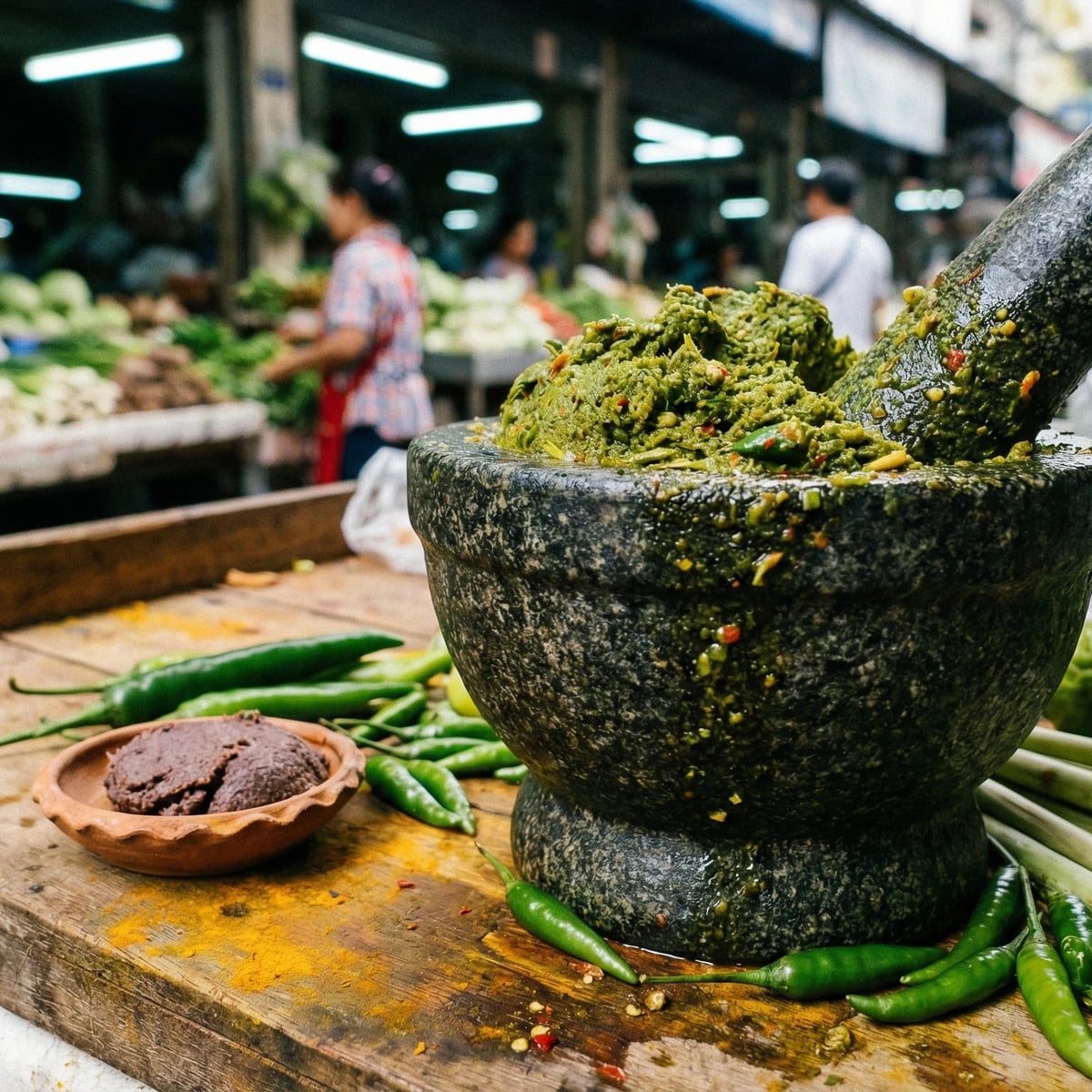
Here's what you need to burn into your brain: order matters. Hardest ingredients enter the mortar first. Dry spices, then fibrous stalks, then chilies, then the wet aromatics, then shrimp paste last. Each ingredient is pounded to a paste before the next goes in. You're not dumping everything in and smashing. You're building layers. The mortar transforms one ingredient at a time, breaking cell walls, releasing essential oils, merging flavors at a molecular level. A blender chops everything simultaneously and gives you green soup. The krok gives you kreung tam.

I've watched my students try to rush this. Thirty minutes feels long when you're standing there pounding. Your arm burns. The pestle gets heavy. Good. That's how you know you're doing it right. Every som tam vendor, every curry paste auntie at the market, every cook who's been doing this for forty years has arms like steel cables. There's a reason. The mortar demands effort, and the effort is what makes the paste sing.

Ajarn always said: "I don't teach you how to cook through recipes. I want you to learn the principles and understand." This paste is the principle. Master it, and every Thai curry is yours.

Green curry (gaeng khiew wan, แกงเขียวหวาน, literally "sweet green curry") is a Central Thai creation distinguished from red curry by its use of fresh green chilies rather than dried red ones. The "wan" (sweet) in the name refers not to sugar but to the milder, sweeter heat profile of fresh green chilies compared to the sharper bite of dried red varieties. The paste's composition reflects the Central Plains' historical access to fresh herbs, coconut, and fermented shrimp paste from the Gulf of Thailand, a regional pantry that shaped Bangkok's curry tradition from the early Rattanakosin period onward.

The technique, the tradition, and the story behind every dish.

Discover Culinary Explorer

Ingredients

white peppercorns (prik thai khao)

Quantity

1 teaspoon

coriander seeds (met phak chi)

Quantity

1 tablespoon

toasted

cumin seeds (met yira)

Quantity

1 teaspoon

toasted

coarse sea salt

Quantity

1 teaspoon

lemongrass (takhrai)

Quantity

3 stalks

tender inner part only, thinly sliced

galangal (kha)

Quantity

1 tablespoon

thinly sliced

kaffir lime zest (phiew makrut)

Quantity

1 tablespoon

finely chopped

green bird's eye chilies (prik khi nu khiew)

Quantity

15

green spur chilies (prik chi fa khiew)

Quantity

5

seeded and roughly chopped

garlic (kratiam)

Quantity

6 cloves

roughly chopped

shallots (hom daeng)

Quantity

4

roughly chopped

cilantro roots (rak phak chi)

Quantity

4

scrubbed and roughly chopped

shrimp paste (kapi)

Quantity

1 tablespoon

Equipment Needed

  • •Heavy granite mortar and pestle (krok hin), at least 7 inches diameter
  • •Dry pan for toasting spices
  • •Small sharp knife for slicing lemongrass and zesting makrut

Instructions

  1. 1

    Toast and pound dry spices

    Toast the coriander seeds and cumin seeds in a dry pan over medium heat for 2 to 3 minutes, shaking the pan, until fragrant and slightly darkened. Don't walk away. Spices go from toasted to burnt in seconds. Let them cool completely. Add the toasted coriander, cumin, and white peppercorns to the granite mortar. Pound to a fine powder. This takes about 3 minutes. You should see no whole seeds remaining. These dry spices form the aromatic backbone of the paste: coriander brings floral warmth, cumin brings earthiness, white pepper brings sharp heat that's different from chili heat. Grind them fresh and you'll understand why pre-ground spices taste like dust.

    Ajarn always said: dry spices go first because they need the most force and the empty mortar gives you maximum impact. Once wet ingredients enter, the mortar loses traction. Hardest first. Always.
  2. 2

    Add salt and fibrous aromatics

    Add the coarse sea salt to the ground spices. The salt acts as an abrasive, gripping the smooth stone and helping the pestle break down the fibrous ingredients that come next. Now add the sliced lemongrass. Pound until it's completely broken down into a fibrous paste with no identifiable rings or chunks. This will take 5 to 7 minutes and your arm will start talking to you. Keep going. Lemongrass is the most stubborn ingredient in the mortar. It provides citral, the compound responsible for that sharp lemon-herbal aroma that defines green curry. No shortcut will extract it the same way.

    Use only the tender inner part of the lemongrass: peel off the tough outer layers until you reach the pale, slightly purple core. Slice it paper-thin before it enters the mortar. Thick slices will fight you for twenty minutes and never fully break down.
  3. 3

    Pound galangal and lime zest

    Add the sliced galangal once the lemongrass is fully incorporated. Pound until the galangal fibers are completely broken. Galangal is harder than ginger and more resinous. It brings a piney, almost camphor-like sharpness that lifts the paste out of one-dimensional green chili territory. Next, add the chopped kaffir lime zest. A few firm strikes to integrate it. The zest contributes intensely floral citrus oils that are unlike any other lime variety on earth. This is the ingredient that makes green curry smell like green curry. If you use regular lime zest, you'll taste the difference immediately.

    Kaffir lime zest (phiew makrut) is the skin of the bumpy makrut lime, not the juice. The juice is barely used in Thai cooking. The zest and leaves are where the magic lives. Use a microplane or a sharp knife to remove just the green outer layer, avoiding the bitter white pith.
  4. 4

    Pound the chilies

    Add all the green chilies to the mortar: both the bird's eye (prik khi nu khiew) and the spur chilies (prik chi fa khiew). Pound until they're fully broken down into the paste. The two types of chili serve different purposes. Bird's eye chilies bring concentrated, searing heat. Spur chilies bring volume, green color, and a gentler warmth. Together, they create the layered heat profile of green curry: immediate bite from the bird's eye, sustained warmth from the spur. You want this pounded until no large chili pieces remain. The paste should be getting visibly green now.

    The green color of the paste comes from the fresh green chilies and the herbs. If your paste looks pale, you need more spur chilies for color. If it's not hot enough, add more bird's eye. Two different chilies, two different jobs.
  5. 5

    Pound garlic and shallots

    Add the roughly chopped garlic. Pound until it disappears into the paste. Then the shallots. These release a lot of moisture, so the paste will loosen up. That's normal. Pound until the shallots are fully incorporated and no chunks remain. Garlic provides pungent sulfur compounds (allicin) that form the savory base. Shallots add sweetness and body. Together they're the workhorses of the paste, the ingredients that give it heft and depth beneath the brighter aromatics.

  6. 6

    Pound cilantro roots

    Add the scrubbed, chopped cilantro roots. Pound until incorporated. Cilantro root (rak phak chi) is one of the most important and most overlooked ingredients in Thai cooking. It tastes nothing like cilantro leaves. The root is earthy, almost parsnip-like, with a concentrated herbal depth that anchors the paste. This is what separates a Thai curry paste from every other spice paste on earth. If your store sells cilantro with the roots cut off, find a different store. Asian grocers almost always sell them with roots attached.

    Scrub the roots thoroughly under running water. They come with dirt. That's fine. It means they're real. Don't peel them, just scrub. The skin has flavor.
  7. 7

    Finish with shrimp paste

    Add the shrimp paste (kapi) last. Pound it in until the paste is completely homogeneous. Kapi goes last because it's soft and acts as a binder, pulling everything together into a cohesive mass. It provides umami, salinity, and a deep funky fermented quality that is the invisible foundation of Thai flavor. Without it, your paste will taste bright and herbal but hollow. With it, the paste has soul. The finished kreung tam should be a smooth, vivid green paste with a complex aroma that hits you in waves: citrus first, then chili heat, then the deep earthy funk of fermented shrimp.

    Kapi quality matters enormously. Good shrimp paste is dense, dark purple-grey, and smells intensely of the sea. If it smells rotten rather than fermented, it's bad product. Thai brands like Pantainorasingh or Tra Chang are reliable. Don't use the watery Malaysian or Indonesian versions. They're different products entirely.
  8. 8

    Check paste consistency

    Run your finger through the finished paste. It should feel smooth with no gritty spice fragments, no fibrous lemongrass strands, no chili skin pieces. If you hit any of those, keep pounding. A properly finished kreung tam is silky and cohesive. It should cling to your finger, not drip off. Smell it. You should get the full arc: sharp citrus from the makrut zest and lemongrass, green chili heat, earthy cilantro root, and the deep undertow of kapi. If all those layers are present, you've built a proper kreung tam. Fai Thai, baby.

Chef Tips

  • •This paste contains all nine of Ajarn McDang's essential Thai ingredients: chilies, garlic, shallots, lemongrass, galangal, kaffir lime zest, cilantro root, peppercorns, and shrimp paste. That's the entire foundation of Thai cooking in one mortar. When you understand this paste, you understand the system. Swap the green chilies for dried red ones and you have red curry paste. Add dried spices and turmeric, you're heading toward massaman or khao soi territory. The kreung tam is a framework, not a fixed formula.
  • •The mortar order is non-negotiable: dry spices first (they need a dry mortar for traction), then fibrous stalks (lemongrass, galangal), then chilies, then wet aromatics (garlic, shallots, cilantro root), then shrimp paste last as a binder. Each ingredient must be fully broken down before the next enters. If you dump everything in at once, the wet ingredients cushion the dry ones and nothing breaks down properly. That's physics, not tradition for tradition's sake.
  • •If you absolutely cannot find cilantro roots, use the lower stems of the cilantro bunch, the part closest to the root that's pale and thick. You'll need twice as much to approximate the flavor, and it still won't be quite right. But it's within the principles. What's NOT within the principles is leaving it out entirely. Cilantro root is the ingredient that makes this Thai and not just 'spicy green paste.'
  • •One batch of this paste will make one pot of gaeng khiew wan (green curry) for four people. To use it: crack coconut cream in a hot wok until the oil separates, fry 3 to 4 tablespoons of this paste in the coconut oil until fragrant (about 2 minutes), then add your protein, thin coconut milk, fish sauce, palm sugar, Thai eggplant, and sweet basil. That's the whole dish. The paste does the heavy lifting.

Advance Preparation

  • •The kreung tam stores beautifully. Refrigerate in an airtight container for up to one week, or freeze in ice cube trays for up to three months. Each cube is roughly one tablespoon, perfect for portioning.
  • •Lemongrass and galangal can be sliced and frozen weeks ahead. Cilantro roots can be washed, dried, and frozen in bags. Having these prepped means the mortar work goes faster on cooking day.
  • •The paste actually improves slightly after a day in the fridge as the flavors merge. Making it the night before is a smart move. The dishes this paste builds: gaeng khiew wan gai (green curry chicken), gaeng khiew wan nuea (green curry beef), gaeng khiew wan look chin pla (green curry fish balls), and gaeng khiew wan pak (green curry vegetables).

Frequently Asked Questions

Nutrition Information

1 serving (about 50g)

Calories
45 calories
Total Fat
1 g
Saturated Fat
0 g
Trans Fat
0 g
Unsaturated Fat
1 g
Cholesterol
5 mg
Sodium
800 mg
Total Carbohydrates
9 g
Dietary Fiber
2 g
Sugars
2 g
Protein
2 g

Note: Chef personas and recipes are created with AI assistance. Cook with care: follow safe food-handling practices and adapt for allergies and your kitchen.

Chef Fai is a fictional culinary guide to Traditional Thai Cuisine, written with the assistance of AI.

Where cooking meets culture.

Culinary guides, cultural storytelling, and the editorial depth that makes cooking meaningful.

Discover Culinary Explorer

More from The Kreung Tam Collection

Browse the full collection