
Chef Jeong-sun
Agwi-jjim (Braised Monkfish with Bean Sprouts)
Firm monkfish buried under crisp soybean sprouts, minari, and a red gochugaru sauce thickened at the end; Masan's market dish asks for heat, timing, and a steady hand.
A cooking platform built around craft, culture, and the stories behind what we eat.

Created by
Daegu's thin, nearly empty market dumpling, filled with just enough glass noodle and chive to count, griddled flat until crisp at the edges and eaten with sharp scallion soy.
Nabjak-mandu is a dumpling that teaches restraint. People expect mandu to be plump, generous, heavy in the hand. Daegu's flat mandu answers differently: a thin skin, a spoonful of glass noodle and chive, pressed almost empty and griddled until the wrapper does most of the talking.
This is market food, not feast food, and that is why it deserves exact recording. A poor snack has no room for careless hands. If the wrapper is too thick, it eats like paste. If the filling is too wet, the mandu tears. If you stuff it like ordinary mandu, you've missed the dish. The filling should season the wrapper, not fill the belly by itself.
Tonight it asks for patience in small motions: chop the noodles short, squeeze the vegetables dry, seal the half-moons thin, then press them flat in the pan so the edges crisp. The sauce is not decoration. Soy, vinegar, scallion, and gochugaru wake up what the dumpling keeps quiet. Write it down. Memory is a borrowed bowl.
Nabjak-mandu is closely tied to Daegu's postwar market cooking, especially the cheap snack culture that grew in the city through the 1960s when wheat flour and starch noodles could stretch a little filling for many mouths. Daegu shops such as Miseongdang, opened in 1963, helped make the style famous: a flat, lightly filled dumpling eaten with seasoned soy sauce, often beside tteokbokki or jjolmyeon. Its plainness is not absence; it is the record of a city making a snack from scarcity and keeping it because it tasted good.
Quantity
24 wrappers, 3 1/2 to 4 inches wide
Quantity
60g dried
Quantity
80g
finely chopped
Quantity
60g
finely chopped
Quantity
1/2 teaspoon, divided
Quantity
1 teaspoon
Quantity
1 teaspoon
Quantity
1/2 teaspoon
minced
Quantity
1/4 teaspoon
Quantity
1 teaspoon
lightly crushed
Quantity
2 tablespoons
for pan-frying
Quantity
3 tablespoons
for dipping sauce
Quantity
1 tablespoon
Quantity
1 tablespoon
Quantity
1 teaspoon
Quantity
1 teaspoon
Quantity
1
finely sliced
Quantity
1/2 teaspoon
for dipping sauce
Quantity
1/2 teaspoon
for dipping sauce
| Ingredient | Quantity |
|---|---|
| round mandu wrappers | 24 wrappers, 3 1/2 to 4 inches wide |
| dangmyeon (sweet potato glass noodles) | 60g dried |
| garlic chives or buchufinely chopped | 80g |
| napa cabbagefinely chopped | 60g |
| salt | 1/2 teaspoon, divided |
| soy sauce | 1 teaspoon |
| toasted sesame oil | 1 teaspoon |
| garlicminced | 1/2 teaspoon |
| ground black pepper | 1/4 teaspoon |
| toasted sesame seedslightly crushed | 1 teaspoon |
| neutral oilfor pan-frying | 2 tablespoons |
| soy saucefor dipping sauce | 3 tablespoons |
| rice vinegar | 1 tablespoon |
| water | 1 tablespoon |
| sugar | 1 teaspoon |
| gochugaru (Korean chili flakes) | 1 teaspoon |
| scallionfinely sliced | 1 |
| toasted sesame oilfor dipping sauce | 1/2 teaspoon |
| toasted sesame seedsfor dipping sauce | 1/2 teaspoon |
Toss the chopped napa cabbage with 1/4 teaspoon salt and let it sit 15 minutes. Squeeze it firmly in your fist until no more liquid drips. This little filling has nowhere to hide water; wet cabbage tears the wrapper and makes the mandu soft instead of crisp.
Boil the dangmyeon in unsalted water for 6 to 7 minutes, until clear and tender but still springy. Drain, rinse briefly under cold water, and drain again very well. Chop the noodles into 1/4-inch pieces. Long noodles pull the filling out when you bite, and that is a small mistake you only need to make once.
In a bowl, mix the chopped noodles, squeezed cabbage, garlic chives, soy sauce, sesame oil, garlic, black pepper, crushed sesame seeds, and the remaining 1/4 teaspoon salt. The filling will look too small. Good. Use about 2 teaspoons per wrapper. Nabjak-mandu is a wrapper-led dumpling, and if you fill it like ordinary mandu it becomes something else.
Lay a wrapper on the board and place 2 teaspoons filling just below the center. Wet the edge with water, fold into a half-moon, and press out the air as you seal. Do not pleat. Press the filled mandu gently with your palm so it lies flat, about 1/4 inch thick. A flat dumpling cooks evenly; a puffed one stays pale in the middle.
Stir together the soy sauce, rice vinegar, water, sugar, gochugaru, sliced scallion, sesame oil, and sesame seeds. Let it sit while you fry the mandu so the scallion softens into the soy. This sauce should be sharp and salty, because the dumpling itself is deliberately quiet.
Heat a wide nonstick or well-seasoned skillet over medium heat and add 1 tablespoon oil. Lay in the mandu in one layer, without crowding. Cook 2 to 3 minutes per side, pressing each one lightly with a spatula, until the wrappers blister in spots and the edges turn crisp and pale gold. Add the remaining oil between batches as needed.
Serve the nabjak-mandu right away, either with the sauce on the side or spooned lightly over the top. Eat them with chopsticks while the edges still crackle. If you want the Daegu snack-shop table, set them beside tteokbokki or a bowl of jjolmyeon, but do not drown them. Let the wrapper stay the main thing.
1 serving (about 185g)
Culinary guides, cultural storytelling, and the editorial depth that makes cooking meaningful.
Discover Culinary ExplorerChef Jeong-sun
Firm monkfish buried under crisp soybean sprouts, minari, and a red gochugaru sauce thickened at the end; Masan's market dish asks for heat, timing, and a steady hand.

Chef Jeong-sun
A quick Korean rice bowl built on contrast: warm rice, cold popping flying-fish roe, chopped vegetables, gim, sesame oil, and the crisp rice bottom a hot stone bowl gives you.
Chef Jeong-sun
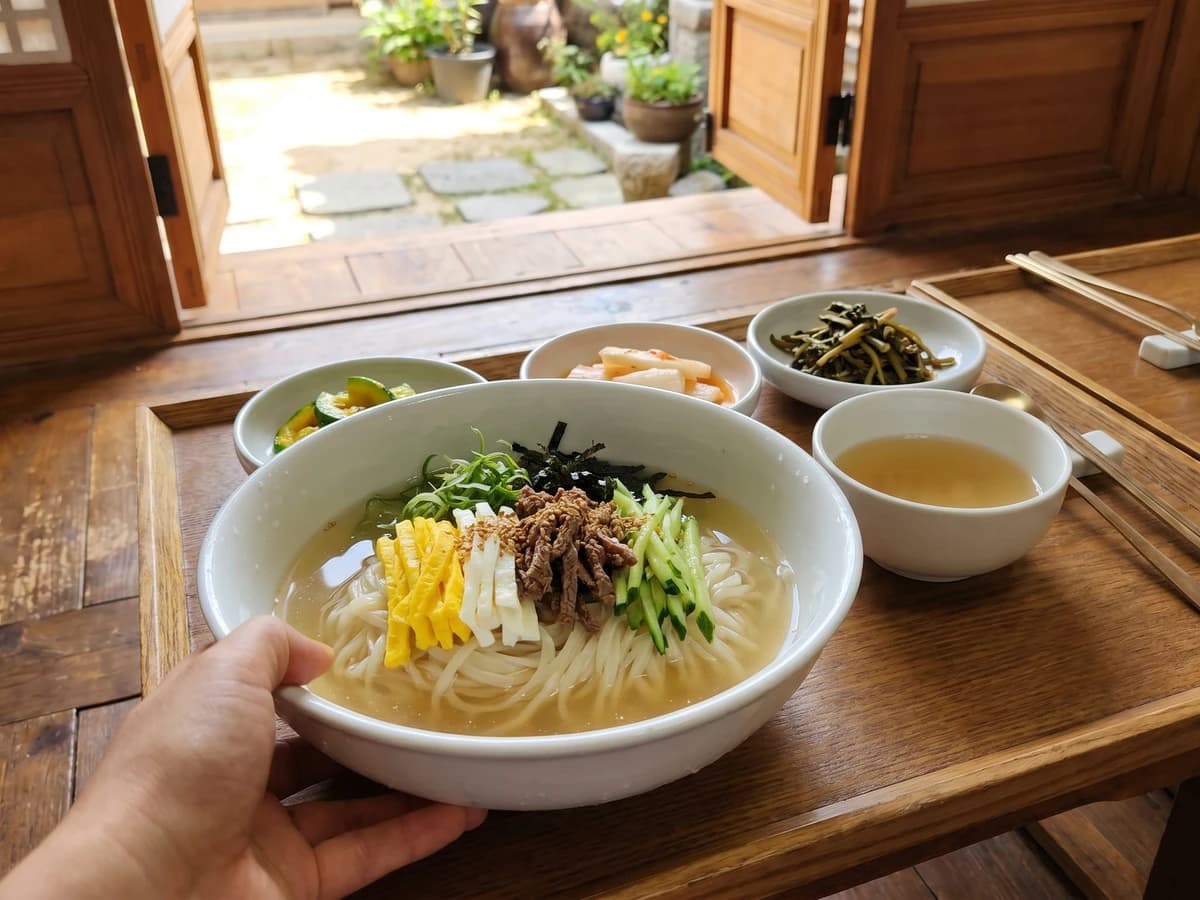
Andong's guest noodles, wheat and roasted soybean flour rolled thin, boiled and rinsed cold, then set in a clear chilled anchovy broth with careful strips of beef, egg, and cucumber.

Chef Jeong-sun
Andong's ritual-table rice served on an ordinary day: separate soy-sesame namul, warm rice, and clear radish soup, mixed without gochujang so every vegetable keeps its own voice.