Culinary Explorer
A cooking platform built around craft, culture, and the stories behind what we eat.
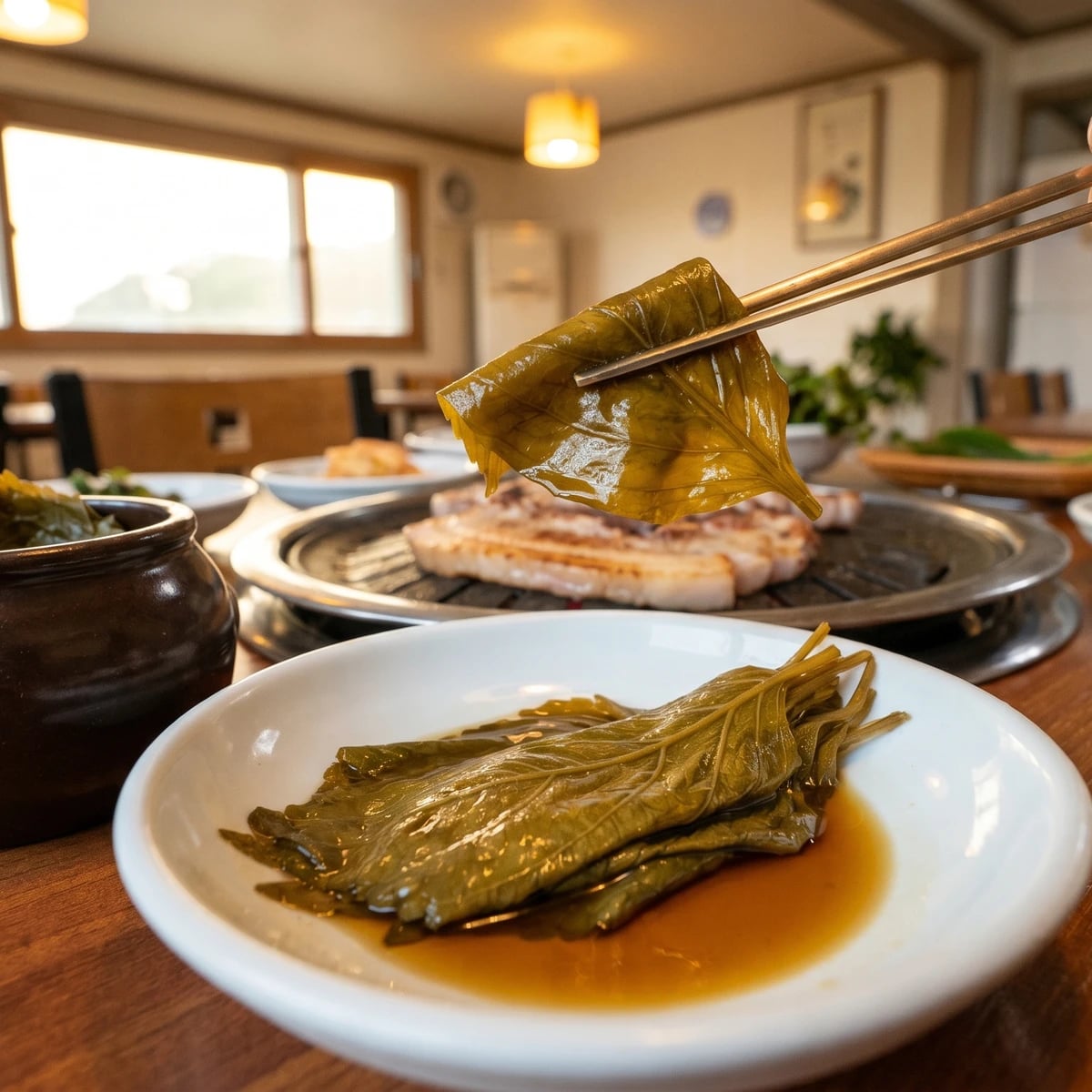
Myeongi-jangajji (Pickled Mountain Garlic)
Created by Chef Jeong-sun
Young mountain garlic leaves folded into a soy-vinegar brine, mellowed until their sharp green bite becomes the leaf you want around grilled pork, rice, and a full table.
Myeongi belongs to the spring market. You see the leaves for a short time, broad and green, stacked in damp bundles from Ulleungdo or the high mountains, and then the season closes. Cook the month you're standing in. If it isn't spring and the leaves are tough or tired, make kkaennip-jangajji (pickled perilla leaves) instead and wait for myeongi to come back honestly.
This jangajji lives or dies by dilution. The leaves must be washed because mountain greens carry grit, then dried because every drop of water weakens the soy-vinegar brine. The first hot pour wilts the leaves and drives the brine into them. The next day you boil the brine again because the leaves have given up their own water. That second boil is not fussiness. It is how the pickle stays clean and clear.
Notebook 41 says 500g leaves, not one basket, and 2/3 cup sugar, not a vague sweet handful. Myeongi should still taste like mountain garlic: mineral, green, faintly sharp under the soy. At the table, one leaf wraps around samgyeopsal (grilled pork belly) and suddenly you need less raw garlic, less ssamjang, less noise. Let it taste like itself.
Ingredients
young myeongi (mountain garlic) leaves
Quantity
500g, about 50 to 80 leaves
trimmed, washed, and dried very well
Korean brewed soy sauce (yangjo ganjang or jin ganjang)
Quantity
1 1/2 cups
water
Quantity
1 1/2 cups
| Ingredient | Quantity |
|---|---|
| young myeongi (mountain garlic) leavestrimmed, washed, and dried very well | 500g, about 50 to 80 leaves |
| Korean brewed soy sauce (yangjo ganjang or jin ganjang) | 1 1/2 cups |
| water | 1 1/2 cups |
Where cooking meets culture.
Culinary guides, cultural storytelling, and the editorial depth that makes cooking meaningful.
Discover Culinary Explorer