
Chef Jeong-sun
Agwi-jjim (Braised Monkfish with Bean Sprouts)
Firm monkfish buried under crisp soybean sprouts, minari, and a red gochugaru sauce thickened at the end; Masan's market dish asks for heat, timing, and a steady hand.
A cooking platform built around craft, culture, and the stories behind what we eat.

Created by
Chewy buckwheat noodles in clear beef and dongchimi broth, served nearly slushed, with radish, pear, cucumber, egg, and the restraint that lets cold sharpen instead of flatten the bowl.
Mul-naengmyeon lives or dies before the noodles boil. It lives in the broth, and in how cold you have the courage to serve it. My teacher, Master Seong-nyeo, made me taste the same broth three times: warm, cold, and nearly slushed. Warm, it seemed too sharp. In the bowl, with noodles and ice, it finally spoke clearly.
This is a Northern noodle that now sits on summer tables all over Korea, especially when heat makes rice feel too heavy. It asks for patience more than difficulty: make the broth ahead, skim the fat, chill the bowls, cut the radish thin, and rinse the noodles harder than you think proper. Starch left on the noodles will cloud the bowl and dull the bite.
Do not load it with sugar or mustard until you cannot taste buckwheat, beef, and dongchimi. Season the broth a little sharper and saltier than drinking broth, because cold mutes flavor. 손맛 is real; I measure it anyway. Write down the vinegar and salt after your first good bowl, because your dongchimi will never be the same twice.
Dongguksesigi, an 1849 book of late Joseon seasonal customs, records naengmyeon as a winter food of buckwheat noodles served in cold dongchimi broth. The Korean War carried northern noodle shops south with refugees from Pyongyang and Hamhung, and the dish that once belonged to icy winters became a summer standard across Korea. Pyongyang mul-naengmyeon remains mild and broth-centered, while Hamhung is better known for chewier starch noodles and spicy bibim or hoe naengmyeon.
Quantity
450g
rinsed
Quantity
for blanching, plus 8 cups cold water
Quantity
1/2 medium
unpeeled and rinsed
Quantity
1
trimmed
Quantity
4 cloves
lightly crushed
Quantity
1 slice, about 5g
Quantity
150g
peeled and cut into 2 thick pieces
Quantity
4 cups
from the cooked broth
Quantity
2 cups
strained and cold
Quantity
2 tablespoons, plus more to serve
Quantity
2 teaspoons
Quantity
2 teaspoons
Quantity
1 teaspoon, plus more as needed
Quantity
250g
peeled and sliced 2 mm thick
Quantity
1 teaspoon
Quantity
2 tablespoons
Quantity
1 tablespoon
Quantity
1/4 teaspoon
Quantity
4 portions, about 560g fresh-frozen or 360 to 400g dried
Quantity
1/2
julienned
Quantity
1/2
peeled, cored, and sliced thin
Quantity
2
halved
Quantity
thin slices
chilled
Quantity
to serve
| Ingredient | Quantity |
|---|---|
| beef brisket or shankrinsed | 450g |
| water | for blanching, plus 8 cups cold water |
| onionunpeeled and rinsed | 1/2 medium |
| scalliontrimmed | 1 |
| garliclightly crushed | 4 cloves |
| fresh ginger | 1 slice, about 5g |
| Korean radish (mu), for brothpeeled and cut into 2 thick pieces | 150g |
| strained chilled beef brothfrom the cooked broth | 4 cups |
| dongchimi (radish water kimchi) brinestrained and cold | 2 cups |
| rice vinegar | 2 tablespoons, plus more to serve |
| sugar | 2 teaspoons |
| soup soy sauce (guk-ganjang) | 2 teaspoons |
| kosher salt | 1 teaspoon, plus more as needed |
| Korean radish (mu), for picklepeeled and sliced 2 mm thick | 250g |
| kosher salt, for radish pickle | 1 teaspoon |
| rice vinegar, for radish pickle | 2 tablespoons |
| sugar, for radish pickle | 1 tablespoon |
| gochugaru (Korean chili flakes) (optional) | 1/4 teaspoon |
| naengmyeon noodles | 4 portions, about 560g fresh-frozen or 360 to 400g dried |
| English cucumberjulienned | 1/2 |
| Korean pear or Asian pearpeeled, cored, and sliced thin | 1/2 |
| hard-boiled eggshalved | 2 |
| cooked beef from the brothchilled | thin slices |
| Korean mustard (yeongyeoja) and rice vinegar (optional) | to serve |
Put the beef in a bowl of cold water for 20 minutes, changing the water once if it darkens. Drain it, cover it with fresh water in a pot, and boil 5 minutes. Discard that water, rinse the beef, and wash the pot. This first boil is not wasteful; it gives you a cleaner broth instead of a cloudy one.
Return the beef to the clean pot with 8 cups cold water, the onion, scallion, garlic, ginger, and 150g radish. Bring it just to a boil, skim the surface, then lower the heat and simmer gently for 75 to 90 minutes, until the beef is tender but not falling apart. Do not let it roll hard. A rough boil breaks the broth cloudy, and naengmyeon has nowhere to hide that mistake.
Lift out the beef, wrap it, and refrigerate it for slicing. Strain the broth through a fine sieve, cool it in an ice bath for 20 minutes, then refrigerate at least 6 hours or overnight. Lift off the solid fat once it firms. Do not leave broth cooling on the counter for half the afternoon; food is respect for life, and that includes keeping it cold when it should be cold.
Toss the 250g sliced radish with 1 teaspoon kosher salt and let it stand 10 minutes. Drain the liquid, but do not rinse away all the seasoning. Toss with 2 tablespoons rice vinegar, 1 tablespoon sugar, and the gochugaru if using. Chill at least 20 minutes. The slices must be thin because this pickle is a topping, not a side dish trying to take over the bowl.
Measure 4 cups chilled beef broth into a bowl. Add 2 cups strained dongchimi brine, 2 tablespoons rice vinegar, 2 teaspoons sugar, 2 teaspoons soup soy sauce, and 1 teaspoon kosher salt. Stir until the salt and sugar dissolve, then taste. It should be cleaner, sharper, and a little saltier than you would drink alone, because noodles and cold will soften every edge.
Pour 1 1/2 cups of the seasoned broth into a shallow metal pan and freeze 1 to 2 hours, scraping once or twice, until it becomes loose slush. Keep the remaining broth very cold. Put the stainless serving bowls in the freezer for 20 minutes. Plain ice dilutes the bowl; broth slush keeps the seasoning honest.
Slice the chilled beef thinly across the grain. Keep the pickled radish, cucumber, pear, egg halves, and beef cold and within reach before you boil the noodles. Once the noodles are cooked, the dish moves quickly. Naengmyeon waits for no one, not even a cook looking for the pear.
Bring a large pot of water to a strong boil. If using fresh-frozen noodles, loosen them gently under cold running water first so the strands separate. Tangled noodles cook unevenly, and you cannot fix a hard clump after it has gone into the bowl.
Add the noodles and stir immediately. Fresh-frozen naengmyeon usually takes 40 to 60 seconds; dried noodles usually take 3 to 4 minutes. Follow the package, but taste one strand before draining. It should be springy and cooked through, with no raw center. Overcooked naengmyeon turns gummy before you can apologize to it.
Drain the noodles and rinse under cold running water, rubbing the strands firmly between your hands for 1 to 2 minutes, until they are cold and the rinse water runs clear. Drain hard. This washing removes surface starch, tightens the chew, and keeps the broth clear. Skip it and you have cold noodle soup, not mul-naengmyeon.
Divide the noodles among the chilled stainless bowls and coil them neatly. Pour the cold broth around the noodles and scrape broth slush over the top. Arrange pickled radish, cucumber, pear, sliced beef, and half an egg on each bowl. Serve at once with Korean mustard, extra vinegar, and kitchen scissors. Taste the broth first, then sharpen your own bowl.
1 serving (about 650g)
Culinary guides, cultural storytelling, and the editorial depth that makes cooking meaningful.
Discover Culinary ExplorerChef Jeong-sun
Firm monkfish buried under crisp soybean sprouts, minari, and a red gochugaru sauce thickened at the end; Masan's market dish asks for heat, timing, and a steady hand.

Chef Jeong-sun
A quick Korean rice bowl built on contrast: warm rice, cold popping flying-fish roe, chopped vegetables, gim, sesame oil, and the crisp rice bottom a hot stone bowl gives you.
Chef Jeong-sun
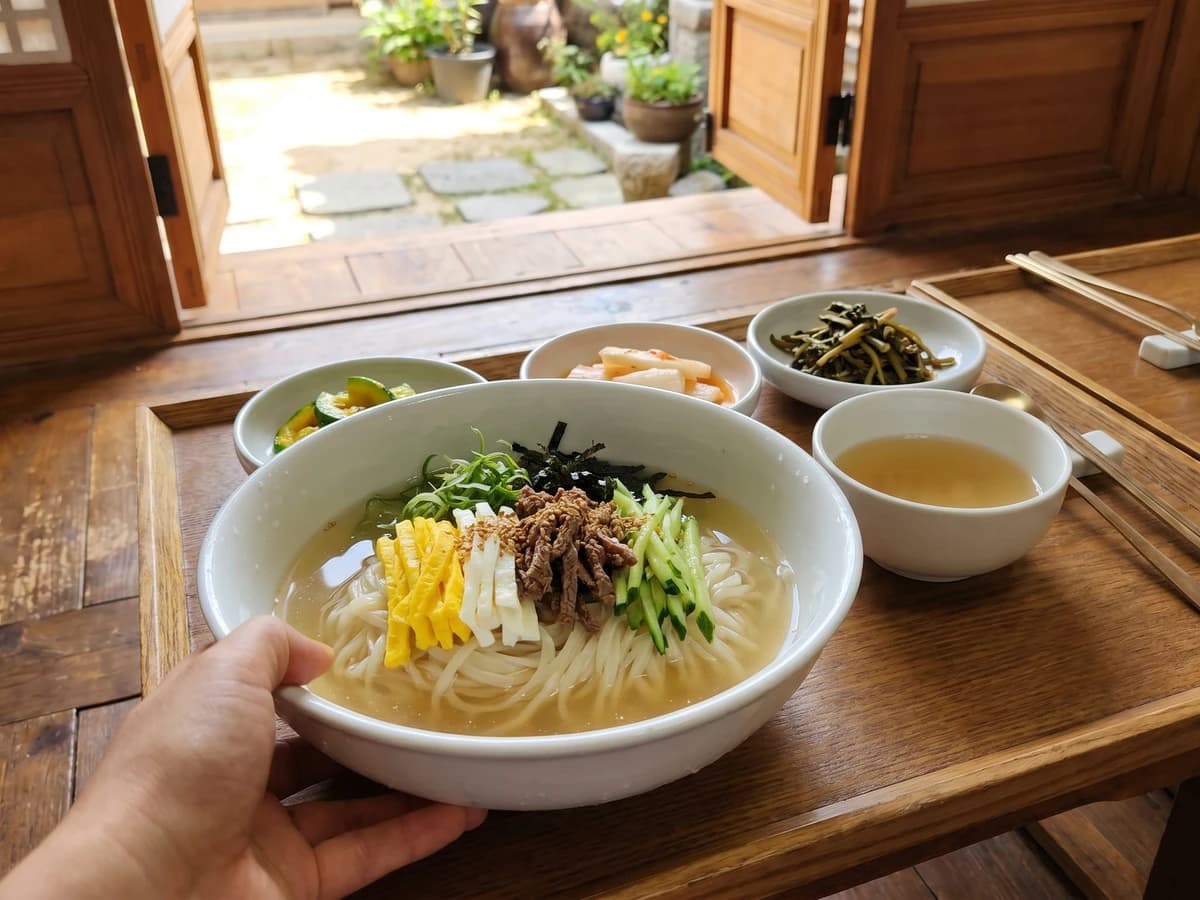
Andong's guest noodles, wheat and roasted soybean flour rolled thin, boiled and rinsed cold, then set in a clear chilled anchovy broth with careful strips of beef, egg, and cucumber.

Chef Jeong-sun
Andong's ritual-table rice served on an ordinary day: separate soy-sesame namul, warm rice, and clear radish soup, mixed without gochujang so every vegetable keeps its own voice.