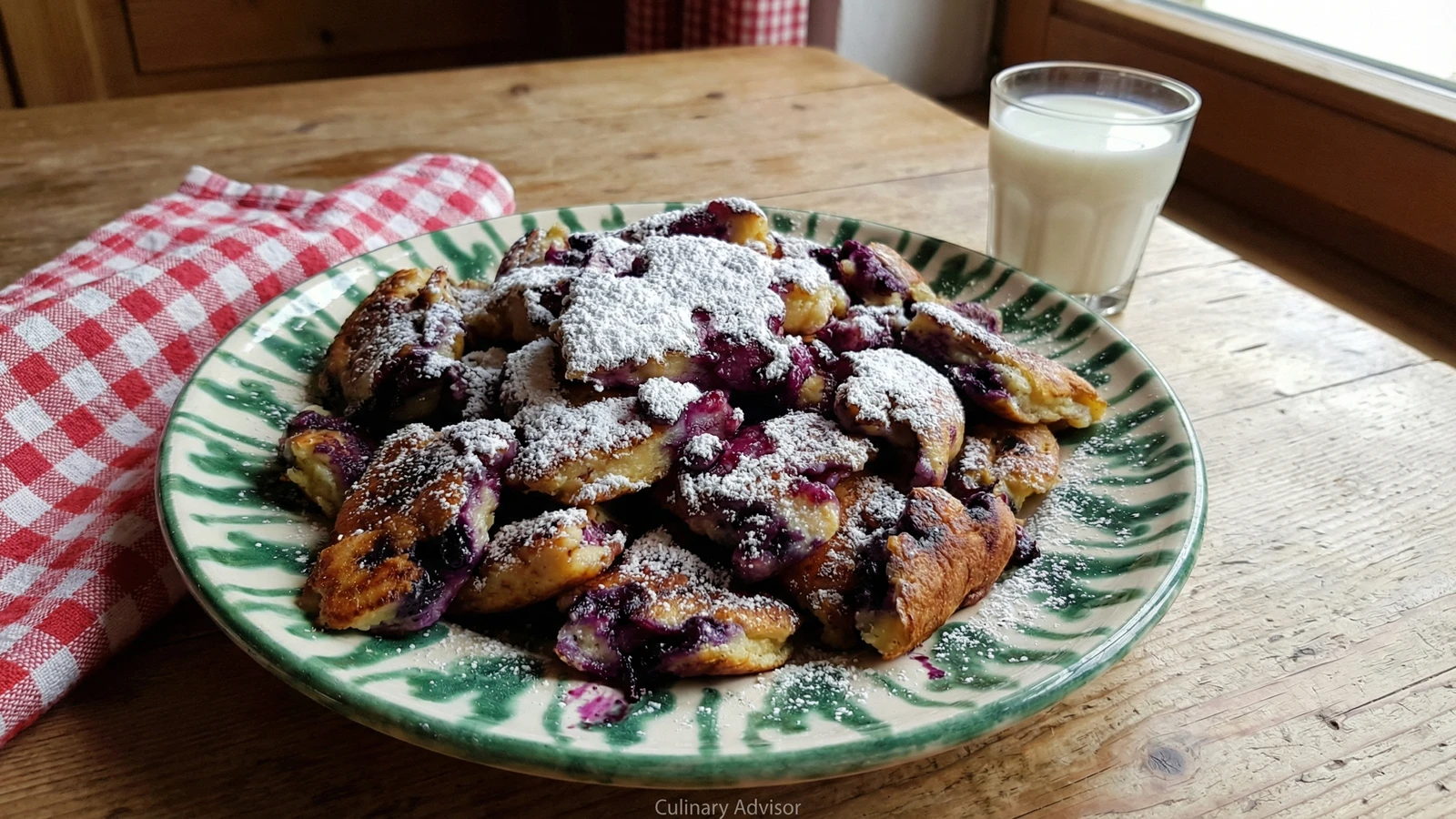
Tyrolean mountain hut cooking at its best: a dense, buttery batter torn apart with wild bilberries that stain everything purple and taste like the Alps in July.
Desserts
Austrian
Special Occasion
Comfort Food
15 min
Active Time
20 min cook•35 min total
Yield2 servings
The first time I ate Moosbeermiasl I was eleven years old, sitting on a wooden bench outside an Almhütte above Innsbruck. Gretel had taken my grandmother Eva and me on one of their annual pilgrimages through Austria, and that summer we went walking in Tyrol. The hut cook made it in a blackened iron pan over a wood fire. The batter was thick and heavy, nothing like the airy Kaiserschmarrn I knew from Eva's kitchen in Kent. It was packed with wild bilberries that had burst in the heat and turned the whole thing a deep, almost violet purple. She tore it apart with a wooden spoon, dusted it with sugar, and set it down on the table with a glass of cold milk. I ate the entire portion and asked for more.
Moosbeermiasl is not Kaiserschmarrn. I want to be clear about that because people see the word Schmarrn and expect something light and pillowy. This is mountain food, Almküche, the cooking of the high pastures. The batter has no separated eggs, no whipped whites, no air folded in. You mix flour, eggs, milk, and sugar together into something thick and almost porridge-like, stir in handfuls of bilberries, and fry the whole mass in far too much butter until it forms a crust on the bottom. Then you tear it. The pieces are dense and chewy where the batter held together, crisp and caramelized where the butter found the edges, and stained purple everywhere the berries touched.
Tyrolean cooks call the berries Moosbeeren. In standard German they're Heidelbeeren, and in English you'd say bilberries or wild blueberries. They're smaller, darker, and more intensely flavored than cultivated blueberries, and they stain your fingers, your lips, and your kitchen cloth a colour that doesn't come out in the wash. If you can find real wild bilberries, use them. If you can't, use the best fresh blueberries available and press a few of them with a fork before adding them to the batter so they release their juice. The colour won't be quite the same but the spirit of the dish will survive.
This is the kind of cooking that doesn't translate well to Instagram. It looks rough and purple and torn apart. It tastes like standing on a mountain with butter on your chin and not caring who sees you lick the plate.
Moosbeermiasl belongs to the Almküche tradition of Tyrol, the cooking done in high-altitude huts during the summer months when farmers moved their cattle to Alpine pastures. The dish predates tourism in the Alps by centuries and was originally made with whatever the Sennerin (dairymaid) had on hand: flour, eggs, butter from the morning milking, and wild bilberries gathered from the slopes around the hut. The name varies across Tyrolean valleys. In some areas it's Moosbeernockn, in others Schwarzbeermuas. The word Miasl comes from the Tyrolean dialect term for Mus, a thick, cooked mass, which tells you everything about the intended texture.
The technique, the tradition, and the story behind every dish.
cold milk or Schlagobers (whipped cream) (optional)
Quantity
for serving
Ingredient
Quantity
plain flour
200g
eggs
3 large
whole milk
150ml
granulated sugar
30g
vanilla sugar (Vanillezucker)
1 teaspoon
salt
pinch
fresh bilberries or wild blueberries (Moosbeeren)
300g
unsalted butter
60g
powdered sugar
for dusting
cold milk or Schlagobers (whipped cream) (optional)
for serving
Equipment Needed
•Heavy cast-iron skillet or carbon steel pan (26-28cm)
•Wooden spatula or two sturdy forks for tearing
•Large mixing bowl
Instructions
1
Make the batter
Whisk together the eggs, sugar, Vanillezucker, and salt in a large bowl until combined. Add the flour and milk and stir with a wooden spoon until you have a thick, heavy batter. This is not a delicate crepe batter. It should be dense and reluctant to pour, closer to thick porridge than pancake mix. A few small lumps are fine. The batter's thickness is what gives Moosbeermiasl its characteristic chew, so resist the urge to thin it out with more milk.
If using cultivated blueberries instead of wild bilberries, press about a third of them with a fork before stirring them in. This releases juice into the batter and gets you closer to the deep purple stain that real Moosbeeren give.
2
Fold in the berries
Wash the bilberries gently and pat them dry. Fold them into the batter with a spatula. Don't be precious about it, but don't crush them all either. Some will burst during cooking and that's what you want. The batter should look crowded with berries. If it doesn't, you haven't used enough.
3
Fry the Miasl
Melt half the butter in a heavy pan over medium heat. A cast-iron skillet is ideal here. When the butter foams and the foam begins to settle, pour in the batter and spread it roughly with a spatula. It won't flow on its own because the batter is too thick. That's correct. Let it cook undisturbed for four to five minutes. The bottom will form a golden crust while the top stays soft. You'll hear the butter sizzling at the edges. If the pan starts to smell like browning butter, reduce the heat slightly. Burnt butter is the only thing that can ruin this dish.
Don't use a non-stick pan if you can help it. You want the batter to form a proper crust against the hot surface. Cast iron or heavy carbon steel gives you that contact and that colour.
4
Turn and tear
Using a spatula, flip the Miasl in rough sections. It doesn't need to turn in one piece. Once the underside has some colour on it too, start tearing the mass apart with two forks or a wooden spatula into thick, ragged pieces. These should be bigger and chunkier than Kaiserschmarrn pieces, roughly the size of a walnut or larger. Some will have a crisp buttery crust on one side and soft purple batter on the other. That contrast is exactly what you're after.
5
Caramelize in butter
Add the remaining butter to the pan and let it melt around the torn pieces. Sprinkle a tablespoon of sugar over everything. Toss the pieces gently in the butter for another two to three minutes, letting the edges crisp and the sugar caramelize into golden-brown patches. The berries that have burst will create sticky, jammy spots where they meet the hot butter. Your kitchen will smell like a mountain morning and your pan will be stained purple. Accept both.
Gretel always said the last minute in the pan is where Schmarrn dishes go from good to wonderful. Don't pull it too early. Let the butter and sugar do their work.
6
Dust and serve
Pile the torn pieces onto a warm plate. Dust generously with powdered sugar. Serve immediately with a glass of cold milk on the side if you want the Alpine hut experience, or with a spoonful of unsweetened Schlagobers if you're closer to the Kaffeehaus end of the spectrum. Both are correct. Mahlzeit!
Chef Tips
•Wild bilberries have a short season, roughly July through August in the Alps. If you can get them fresh, make this dish immediately and don't waste a single one. If you're outside that window, frozen wild bilberries from a Scandinavian or Eastern European supplier work well. Don't thaw them before adding to the batter. They'll release less juice during mixing and more during cooking, which is what you want.
•The batter should feel too thick. If it pours easily off your spoon, you've added too much milk and you'll end up with something closer to Kaiserschmarrn than Moosbeermiasl. The dense, heavy texture is the whole identity of the dish. Trust it.
•Serve this to two people, not four. Moosbeermiasl is a Hauptspeise in the mountains, not a dainty dessert. Tyrolean farmers ate this as a full meal after a morning of work on the Alm. Honor the portion size.
•Your pan, your spatula, your cloth, and possibly your fingertips will be purple after making this. Real bilberries stain everything they touch. This is not a flaw. It's proof you used the right ingredient.
Advance Preparation
•The batter can be mixed up to one hour ahead and refrigerated, but do not fold in the berries until you're ready to cook. They'll bleed into the batter and make it watery.
•Moosbeermiasl cannot be made ahead or reheated. It must go from pan to plate to mouth without stopping. The crisp edges soften within minutes.
Frequently Asked Questions
Nutrition Information
1 serving (about 400g)
Calories
905 calories
Total Fat
35 g
Saturated Fat
19 g
Trans Fat
1 g
Unsaturated Fat
12 g
Cholesterol
350 mg
Sodium
345 mg
Total Carbohydrates
124 g
Dietary Fiber
6 g
Sugars
41 g
Protein
23 g
Where cooking meets culture.
Culinary guides, cultural storytelling, and the editorial depth that makes cooking meaningful.