
Chef Elsa
Almjause (Alpine Hut Snack Board)
A wooden board loaded with mountain cheese, juniper-smoked Speck, air-dried Hauswürstel, handmade Liptauer, fresh Kren, and thick-cut Bauernbrot, the way Austrian Almhütten have fed hikers for generations.
A cooking platform built around craft, culture, and the stories behind what we eat.
Created by
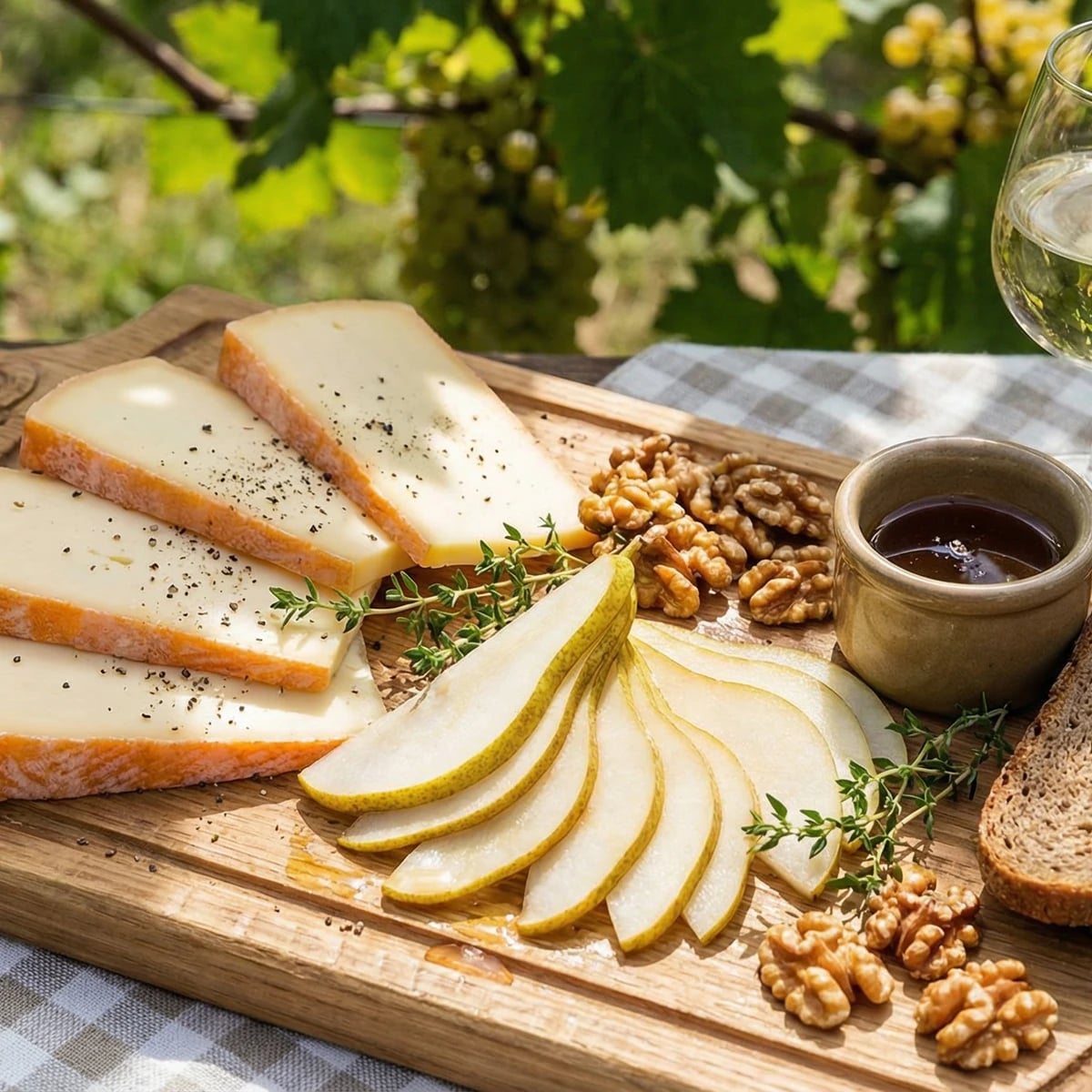
Upper Austria's boldest washed-rind cheese, sliced thick and served on a wooden Brettl with ripe pear, toasted walnuts, and dark honey, the way they eat it in the Salzkammergut.
Every autumn when I was a girl, Gretel and my grandmother Eva took me to the Salzkammergut. We'd stop in towns along the lakes, and somewhere between Mondsee and St. Wolfgang there was always a Gasthaus where they served the local cheese on a wooden board with whatever fruit was ripe. Gretel would order it before we'd even sat down. The cheese came out in thick slices, the rind washed to a sticky orange, the paste inside pale and springy with a smell that announced itself across the table. Pear slices fanned beside it, a small jar of dark honey, a handful of walnuts. That was the whole plate. That was enough.
Mondseer is not a polite cheese. It has a washed rind, which means the cheesemaker bathes it in brine as it ages, encouraging bacteria that give it a pungent, almost meaty intensity on the outside and a smooth, buttery depth within. The flavor sits somewhere between a young Gruyere and a farmhouse Munster, with a sweet-spicy bite that catches you at the back of the tongue. It needs something to balance that strength, and a ripe pear does the job beautifully. The fruit is cool, sweet, and juicy where the cheese is warm-flavored and bold. Walnuts bring a bitter crunch that ties the two together.
This is a Jause, an Austrian between-meals spread that can also open a dinner or close a long evening. It doesn't need technique. It needs good ingredients, a sharp knife, and the confidence to put three things on a board and call it done. Austrian cooking is simple food done well, and this is that principle in its purest form.
Mondseer cheese takes its name from the town of Mondsee in Upper Austria's Salzkammergut, where washed-rind cheesemaking has been practiced since at least the 19th century. The Benedictine monastery at Mondsee, founded in 748 and one of the oldest in Austria, is often credited with establishing the dairy traditions of the region, though the specific washed-rind style developed later among local Sennereien (small alpine dairies). Today Mondseer carries an Austrian geographical designation, and the cheese can only bear the name if produced in the defined lake district area of Upper Austria.
Quantity
300g
at room temperature
Quantity
2
Quantity
1 tablespoon
Quantity
80g
Quantity
3 tablespoons
Quantity
to taste
freshly cracked
Quantity
small bunch
Quantity
for serving
| Ingredient | Quantity |
|---|---|
| Mondseer cheeseat room temperature | 300g |
| ripe pears (Williams or Bosc) | 2 |
| lemon juice | 1 tablespoon |
| walnut halves | 80g |
| dark honey (chestnut or forest honey) | 3 tablespoons |
| black pepperfreshly cracked | to taste |
| fresh thyme (optional) | small bunch |
| dark rye bread (Schwarzbrot) | for serving |
Take the Mondseer out of the fridge at least one hour before you plan to serve it. This is the single most important step. Cold cheese is muted cheese. You lose half the flavor and all of the texture when you serve it straight from the refrigerator. At room temperature, the paste softens and becomes supple, almost creamy near the rind, and the aroma opens up into something complex and inviting. Set it on a plate, cover it loosely with a clean cloth, and leave it alone.
Spread the walnut halves in a dry pan over medium-low heat. Shake the pan every thirty seconds. Watch them carefully. Walnuts go from toasted to burnt in the time it takes to check your phone, and burnt walnuts taste like regret. You want them fragrant and just starting to darken, about three to four minutes. Tip them onto a plate immediately. The residual heat of the pan will keep cooking them if you leave them sitting there.
Cut the pears in half lengthwise, core them, and slice each half into thin wedges, about half a centimeter thick. Toss gently with lemon juice. The lemon isn't there for flavor, it's there to keep the pear from turning brown before it reaches the table. Choose pears that are ripe but still hold their shape. If they're soft enough to mash with your thumb, they're too ripe for this. You want a clean bite that gives way to sweetness, not something that collapses on the board.
Cut the Mondseer into slices about a centimeter thick. Leave the rind on. The rind is edible and it's where the strongest flavor lives. Some people prefer to cut it off, and that's their business, but I always serve it intact so everyone can decide for themselves. A good sharp knife, wiped clean between cuts, keeps the slices neat. The cheese may stick a little. That's normal for a washed rind.
Arrange the cheese slices on one side of a wooden board, fanning them so each piece is easy to pick up. Lay the pear wedges alongside, slightly overlapping. Scatter the toasted walnuts in the gaps. Drizzle the honey into a small crock or ramekin and set it on the board with a small spoon. If you have fresh thyme, tuck a few sprigs in among the cheese. Crack black pepper directly over the cheese slices, just a few turns. Serve the Schwarzbrot on the side, sliced thick.
Bring the board to the table with a glass of Gruner Veltliner or a dry Austrian cider. Tell your guests to build their own bites: a slice of cheese on dark bread, a wedge of pear on top, a drizzle of honey, a walnut pressed into the whole thing. Each bite should have all four elements. The sweet, the sharp, the bitter, the rich. That's the whole point. Mahlzeit!
1 serving (about 250g)
Culinary guides, cultural storytelling, and the editorial depth that makes cooking meaningful.
Discover Culinary Explorer
Chef Elsa
A wooden board loaded with mountain cheese, juniper-smoked Speck, air-dried Hauswürstel, handmade Liptauer, fresh Kren, and thick-cut Bauernbrot, the way Austrian Almhütten have fed hikers for generations.

Chef Elsa
Dark, spiced, and wickedly good: Blunzn mashed with onion, mustard, and marjoram into the kind of spread that disappears first from every Heuriger Brettl, scooped up on torn hunks of dark bread.

Chef Elsa
A silky potato and sour cream spread with raw onion and paprika, piled onto dark rye bread the way they serve it at every Heuriger in Lower Austria. No cheese, despite the name. Just good potatoes and honest cooking.

Chef Elsa
A proper Carinthian Brettljause built around PDO Gailtaler Almkäse, nutty raw-milk alpine cheese served with Speck, dark Bauernbrot, pickles, fresh horseradish, and everything you need for an afternoon on an Almhütte terrace.