Chef Lupita
Acúmara Tatemada al Comal
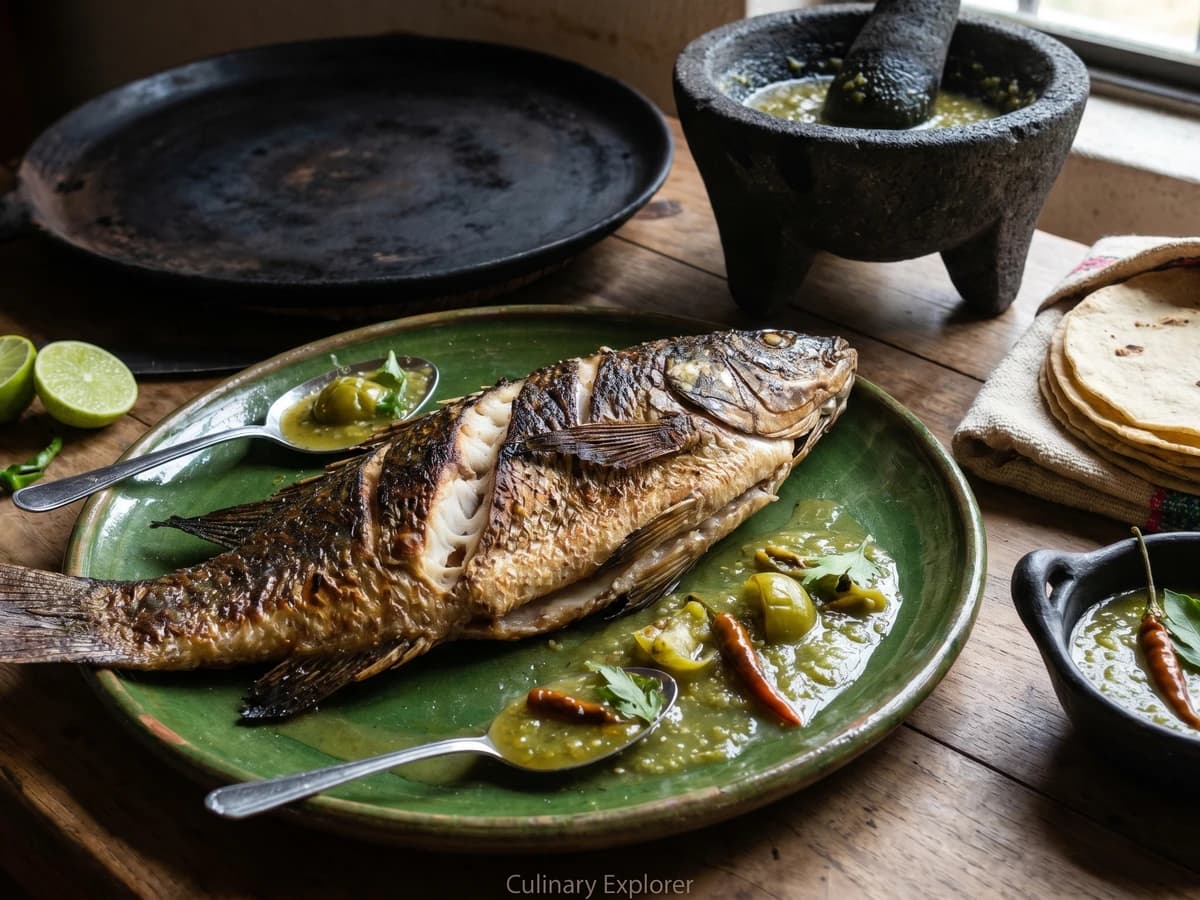
Michoacán's Lake Pátzcuaro acúmara, a whole kurucha from the lago tatemada on a comal de leña and served with chile perón atápakua, corn tortillas, and P'urhépecha discipline.
A cooking platform built around craft, culture, and the stories behind what we eat.

Created by
Michoacán's Meseta P'urhépecha mole rojo, lamb braised until tender in toasted ancho, guajillo, pasilla, sesame, and manteca, the fiesta pot Zacán's cocineras serve with rice and guacamole.
Michoacán, Meseta P'urhépecha, Zacán. Put the dish on the map first. This mole rojo con borrego belongs to the fiesta table of Zacán, where the cocineras tradicionales cook for patron saint days, weddings, cargos, and the kind of family obligation that feeds more people than the cook counted. It is served with rice and guacamole, in barro, with corn tortillas nearby. Cada estado, su propia cocina.
The color comes from chile ancho, chile guajillo, and chile pasilla toasted on the comal until their oils wake up. The body comes from sesame, peanuts, almonds, bolillo, tortilla, and the slow frying of the paste in manteca de cerdo. The lamb is not an afterthought. Bone-in borrego gives the broth its weight, and that broth becomes the liquid of the mole. If you boil meat in water and pour jarred sauce over it, do not call it this dish. No me vengas con atajos.
I learned this style by watching women in Zacán work around a fogón, the way other P'urhépecha cooks work in Janitzio with kurucha from the lago, in Cocucho with clay and fire, in Cherán with monte ingredients, and in Uruapan where market baskets tell you the season before anyone speaks. P'urhépecha is a language isolate, and the kitchen carries that independence. Milpa gives the corn tortilla and chiles. Monte gives nurite, avocado leaf, mushrooms, and quelites. Lago gives acúmara and kurucha, though not to this pot. Know the map and the recipe starts making sense.
This is not chocolate sauce. A little chocolate de metate rounds the bitterness, nothing more. The work is in the chiles, the broth, the frying, and the patience. La cocina no es decoración, es trabajo. Saber cocinar es saber vivir.
Before Spanish rule, the Cazonci governed a P'urhépecha state whose food economy moved between milpa, monte, and lago: corn, beans, squash, chiles, quelites, mushrooms, kurucha, and acúmara. Sheep arrived with the Spanish in the 16th century, and borrego entered ceremonial cooking through older P'urhépecha sauce traditions such as atápakua, thickened with ground seeds, corn, and chiles. The 2010 UNESCO inscription of Traditional Mexican Cuisine used the Michoacán paradigm, with cocineras tradicionales from Zacán, Janitzio, Cocucho, Cherán, and Uruapan serving as living transmission, not museum display.
Quantity
5 pounds
cut into 2 1/2-inch pieces
Quantity
1 pound
for broth body
Quantity
2 tablespoons, divided, plus more to taste
Quantity
12 cups, plus more as needed
Quantity
1 large
halved
Quantity
1
halved crosswise
Quantity
3
Quantity
3 sprigs
Quantity
2 sprigs
Quantity
2
lightly toasted on a comal
Quantity
1 small sprig nurite or 2 sprigs epazote
rinsed
Quantity
8
wiped clean, stemmed, and seeded
Quantity
8
wiped clean, stemmed, and seeded
Quantity
4
wiped clean, stemmed, and seeded
Quantity
1/2 cup, divided
Quantity
1 medium
thickly sliced for the mole
Quantity
6
unpeeled
Quantity
4
ripe
Quantity
4
husked and rinsed
Quantity
3/4 cup, plus 2 tablespoons for finishing
Quantity
1/3 cup
Quantity
1/4 cup
Quantity
1/4 cup
Quantity
1
sliced
Quantity
2
torn
Quantity
1/2
peeled and sliced
Quantity
1 piece (2 inches)
Quantity
4
Quantity
8
Quantity
1 teaspoon
Quantity
1 teaspoon
Quantity
1 ounce
chopped
Quantity
1 teaspoon
only if needed
Quantity
for serving
Quantity
3
for guacamole
Quantity
1
finely chopped for guacamole
Quantity
2 tablespoons
finely chopped for guacamole
Quantity
2 tablespoons
chopped for guacamole
Quantity
2 tablespoons
for guacamole
Quantity
for serving
warmed
| Ingredient | Quantity |
|---|---|
| bone-in lamb shoulder or legcut into 2 1/2-inch pieces | 5 pounds |
| lamb neck bones or shanksfor broth body | 1 pound |
| kosher salt | 2 tablespoons, divided, plus more to taste |
| cold water | 12 cups, plus more as needed |
| white onionhalved | 1 large |
| head of garlichalved crosswise | 1 |
| bay leaves | 3 |
| fresh thyme | 3 sprigs |
| fresh marjoram | 2 sprigs |
| dried avocado leaveslightly toasted on a comal | 2 |
| fresh nurite or fresh epazote (optional)rinsed | 1 small sprig nurite or 2 sprigs epazote |
| dried chile anchowiped clean, stemmed, and seeded | 8 |
| dried chile guajillowiped clean, stemmed, and seeded | 8 |
| dried chile pasillawiped clean, stemmed, and seeded | 4 |
| manteca de cerdo | 1/2 cup, divided |
| white onionthickly sliced for the mole | 1 medium |
| garlic clovesunpeeled | 6 |
| Roma tomatoesripe | 4 |
| tomatilloshusked and rinsed | 4 |
| sesame seeds | 3/4 cup, plus 2 tablespoons for finishing |
| raw peanuts | 1/3 cup |
| blanched almonds | 1/4 cup |
| raisins | 1/4 cup |
| stale bolillosliced | 1 |
| day-old corn tortillastorn | 2 |
| ripe plantainpeeled and sliced | 1/2 |
| Mexican cinnamon stick | 1 piece (2 inches) |
| whole cloves | 4 |
| black peppercorns | 8 |
| cumin seeds | 1 teaspoon |
| dried Mexican oregano | 1 teaspoon |
| Mexican chocolate de metatechopped | 1 ounce |
| grated piloncillo (optional)only if needed | 1 teaspoon |
| cooked Mexican white rice (optional) | for serving |
| ripe avocadosfor guacamole | 3 |
| fresh chile serranofinely chopped for guacamole | 1 |
| white onionfinely chopped for guacamole | 2 tablespoons |
| fresh cilantrochopped for guacamole | 2 tablespoons |
| fresh lime juicefor guacamole | 2 tablespoons |
| hand-pressed corn tortillas (optional)warmed | for serving |
Pat the lamb pieces dry and season them with 1 tablespoon of the salt. Let them sit at room temperature for 30 minutes while you clean the chiles. Bone-in meat matters here. The bones give the broth body, and the broth is what carries the mole.
Place the lamb pieces, neck bones or shanks, cold water, halved onion, halved head of garlic, bay leaves, thyme, marjoram, toasted avocado leaves, and nurite or epazote if using in a heavy stockpot. Bring to a gentle simmer over medium heat. Skim the gray foam during the first 15 minutes. Lower the heat and cook partially covered for 2 1/2 to 3 hours, until the lamb is tender but not shredded. Lift the meat into a bowl, strain the broth, and reserve at least 8 cups.
Heat a dry comal over medium. Toast the chile ancho, chile guajillo, and chile pasilla separately, about 20 to 30 seconds per side for the ancho, 15 to 20 seconds for the guajillo, and 10 to 15 seconds for the pasilla. The skins should puff and darken slightly. They should not blacken. Put the toasted chiles in a bowl and cover with hot water for 20 minutes.
On the same comal, char the sliced onion, unpeeled garlic cloves, Roma tomatoes, and tomatillos. Turn them until the skins blister and the flesh softens. Peel the garlic after charring. This is where the mole gets depth before it ever touches the cazuela.
Melt 1/4 cup of the manteca in a wide skillet over medium heat. Fry the bolillo slices, torn tortillas, and plantain slices until golden, then remove them to a plate. In the same fat, fry the raisins just until they puff. Add the sesame seeds, peanuts, almonds, cinnamon, cloves, peppercorns, and cumin seeds, stirring until the sesame turns gold and the spices smell warm. Do not walk away. Seeds burn faster than pride.
Drain the soaked chiles. Blend them in batches with the charred vegetables, fried bread, tortillas, plantain, raisins, seeds, nuts, spices, dried Mexican oregano, and enough lamb broth to move the blades, about 4 cups total. Blend until the puree is completely smooth. A rough mole feels lazy in the mouth.
Pass the blended mole through a fine-mesh strainer into a bowl, pressing hard with a spoon. Discard the chile skins and seed bits left behind. This takes time. Do it anyway. Zacán's ceremonial mole should be thick and smooth, not gritty.
Melt the remaining 1/4 cup manteca in a deep black-clay cazuela, heavy clay pot, or Dutch oven over medium heat. Add the strained mole paste carefully. It will sputter. Stir with a wooden spoon for 18 to 22 minutes, scraping the bottom constantly, until the color deepens to brick red and small freckles of chile-stained fat show at the edges. La manteca es el sabor. This frying is the difference between raw chile paste and mole.
Add 4 cups of the reserved lamb broth and stir until the mole loosens. Add the chopped chocolate de metate and the remaining salt. Simmer gently for 45 minutes, stirring often, until the sauce coats the back of a spoon and the surface looks glossy. Taste. If the chiles are harsh, add the grated piloncillo, but only then. The chocolate is a shadow, not the dish. Mole is not chocolate sauce.
Add the cooked lamb pieces back to the cazuela. Simmer for 30 to 40 minutes, turning the meat gently so the mole clings to every surface. If the sauce gets too thick, add more lamb broth a half cup at a time. The final mole should move slowly when you drag the spoon through it, with enough body to sit beside rice without running all over the plate.
Toast the final 2 tablespoons sesame seeds until pale gold. Mash the avocados with the chopped serrano, chopped white onion, cilantro, lime juice, and salt to taste. Keep the guacamole direct. Warm the corn tortillas on the comal and have the rice ready. Flour tortillas are a northern wheat tradition. They do not belong on this Zacán table.
Rest the mole off the heat for 20 minutes before serving. Spoon the lamb and mole into a loza de barro cazuela from Capula or Tzintzuntzan, or a black-clay cazuela from Patamban if you have one. Scatter toasted sesame seeds over the top. Serve family-style with rice, guacamole, and warm corn tortillas. Recetas probadas y garantizadas.
1 serving (about 560g)
Culinary guides, cultural storytelling, and the editorial depth that makes cooking meaningful.
Discover Culinary ExplorerChef Lupita
Michoacán's Lake Pátzcuaro acúmara, a whole kurucha from the lago tatemada on a comal de leña and served with chile perón atápakua, corn tortillas, and P'urhépecha discipline.

Chef Lupita
Puebla's weekday adobo of pork shoulder braised in a thick guajillo and ancho sauce sharpened with vinegar, cumin, and clove. The deep red of a market spice stall, the dish a poblana cooks without thinking.

Chef Lupita
Loreto's pit-roasted clams, planted hinge-up in beach sand and tatemadas under a fast fire of dried romerillo brush, the resinous Baja desert shrub that gives this dish its smoke.

Chef Lupita
Oaxaca's eighth mole, the silky, almond-and-cinnamon almendrado, served over poached chicken. Mild, sweet, restrained, and a quiet rebuttal to anyone who thinks Mexican food has to be hot to be Mexican.