Chef Lupita
Acúmara Tatemada al Comal
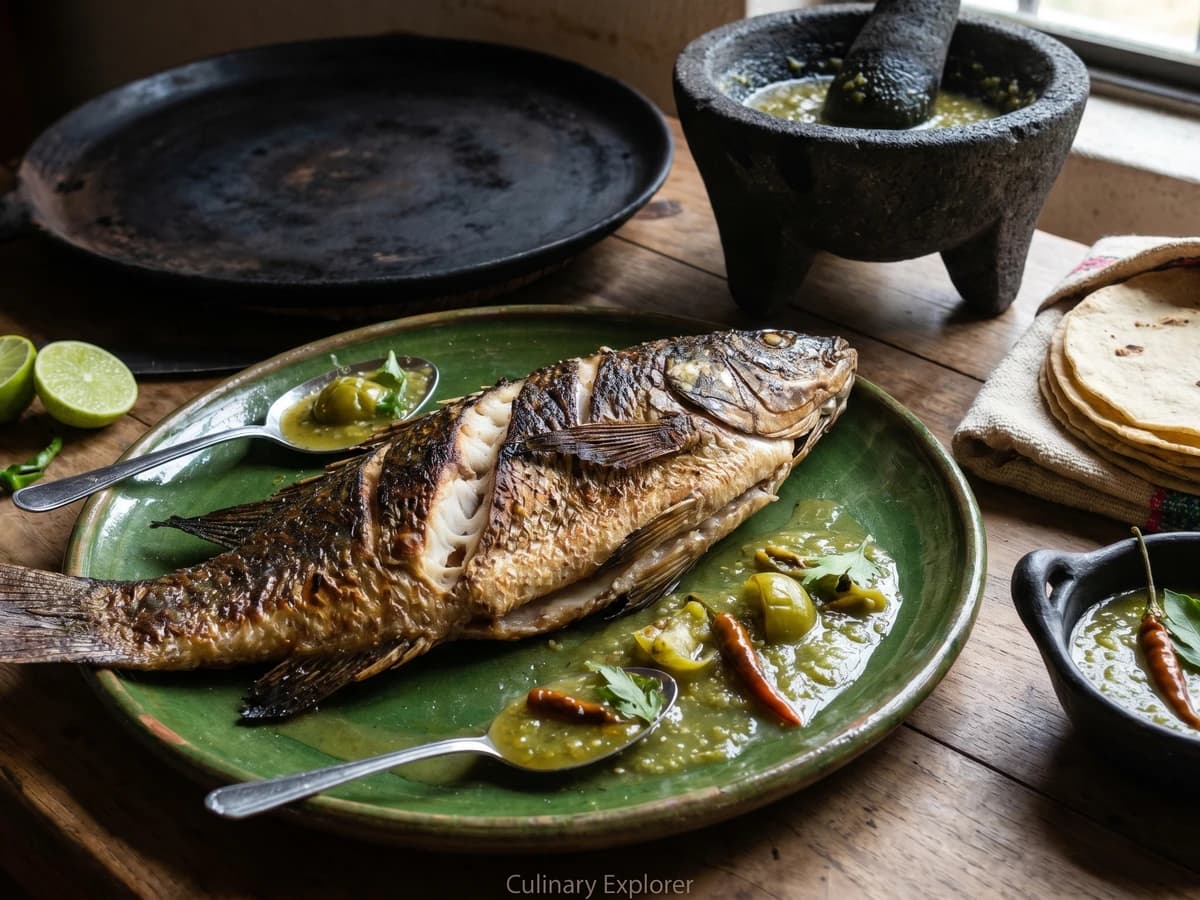
Michoacán's Lake Pátzcuaro acúmara, a whole kurucha from the lago tatemada on a comal de leña and served with chile perón atápakua, corn tortillas, and P'urhépecha discipline.
A cooking platform built around craft, culture, and the stories behind what we eat.

Created by
Guanajuato's Lerma corridor fish, scored to the bone, rubbed with garlic, serrano, and limón, then pan-fried whole until the fins turn crisp and the table smells like a Bajío river picnic.
Guanajuato, the southern Bajio along the Lerma River corridor from Acambaro and Salvatierra toward Salamanca, has its own fish register. People hear landlocked and think fishless. Wrong. The river, the canals, the presas, and the old lake at Yuriria have fed kitchens with mojarra, charales, carp, and whatever the water gave that week.
This dish belongs to the home cooks and roadside señoras who learned to fry freshwater fish without burying it. Garlic is the authority here. Not one polite clove. A real ajo paste, pounded with salt, chile serrano, cilantro, and limón, pushed into deep cuts so the seasoning reaches the bone. Then a light dusting of harina de trigo and masa harina, and into clean hot aceite de maiz until the fins crisp and the skin turns golden.
The trick is control. Garlic burns if you put all of it in the pan too early, so the sliced garlic finishes at the end in the hot oil, where it turns pale gold and perfumes the fish instead of making it bitter. I learned this from a woman near the Salamanca market who sold fried mojarra wrapped in paper with tortillas and lime. She watched my hands and said, 'El ajo manda, pero no lo dejes gritar.' The garlic leads, but don't let it shout. She was right.
Serve it on barro or Guanajuato talavera, with corn tortillas from the comal and lime halves on the table. This is not coastal seafood trying to be fancy. This is Bajio river food. Saber cocinar es saber vivir.
The Lerma River rises near Almoloya del Rio in Estado de Mexico, crosses the Bajio, and continues toward Lake Chapala, making it one of central Mexico's major freshwater food corridors. Tilapia, commonly sold as mojarra in central Mexican markets, became widespread after mid-20th-century aquaculture programs stocked rivers, ponds, and reservoirs, while older Guanajuato freshwater cooking also relied on charales and carp from places like Yuriria. Mojarras al ajo belong to that modern river-table habit: landlocked Guanajuato did not stop cooking fish just because it had no coast.
Quantity
4, 10 to 12 ounces each
scaled, gutted, gills removed, and fins trimmed if needed
Quantity
1 1/2 teaspoons, plus more to taste
Quantity
1/2 teaspoon
Quantity
12
8 pounded for the paste, 4 thinly sliced
Quantity
1/3 cup
plus lime halves for serving
Quantity
2
1 finely minced and 1 sliced lengthwise into thin strips
Quantity
1/4 cup
chopped, plus a few leaves for serving
Quantity
1/2 cup
Quantity
2 tablespoons
Quantity
1 cup
for shallow frying
Quantity
for serving
warmed
| Ingredient | Quantity |
|---|---|
| whole small tilapia or mojarrascaled, gutted, gills removed, and fins trimmed if needed | 4, 10 to 12 ounces each |
| coarse sea salt | 1 1/2 teaspoons, plus more to taste |
| freshly ground black pepper | 1/2 teaspoon |
| large garlic cloves8 pounded for the paste, 4 thinly sliced | 12 |
| fresh Mexican lime juiceplus lime halves for serving | 1/3 cup |
| fresh chile serrano1 finely minced and 1 sliced lengthwise into thin strips | 2 |
| fresh cilantrochopped, plus a few leaves for serving | 1/4 cup |
| harina de trigo | 1/2 cup |
| masa harina | 2 tablespoons |
| aceite de maizfor shallow frying | 1 cup |
| hand-pressed corn tortillas (optional)warmed | for serving |
Pat the mojarras very dry inside and out. Make three deep diagonal cuts on each side of every fish, cutting almost to the bone. This is not decoration. The cuts let the salt, garlic, and limón reach the flesh, and they help the fish cook evenly before the skin burns.
In a molcajete, pound 8 garlic cloves with the sea salt, black pepper, and the minced chile serrano until you have a rough paste. Stir in 3 tablespoons of the lime juice and the chopped cilantro. The paste should smell sharp and green, with the garlic leading. If you only chop the garlic, it sits on the surface. Pound it and it enters the fish.
Rub the garlic paste into the cuts, over the skin, and lightly inside the cavity of each fish. Let the fish rest at room temperature for 20 minutes, no longer. Limón is useful, but it is not a bath. Leave fish too long in lime and the flesh tightens before it ever touches the pan.
Mix the harina de trigo and masa harina on a wide plate. Lift each fish from the marinade, letting excess liquid drip away, then dust it lightly on both sides and inside the scored cuts. Shake off everything loose. You want a thin veil, not a breaded fish. The flour protects the skin and the masa gives a faint corn edge. Cada estado, su propia cocina.
Pour the aceite de maiz into a large heavy skillet to a depth of about 1/4 inch and heat over medium-high. Drop in a pinch of the flour mixture. It should sizzle immediately and turn pale gold, not black. This fish needs clean hot oil. Do not use olive oil here. It brings the wrong flavor and complains too early over heat.
Lay one or two fish into the skillet, depending on the size of your pan. Do not crowd them. Fry 4 to 5 minutes per side, turning once with two spatulas, until the skin is deep golden, the fins are crisp, and the flesh at the scored cuts looks opaque and moist. Move the cooked fish to a wire rack. Repeat with the remaining fish.
Pour off all but 2 tablespoons of oil from the skillet and lower the heat to medium-low. Add the sliced garlic and the serrano strips. Cook 45 to 60 seconds, stirring constantly, until the garlic turns pale gold at the edges. Pull the pan off the heat and add the remaining lime juice carefully. It will spit a little. Stir once and taste for salt.
Set the fried mojarras on a Guanajuato talavera platter or a wide barro plate from Apaseo el Alto. Spoon the garlic, serrano, and lime oil over the top. Scatter a few cilantro leaves and put lime halves on the side. Serve with hot corn tortillas wrapped in a servilleta. No me vengas con atajos. The whole fish is the point.
1 serving (about 255g)
Culinary guides, cultural storytelling, and the editorial depth that makes cooking meaningful.
Discover Culinary ExplorerChef Lupita
Michoacán's Lake Pátzcuaro acúmara, a whole kurucha from the lago tatemada on a comal de leña and served with chile perón atápakua, corn tortillas, and P'urhépecha discipline.

Chef Lupita
Puebla's weekday adobo of pork shoulder braised in a thick guajillo and ancho sauce sharpened with vinegar, cumin, and clove. The deep red of a market spice stall, the dish a poblana cooks without thinking.

Chef Lupita
Loreto's pit-roasted clams, planted hinge-up in beach sand and tatemadas under a fast fire of dried romerillo brush, the resinous Baja desert shrub that gives this dish its smoke.

Chef Lupita
Oaxaca's eighth mole, the silky, almond-and-cinnamon almendrado, served over poached chicken. Mild, sweet, restrained, and a quiet rebuttal to anyone who thinks Mexican food has to be hot to be Mexican.