Culinary Explorer

A cooking platform built around craft, culture, and the stories behind what we eat.
Discover Culinary Explorer
Mojarra de Tachogobi de Catemaco

Mojarra de Tachogobi de Catemaco

Created by

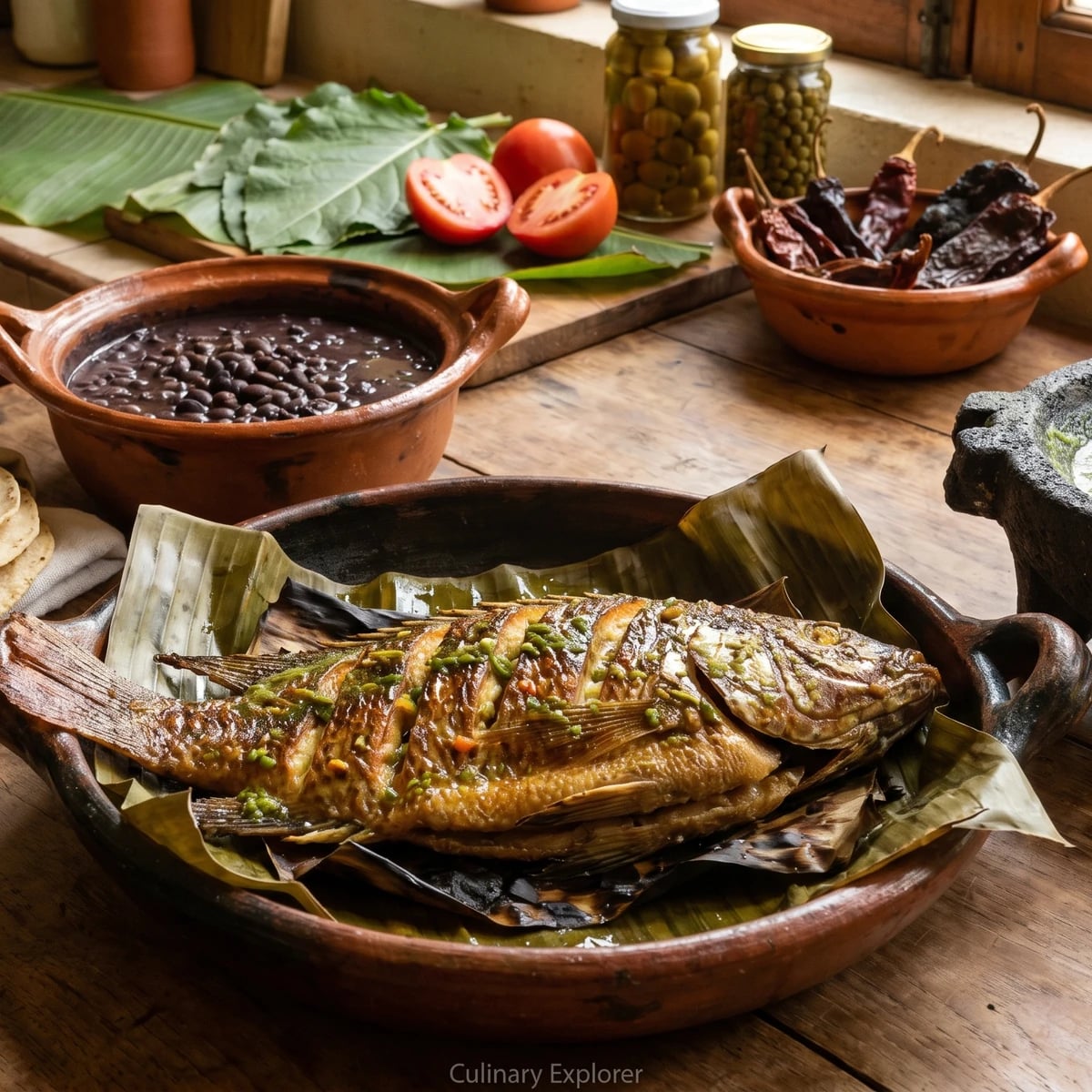
Catemaco's mojarra from Veracruz's Los Tuxtlas, wrapped with hoja santa and banana leaf, roasted whole, then dressed with green piquín, garlic, and lime sauce that bites clean and stays.

Main Dishes
Mexican
Weeknight
Dinner Party
Special Occasion
35 min
Active Time
25 min cook1 hr total
Yield4 servings

Veracruz, Los Tuxtlas, Lake Catemaco: that is where this mojarra lives. Not the port of Veracruz with tomato, olives, and capers. Those dishes have their place, but this one belongs to the lake, to the volcanic green around Catemaco, and to cooks who know freshwater fish is not handled like Gulf fish.

What makes it tachogobi is the green chile piquín, called chile de monte by many vendors, pounded with roasted garlic, sal de grano, and lime until it becomes sharp enough to wake up a lean whole fish. The acuyo, hoja santa, gives the perfume. The banana leaf protects the flesh. The thin brush of manteca de cerdo keeps the chile stuck to the skin and the cuts. La manteca es el sabor, even when the hand is light.

I learned this method from women who cook near the Catemaco malecón, the kind who clean fish faster than most people can find a knife. They score the mojarra, salt it, tuck acuyo and epazote inside, wrap it in banana leaf, and roast it until the collar releases cleanly from the bone. They don't bury it. They don't hide it. The fish comes first.

If your market can't bring you Catemaco mojarra, buy the freshest whole perch or tilapia you can find: clear eyes, red gills, firm flesh, no muddy smell. A substitution is a compromise, not an upgrade. This is a 32-state cuisine. Cada estado, su propia cocina.

Catemaco sits in Los Tuxtlas in southern Veracruz, a volcanic region with Nahua and Popoluca communities whose cooking used banana leaves, acuyo, chiles de monte, and freshwater fish long before the colonial port pantry became a Veracruz signature. After Hernán Cortés founded Villa Rica de la Vera Cruz in 1519, the port connected Mexico to Spanish ingredients such as olives, capers, and olive oil, which shaped pescado a la veracruzana but did not define every fish dish in the state. Around Lake Catemaco, mojarra is a market name for several perch-like freshwater fish sold whole, so a careful cook buys by freshness and size, not by a restaurant species label.

The technique, the tradition, and the story behind every dish.

Discover Culinary Explorer

Ingredients

whole Lake Catemaco mojarra, freshwater perch, or whole tilapia

Quantity

2 fish, 1 to 1 1/4 pounds each

scaled, gutted, gills removed, and scored

sal de grano or kosher salt

Quantity

2 teaspoons, divided, plus more to taste

Mexican limes

Quantity

6

enough for 6 tablespoons juice plus halves for serving

banana leaf rectangles

Quantity

4 large pieces, about 14 by 18 inches each

wiped clean

hoja santa (acuyo) leaves

Quantity

5 large leaves

4 left whole and 1 finely chopped

white onion

Quantity

1 small

sliced into thin half-moons

fresh epazote

Quantity

8 sprigs

manteca de cerdo

Quantity

2 tablespoons

melted

fresh green chile piquín or chile de monte

Quantity

24

stemmed

garlic cloves

Quantity

5

unpeeled

water

Quantity

2 tablespoons

frijoles negros de olla (optional)

Quantity

for serving

hand-pressed corn tortillas (optional)

Quantity

for serving

warmed

Equipment Needed

  • Volcanic stone molcajete
  • Cast iron comal or heavy skillet
  • Wide oven-safe clay cazuela or rimmed sheet pan
  • Kitchen twine
  • Instant-read thermometer

Instructions

  1. 1

    Salt the fish

    Rinse the fish quickly under cold water and pat it very dry. Make three deep diagonal cuts on each side, down to the bone but not through it. Rub the fish inside and out with 1 1/2 teaspoons salt and 2 tablespoons lime juice. Let it rest 15 minutes while you prepare the leaves and sauce. Do not leave fish sitting in lime all afternoon. Lime tightens the flesh before it ever reaches the fire.

    Good mojarra smells clean, never muddy. The eyes should be clear and the gills red. If the fish looks tired, change dinner. Si no conoces el mercado, no conoces la cocina.
  2. 2

    Soften the leaves

    Heat a dry comal or heavy skillet over medium. Pass each banana leaf over the heat for a few seconds per side until the color deepens and the leaf bends without cracking. Wipe again if needed. Lay two banana leaf pieces crosswise for each fish on a rimmed sheet pan or in a wide oven-safe clay cazuela. Put two whole acuyo leaves in the center of each packet.

  3. 3

    Roast the garlic

    Place the unpeeled garlic cloves on the dry comal and turn them until the skins are spotted and the cloves feel soft, 6 to 8 minutes. Peel them. Keep the green chile piquín raw unless the skins are tough. If they need waking up, touch them to the comal for 5 seconds only. Piquín is small and it burns fast. Burned piquín turns mean.

    Fresh green piquín gives the sauce its clean bite. Dried piquín can work in an emergency, but it gives a darker, smokier flavor. That is a compromise, not the same dish.
  4. 4

    Make the tachogobi

    In a molcajete, grind the roasted garlic with the remaining 1/2 teaspoon salt until you have a paste. Add the green piquín a few at a time and pound until the chiles are crushed but not liquefied. Add the finely chopped acuyo leaf and work it into the paste. Stir in 1/4 cup lime juice and 2 tablespoons water. Taste it. It should be salty, sharp, and hot enough to announce itself without erasing the fish. Spoon half into a clean bowl for the table and keep the other half for seasoning the raw fish.

    A blender works only if you pulse. Do not turn this into a smooth green drink. Tachogobi needs a little texture from the crushed chile and garlic. Así se hace y punto.
  5. 5

    Wrap the mojarra

    Brush the banana leaves and the fish with the melted manteca de cerdo. Use a light hand. This is fish, not carnitas. Tuck the white onion and epazote into the cavities. Work the fish-seasoning half of the tachogobi into the slashes and inside the fish. Set each fish over the acuyo leaves, fold the banana leaves tightly around it, and place the packets seam side down. Tie with kitchen twine if the leaves want to open.

  6. 6

    Roast until done

    Heat the oven to 425F. Roast the wrapped fish for 20 to 25 minutes, depending on thickness. The fish is done when the flesh near the backbone is opaque, the collar releases when nudged with a spoon, and an instant-read thermometer inserted at the thickest part reads 145F. Do not keep cooking after that. Lean lake fish dries out while you are still congratulating yourself.

    For a charcoal grill, cook the closed banana leaf packets over medium heat, covered, 10 to 12 minutes per side. The leaf edges will darken. That is fine. The fish inside should stay protected.
  7. 7

    Open and serve

    Rest the packets 5 minutes. Open them on a wide clay platter or leave them in the cazuela, with the banana leaf underneath. Spoon the clean reserved tachogobi over the scored fish and add a little of the leaf juices from the packet. Serve with lime halves, frijoles negros de olla, and warm hand-pressed corn tortillas. Keep the tomato, olives, and capers for another Veracruz dish. This one belongs to Catemaco.

Chef Tips

  • Ask for whole fish, not fillets. The bones protect the flesh and give you the clean pull at the collar. Fillets cook faster, yes, and they also dry faster. No me vengas con atajos.
  • Hoja santa is called acuyo in Veracruz. Do not replace it with bay leaf, basil, or parsley. If you cannot find it, use the banana leaf and epazote and understand what is missing: that soft anise-green perfume that tells a Veracruz cook where the dish is from.
  • Use fresh green piquín or chile de monte if your market has it. If you only find dried chile piquín, toast 1 tablespoon for 5 seconds, soak it in hot water for 10 minutes, and pound it with the garlic. The sauce will be darker and less fresh, but it will still have spine.
  • The manteca de cerdo is a brush, not a bath. It keeps the lean fish moist and helps the chile cling to the skin. Vegetable oil will cook the fish, but the flavor is thinner. A substitution is a compromise, not an upgrade.
  • This is not pescado a la veracruzana. Veracruz has more than one fish recipe. The port has tomato, olives, and capers. Catemaco has lake fish, acuyo, banana leaf, lime, and piquín. Cada estado, su propia cocina.

Advance Preparation

  • The garlic, piquín, salt, and chopped acuyo can be pounded into a paste up to 4 hours ahead. Stir in the lime juice only shortly before cooking so the flavor stays clean.
  • Banana leaves can be softened, wiped, folded, and refrigerated one day ahead. Bring them to room temperature before wrapping the fish so they do not crack.
  • The fish can be cleaned and scored the morning of cooking, then kept covered in the refrigerator. Salt and lime it only 15 to 30 minutes before roasting.

Frequently Asked Questions

Nutrition Information

1 serving (about 350g)

Calories
470 calories
Total Fat
12 g
Saturated Fat
4 g
Trans Fat
0 g
Unsaturated Fat
7 g
Cholesterol
70 mg
Sodium
1600 mg
Total Carbohydrates
53 g
Dietary Fiber
12 g
Sugars
3 g
Protein
40 g

Note: Chef personas and recipes are created with AI assistance. Cook with care: follow safe food-handling practices, check doneness with a thermometer when needed, and adapt for allergies and your kitchen.

Where cooking meets culture.

Culinary guides, cultural storytelling, and the editorial depth that makes cooking meaningful.

Discover Culinary Explorer

More from Veracruz Main Dishes

Browse the full collection