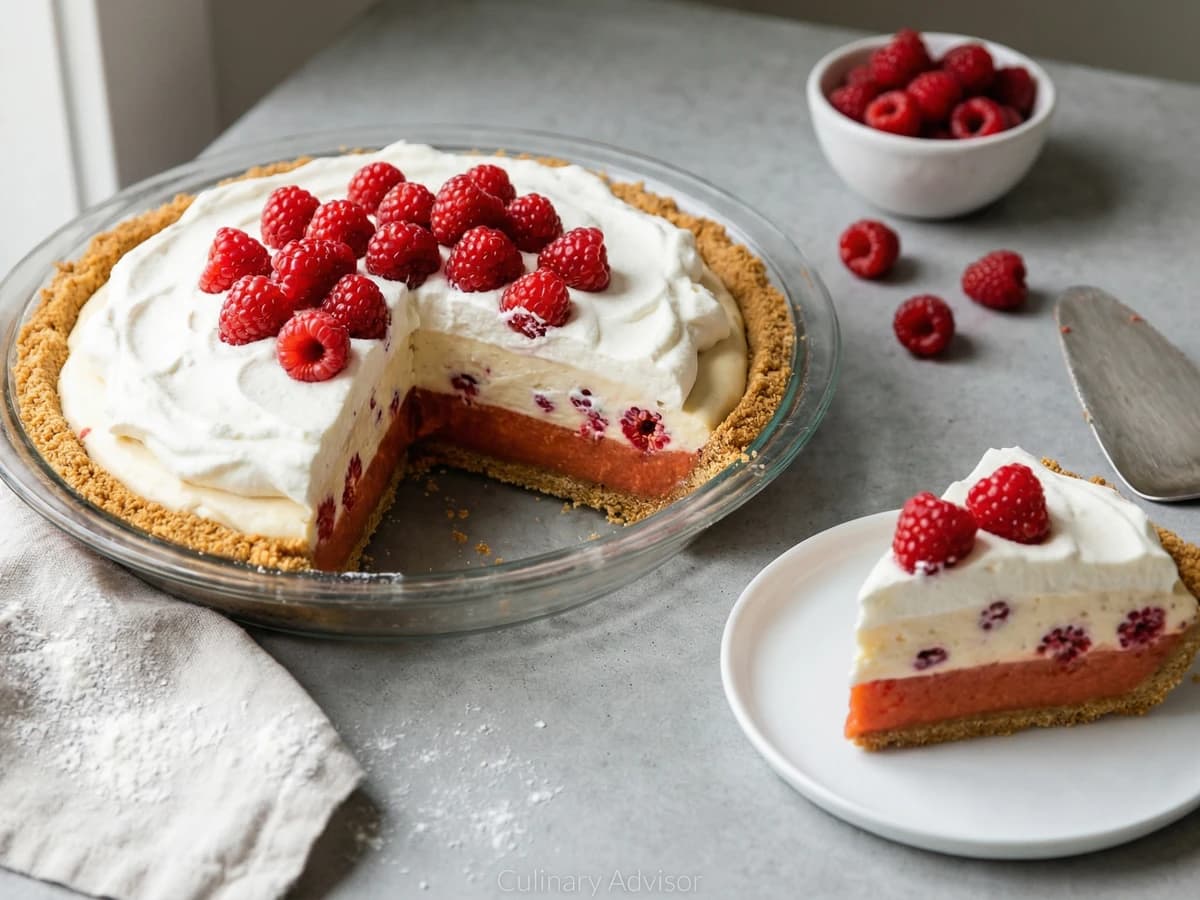
Three layers of unapologetic chocolate excess: a crumbly cookie crust, a dense brownie heart, and velvet pudding crowned with clouds of whipped cream. This is the pie that made the Mississippi Delta famous for something other than blues.
Pastries & Cookies
American
Birthday, Comfort Food, Potluck
45 min
Active Time
35 min cook•5 hr total
Yield10 servings
The Mississippi River runs thick and dark through the Deep South, carrying silt that turns its banks into something between earth and chocolate. Some time in the 1970s, a baker with a sense of poetry looked at that muddy water and saw dessert. The pie that bears the river's name has been making its way across church potlucks and diner counters ever since.
This is not a subtle dessert. It makes no apologies for what it is: layer upon layer of chocolate in different textures, each one richer than the last. The cookie crust shatters. The brownie layer clings to your fork. The pudding trembles. And above it all, whipped cream cuts through with merciful lightness. To eat Mississippi Mud Pie is to understand that sometimes more is exactly enough.
I first encountered this pie at a roadside diner outside Vicksburg, where a hand-painted sign promised the best mud pie in three counties. The waitress, whose grandmother had invented their recipe, served it on mismatched china with the kind of pride usually reserved for heirloom jewelry. She was right about the pie. Three counties was selling it short.
The technique, the tradition, and the story behind every dish.
Preheat your oven to 350°F. Place the whole sandwich cookies in a food processor and pulse until you have fine, even crumbs with no large pieces remaining. This takes about thirty seconds of processing. The filling should be fully incorporated, lending moisture and sweetness to the crust. Transfer to a bowl and stir in the melted butter and salt until the mixture resembles wet sand that clumps when pressed.
No food processor? Seal cookies in a zip-top bag and crush with a rolling pin. Work methodically until no large pieces remain.
2
Press and blind bake
Pour the crumb mixture into a 9-inch deep-dish pie plate. Using the bottom of a measuring cup or your fingers, press the crumbs firmly and evenly across the bottom and up the sides, creating a compact shell about 1/4-inch thick. The edges should reach the rim. Bake for 10 minutes until the crust is fragrant and set but not darkened. It will firm as it cools. Set aside while you prepare the brownie layer.
3
Make the brownie batter
In a medium saucepan over low heat, melt the butter with the chopped chocolate, stirring constantly until smooth and glossy. Remove from heat immediately when the last pieces dissolve. Let cool for five minutes. Whisk in the sugar until combined, then add the eggs one at a time, beating well after each. The mixture will turn glossy and slightly thickened. Stir in the vanilla.
The chocolate and butter must cool slightly before adding eggs, or you'll scramble them. If the mixture feels warm to the touch, wait another minute.
4
Finish and bake the brownie
Sift the flour, cocoa powder, and salt together directly into the chocolate mixture. Fold gently with a spatula until just combined and no dry streaks remain. Pour the batter into the prepared crust, spreading evenly with an offset spatula. Bake for 22 to 25 minutes until the top looks set and slightly crackled. A toothpick inserted near the center should come out with moist crumbs, not wet batter. The brownie will settle as it cools.
5
Cool completely
Let the pie cool on a wire rack for at least one hour. The brownie layer needs to be completely cool before you add the pudding, or the heat will prevent proper setting. Patience here determines whether your layers remain distinct or become a muddled mess. Use this time to make the pudding.
6
Cook the chocolate pudding
In a heavy-bottomed saucepan, whisk together the sugar, cornstarch, cocoa powder, and salt until thoroughly combined with no lumps. Slowly pour in the milk while whisking constantly to prevent lumps from forming. Set over medium heat and cook, whisking without pause, until the mixture thickens and begins to bubble, about 8 to 10 minutes. The pudding should coat the back of a spoon heavily.
Do not walk away during this step. Pudding goes from liquid to scorched in moments if neglected. Keep that whisk moving across the entire bottom of the pan.
7
Finish the pudding
Remove the pan from heat and immediately add the chopped chocolate and butter, whisking until both are fully melted and the pudding is smooth and glossy. Stir in the vanilla. The pudding should be deeply chocolatey, dark as river silt, and thick enough to mound briefly when dropped from the whisk. Press plastic wrap directly onto the surface to prevent a skin from forming. Let cool for 15 minutes.
8
Layer the pudding
Remove the plastic wrap and give the pudding a good stir to loosen it. Pour the warm pudding over the cooled brownie layer, using an offset spatula to spread it evenly to the edges. Work gently to avoid disturbing the brownie beneath. The pudding should form a smooth, level layer about 3/4-inch thick. Refrigerate uncovered for 30 minutes until the surface is cool to the touch, then cover loosely with plastic wrap and chill for at least 3 hours or overnight.
9
Whip the cream
Chill your mixing bowl and whisk attachment in the freezer for 10 minutes before whipping. Pour the cold heavy cream into the chilled bowl and beat on medium-high speed until soft peaks form, about 2 minutes. Add the powdered sugar and vanilla, then continue beating until you reach stiff peaks that hold their shape when the whisk is lifted. Do not overbeat into butter.
Stop beating the moment the cream holds peaks. There is a narrow window between stiff peaks and grainy, broken cream. Err on the side of slightly soft.
10
Top and garnish
Mound the whipped cream generously over the chilled pudding layer, creating dramatic swirls and peaks with the back of a spoon or an offset spatula. The cream should billow above the rim of the pie plate. Scatter chocolate shavings over the top, letting some tumble down the sides. If using pecans, arrange them around the outer edge in a rustic crown. Refrigerate until ready to serve, at least 30 minutes more for the cream to set.
11
Slice and serve
Run a thin knife under hot water and wipe dry before each cut. This prevents the layers from dragging. Slice into generous wedges, using a pie server to lift each piece cleanly. The layers should remain distinct: dark crust, dense brownie, trembling pudding, ethereal cream. Serve cold, directly from the refrigerator. This pie does not improve at room temperature.
Chef Tips
•Dutch-process cocoa is essential here, not natural cocoa. The alkalization creates that deep, dark color and mellow bitterness that defines mud pie. Natural cocoa tastes sharper and bakes lighter.
•Use the best bittersweet chocolate you can afford. This pie contains half a pound of the stuff, and its quality determines whether you've made something memorable or merely acceptable. Sixty to seventy percent cacao hits the sweet spot.
•The pie must be cold when served. At room temperature, the pudding softens, the cream deflates, and the layers lose their distinction. Keep it refrigerated until the moment you slice.
•For cleaner slices, freeze the fully assembled pie for 20 minutes before cutting. The layers firm up enough to slice neatly, but the texture remains creamy when it hits your tongue.
•If you want to gild the lily, drizzle warm chocolate sauce over each slice just before serving. The contrast of warm sauce and cold pie borders on the indecent.
Advance Preparation
•The crust can be baked, wrapped tightly in plastic, and stored at room temperature for up to 2 days before proceeding.
•The fully assembled pie (without whipped cream) can be refrigerated for up to 3 days. Add the whipped cream within 4 hours of serving.
•The finished pie keeps refrigerated for up to 5 days, though the whipped cream will begin to weep after 24 hours. If making far ahead, leave the cream off and add fresh before serving.
Frequently Asked Questions
Nutrition Information
1 serving (about 210g)
Calories
1085 calories
Total Fat
83 g
Saturated Fat
52 g
Trans Fat
2 g
Unsaturated Fat
26 g
Cholesterol
185 mg
Sodium
210 mg
Total Carbohydrates
92 g
Dietary Fiber
3 g
Sugars
78 g
Protein
6 g
Where cooking meets culture.
Culinary guides, cultural storytelling, and the editorial depth that makes cooking meaningful.