
Chef Jeong-sun
Albaechu-mul-kimchi (Baby Cabbage Water Kimchi)
Tender baby napa cabbage in a clear pear-garlic brine, lightly fermented until the broth turns clean and bright, the summer kimchi a beginner can make without a kimjang floor.
A cooking platform built around craft, culture, and the stories behind what we eat.
Created by
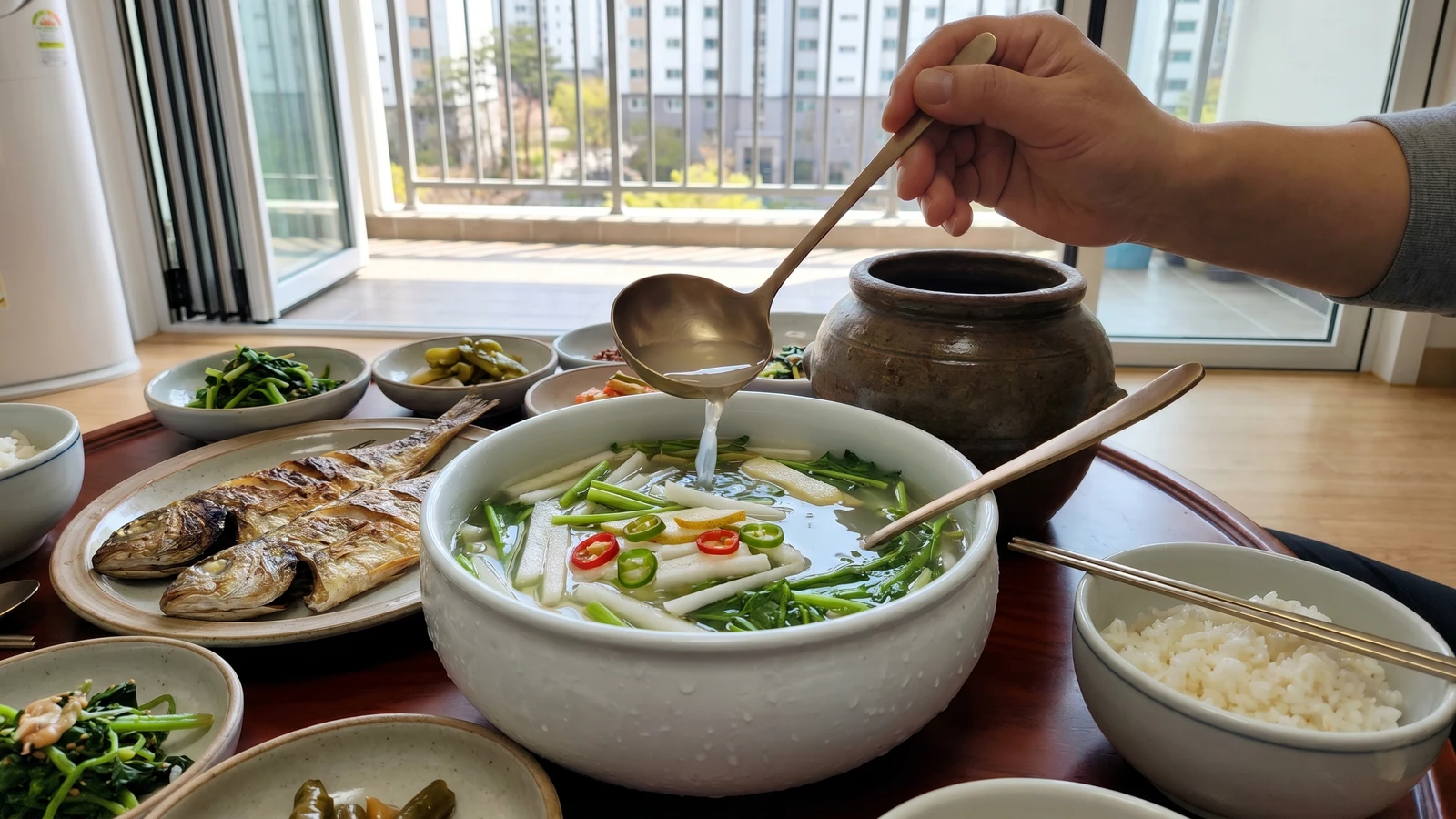
A clear water kimchi of fragrant minari and crisp radish, lightly fermented until the brine turns clean, tart, and alive without burying the green taste of the herb.
Minari comes to the market in cool weather with mud still remembering the stream. Buy it then if you can, from late winter into spring, when the stems are crisp and the scent is sharp. Cook the month you're standing in. If your market's minari is tired, make dongchimi instead and wait for better greens.
This kimchi lives or dies by the brine. People think water kimchi is weak because it has no red paste to hide behind. That is exactly why it needs better hands. The salt must season the radish all the way through, the rice-flour water must give the lactic ferment something gentle to eat, and the minari must go in late enough that it stays green and fragrant instead of collapsing into the jar.
My teacher, Master Seong-nyeo, made us taste the brine before the vegetables went in, then again after one night on the floor. Too salty at the start becomes harsh. Too bland becomes flat and unsafe. Notebook 31 says 2 tablespoons fine sea salt for 6 cups water, plus the salt rubbed into the radish first. Write it down. Memory is a borrowed bowl.
Serve this cold beside grilled fish, a bowl of rice, or a rich stew that needs clearing. It is a small dish, but not a careless one. The crunch and scent carry it.
Minari kimchi is counted among Korea's oldest recorded kimchi, with water dropwort named in a Goryeo-period record dated 983, long before chili became part of the Korean jar. Early kimchi were brined vegetables, often pale, sour, and clean, and mul-kimchi still carries that older habit more plainly than the red napa kimchi now seen around the world. Minari itself has long belonged to streamside and wet-field cooking, valued for its clear herbal scent and its place in spring tables.
Quantity
300g
trimmed and washed very well
Quantity
450g
peeled and cut into 1/4-inch thick matchsticks
Quantity
1 tablespoon
for salting the radish
Quantity
1/2 medium
peeled and cut into thin matchsticks
Quantity
4
cut into 2-inch lengths
Quantity
1 small
seeded and thinly sliced
Quantity
1 small
seeded and thinly sliced
Quantity
4 cloves
thinly sliced
Quantity
10g
thinly sliced
Quantity
6 cups
Quantity
2 tablespoons
for the brine
Quantity
1 tablespoon
Quantity
1/2 cup
for rice-flour paste
Quantity
1 tablespoon
Quantity
2 tablespoons
| Ingredient | Quantity |
|---|---|
| minari (Korean water dropwort)trimmed and washed very well | 300g |
| Korean radish (mu)peeled and cut into 1/4-inch thick matchsticks | 450g |
| fine sea saltfor salting the radish | 1 tablespoon |
| Korean pear or Asian pearpeeled and cut into thin matchsticks | 1/2 medium |
| scallionscut into 2-inch lengths | 4 |
| red chili (optional)seeded and thinly sliced | 1 small |
| green chili (optional)seeded and thinly sliced | 1 small |
| garlicthinly sliced | 4 cloves |
| fresh gingerthinly sliced | 10g |
| water | 6 cups |
| fine sea saltfor the brine | 2 tablespoons |
| sweet rice flour (chapssal-garu) | 1 tablespoon |
| waterfor rice-flour paste | 1/2 cup |
| sugar | 1 tablespoon |
| maesil-cheong (Korean green plum syrup) (optional) | 2 tablespoons |
Trim away tough root ends and any yellow leaves from the minari. Wash it in a large bowl of cold water, lifting the stems out so grit stays behind, then repeat two or three times until the water is clear. Cut the stems and leaves into 2-inch lengths. Minari grows where mud and water meet, so this washing is not fussing. It is the dish.
Put the radish matchsticks in a bowl and toss with 1 tablespoon fine sea salt. Let them stand 25 minutes, turning once halfway through, until the radish bends slightly and gives off a little liquid. Do not rinse. The radish needs this first salting so it stays crisp and seasons the brine from inside, not only on the surface.
Whisk 1 tablespoon sweet rice flour with 1/2 cup water in a small pot. Cook over medium-low heat, stirring, until it turns slightly glossy and lightly thickened, about 3 to 4 minutes. Cool completely. This small paste feeds fermentation and gives the brine a soft body; too much makes water kimchi cloudy and heavy.
In a large bowl, stir 6 cups water with 2 tablespoons fine sea salt, 1 tablespoon sugar, the cooled rice-flour paste, and maesil-cheong if using. Stir until dissolved, then taste. It should be cleanly salty, a little sweeter than you expect, and not harsh. The vegetables will dilute it, and fermentation will sharpen it.
Put the salted radish and its liquid into a clean 2-liter glass jar or small onggi. Add the pear, scallions, chilies if using, garlic, and ginger. Add the minari last, tucking it in loosely rather than crushing it. Pour the brine over everything, leaving about 1 inch of headspace. Press gently so the vegetables sit under the liquid.
Cover the jar loosely and leave it at cool room temperature, 18 to 21 C, for 18 to 24 hours. Open once to release gas and press the vegetables back under the brine with clean tongs. When the brine smells lightly sour and tastes brighter than yesterday, move it to the refrigerator. Warm rooms work faster, so taste after 12 hours if your kitchen is above 23 C.
Chill at least 4 hours before serving. Ladle both vegetables and brine into small bowls, giving each person some radish, minari, and a little clear broth to sip. Eat within 7 days, while the minari still tastes green and the radish still snaps under the teeth.
1 serving (about 220g)
Culinary guides, cultural storytelling, and the editorial depth that makes cooking meaningful.
Discover Culinary ExplorerChef Jeong-sun
Tender baby napa cabbage in a clear pear-garlic brine, lightly fermented until the broth turns clean and bright, the summer kimchi a beginner can make without a kimjang floor.

Chef Jeong-sun
The kimchi from before chili, salted napa cabbage packed with radish, pear, jujube, and pine nuts in a clear brine that turns quietly tart in the jar.

Chef Jeong-sun
A pale summer cucumber kimchi, split and stuffed with radish and chives, then held in a cool pear brine so the cucumber stays clean, crunchy, and plainly itself.

Chef Jeong-sun
Flat spring bomdong cabbage, lightly brined and tucked into a clear pear-radish kimchi broth, made without chili and eaten young while the leaves still taste like spring.