
Chef Jeong-sun
Agwi-jjim (Braised Monkfish with Bean Sprouts)
Firm monkfish buried under crisp soybean sprouts, minari, and a red gochugaru sauce thickened at the end; Masan's market dish asks for heat, timing, and a steady hand.
A cooking platform built around craft, culture, and the stories behind what we eat.
Created by
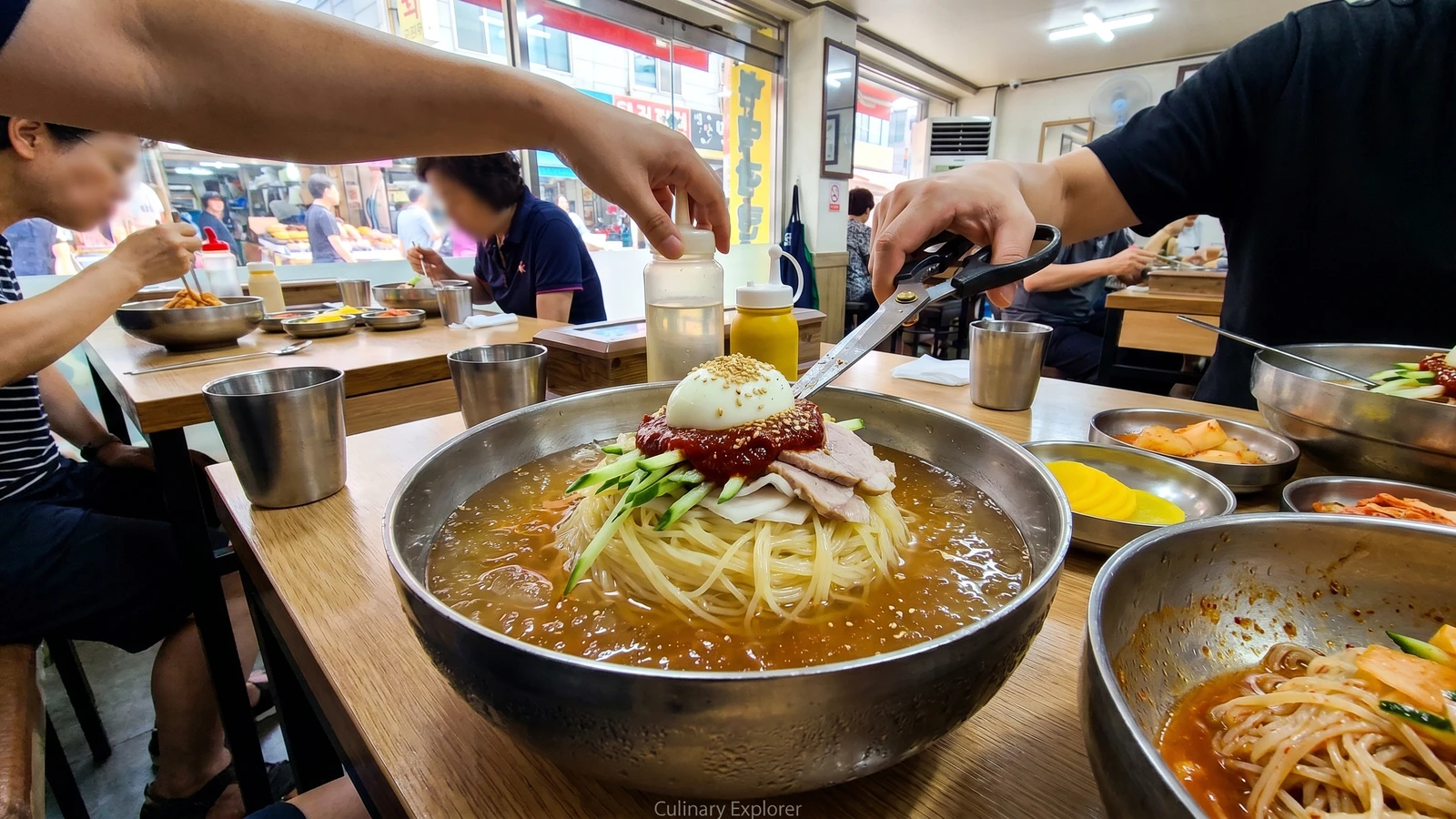
Chewy wheat-starch noodles in a sharp cold broth, Busan's post-war answer to naengmyeon, finished with pickled radish, cucumber, egg, sliced meat, and a red seasoning paste measured with restraint.
People call milmyeon a cheaper naengmyeon, and that is lazy thinking. Busan did not make a copy; it answered the market in front of it. Wheat noodles, a chilled meat broth, a spoon of red sauce, cucumber, radish, egg. A city crowded with people made a cold bowl that could feed them.
The dish lives or dies by three things: broth, cold, and rinse. The broth must be clean enough to drink after it is chilled, because fat that tastes rich when hot turns heavy when cold. The noodles must be rinsed until they feel squeaky between your fingers. If you leave starch on them, the bowl becomes glue with ice in it, and nobody needs that lesson twice.
My teacher, Master Seong-nyeo, did not make Busan food sound sentimental. She would say: write the broth, write the vinegar, write the salt, then you may say you have a recipe. This one gives you both mul-milmyeon (cold broth wheat noodles) and bibim-milmyeon (spicy mixed wheat noodles), because Busan tables argue happily over which one is better. The safe corner to cut is buying good noodles. The corner you do not cut is chilling the broth and washing the noodles. 손맛 is real; I measure it anyway.
Milmyeon is tied to Busan after the 1950 to 1953 Korean War, when refugees from the North brought cold noodle habits south and cooked with what the port city and relief supplies made available. American wheat flour aid made milgaru (wheat flour) cheaper and easier to find than buckwheat, so the cold noodle changed into the springy wheat-starch bowl Busan now claims as its own. Several Busan shops are named in its early story, including Naeho Naengmyeon, a Hamhung-rooted restaurant that reopened in Busan in 1953, though the city still debates the exact first bowl.
Quantity
10 cups
Quantity
450g
rinsed
Quantity
300g
rinsed
Quantity
250g
peeled and cut into 1-inch chunks
Quantity
1/2 medium
unpeeled and halved
Quantity
4 cloves
lightly crushed
Quantity
1 thumb-size piece
sliced
Quantity
2
cut in half
Quantity
1 teaspoon
Quantity
1 piece, about 4 inches square
Quantity
6 cups
Quantity
1/2 cup
Quantity
3 tablespoons, plus more to serve
Quantity
1 1/2 tablespoons
Quantity
1 tablespoon
Quantity
1 teaspoon, plus more as needed
Quantity
250g
thinly sliced into half-moons
Quantity
1 teaspoon
Quantity
2 tablespoons
Quantity
1 tablespoon
Quantity
1/4 teaspoon
Quantity
1
julienned
Quantity
1/4 teaspoon
Quantity
4 portions, about 720g total
or 400g dried wheat naengmyeon-style noodles
Quantity
4 tablespoons
Quantity
2 tablespoons
Quantity
2 tablespoons
Quantity
3 tablespoons
Quantity
2 tablespoons
grated
Quantity
1 tablespoon
Quantity
2 teaspoons
minced
Quantity
1/2 teaspoon
grated
Quantity
1 teaspoon
Quantity
1/4 teaspoon
Quantity
1 teaspoon, plus more to serve
Quantity
2 tablespoons
Quantity
4
halved
Quantity
about 200g
thinly sliced
Quantity
2 teaspoons
| Ingredient | Quantity |
|---|---|
| cold water | 10 cups |
| beef shank or brisketrinsed | 450g |
| pork shoulder or chicken wingsrinsed | 300g |
| Korean radish, for brothpeeled and cut into 1-inch chunks | 250g |
| onionunpeeled and halved | 1/2 medium |
| garlic, for brothlightly crushed | 4 cloves |
| ginger, for brothsliced | 1 thumb-size piece |
| scallions, for brothcut in half | 2 |
| black peppercorns | 1 teaspoon |
| dried kelp (dasima) | 1 piece, about 4 inches square |
| strained chilled meat broth | 6 cups |
| dongchimi (radish water kimchi) brine or strained radish pickle brine (optional) | 1/2 cup |
| rice vinegar, for broth seasoning | 3 tablespoons, plus more to serve |
| sugar, for broth seasoning | 1 1/2 tablespoons |
| soup soy sauce (guk-ganjang) or light soy sauce | 1 tablespoon |
| fine sea salt, for broth seasoning | 1 teaspoon, plus more as needed |
| Korean radish, for picklethinly sliced into half-moons | 250g |
| fine sea salt, for radish pickle | 1 teaspoon |
| rice vinegar, for radish pickle | 2 tablespoons |
| sugar, for radish pickle | 1 tablespoon |
| gochugaru (Korean chili flakes), for radish pickle (optional) | 1/4 teaspoon |
| English or Korean cucumberjulienned | 1 |
| fine sea salt, for cucumber | 1/4 teaspoon |
| fresh or frozen milmyeon noodlesor 400g dried wheat naengmyeon-style noodles | 4 portions, about 720g total |
| gochugaru (Korean chili flakes), for sauce | 4 tablespoons |
| gochujang (Korean chili paste) | 2 tablespoons |
| soy sauce, for sauce | 2 tablespoons |
| rice vinegar, for sauce | 3 tablespoons |
| Korean pear or crisp applegrated | 2 tablespoons |
| sugar, for sauce | 1 tablespoon |
| garlic, for sauceminced | 2 teaspoons |
| ginger, for saucegrated | 1/2 teaspoon |
| toasted sesame oil | 1 teaspoon |
| ground black pepper | 1/4 teaspoon |
| Korean mustard (yeongyeoja) (optional) | 1 teaspoon, plus more to serve |
| cold broth, to loosen sauce | 2 tablespoons |
| hard-boiled eggshalved | 4 |
| cooked beef or pork from the broththinly sliced | about 200g |
| toasted sesame seeds | 2 teaspoons |
Put the cold water, beef, pork or chicken, radish chunks, onion, garlic, ginger, scallions, peppercorns, and kelp in a large pot. Bring it slowly to a simmer over medium heat and skim the gray foam as it rises. Pull the kelp out after 8 to 10 minutes, when the water has taken its savor but before it turns slick and bitter. Lower the heat and simmer gently for 75 to 85 minutes, until the meat is tender. Do not boil hard. A cold noodle broth has nowhere to hide a muddy taste.
Lift out the cooked meat and save it for topping. Strain the broth through a fine strainer, then cool it quickly in a shallow container. Refrigerate at least 6 hours, or overnight, until the fat firms on top. Remove every bit of that fat. Fat that feels rich in a hot soup tastes heavy and dull in a cold bowl.
Measure 6 cups of the chilled, skimmed broth. Stir in the dongchimi brine if using, rice vinegar, sugar, soup soy sauce, and 1 teaspoon salt. Taste it cold. It should be a little sharper and saltier than you would drink by the cup, because the noodles and ice will quiet it. Pour 1 cup of this seasoned broth into a shallow container and freeze it until slushy at the edges. Keep the rest very cold.
Toss the thin radish slices with 1 teaspoon salt and let them stand 10 minutes. Drain off the liquid, but do not rinse all the seasoning away. Add 2 tablespoons vinegar, 1 tablespoon sugar, and the optional 1/4 teaspoon gochugaru. Let it sit at least 20 minutes. The radish should bend and snap lightly under the teeth, not collapse.
Stir together the gochugaru, gochujang, soy sauce, vinegar, grated pear or apple, sugar, minced garlic, grated ginger, sesame oil, black pepper, Korean mustard if using, and 2 tablespoons cold broth. Let the sauce rest 20 minutes so the chili flakes soften and the raw garlic settles down. This is a seasoning paste, not a blanket. For mul-milmyeon, use about 1 tablespoon per bowl. For bibim-milmyeon, use about 2 tablespoons per bowl.
Toss the julienned cucumber with 1/4 teaspoon salt and let it stand 5 minutes, then squeeze it lightly. Slice the saved meat thinly across the grain. Halve the eggs. Put the cold broth, sauce, radish, cucumber, meat, eggs, sesame seeds, mustard, vinegar, scissors, and chilled bowls near the stove before the noodles go in. Milmyeon waits for no one once the noodles are cooked.
Bring a large pot of water to a full boil. Loosen the milmyeon noodles with your hands before adding them, then boil according to the package. Fresh or frozen milmyeon often needs only 40 to 90 seconds; dried wheat naengmyeon-style noodles usually need 3 to 4 minutes. Stir the whole time so they do not clump. Taste one strand. It should be chewy through the center, not floury, and not soft.
Drain the noodles and rinse them under cold running water, rubbing them between both hands to wash off surface starch. Move them into ice water for 30 seconds, then drain hard. They should feel cold, springy, and almost squeaky. Leave starch on the noodles and the broth turns cloudy and thick. This is the step people rush, and this is the step that punishes them.
For mul-milmyeon, divide the cold noodles among four chilled stainless bowls and coil them neatly. Pour 1 to 1 1/4 cups icy seasoned broth around each portion, then add a spoonful of the frozen broth slush. Set 1 tablespoon sauce on top of each coil. Add pickled radish, cucumber, sliced meat, half an egg, and sesame seeds. Serve at once with vinegar and Korean mustard on the side, and cut the noodles with scissors at the table.
For bibim-milmyeon, put one drained noodle portion in a mixing bowl with 2 tablespoons sauce and 2 tablespoons cold broth. Toss with chopsticks and a gloved hand until every strand is coated and glossy. Transfer to a chilled bowl and top with radish, cucumber, sliced meat, half an egg, and sesame seeds. Serve 1/2 cup cold broth on the side, because bibim noodles still need that cold sip between bites.
1 serving (about 900g)
Culinary guides, cultural storytelling, and the editorial depth that makes cooking meaningful.
Discover Culinary ExplorerChef Jeong-sun
Firm monkfish buried under crisp soybean sprouts, minari, and a red gochugaru sauce thickened at the end; Masan's market dish asks for heat, timing, and a steady hand.

Chef Jeong-sun
A quick Korean rice bowl built on contrast: warm rice, cold popping flying-fish roe, chopped vegetables, gim, sesame oil, and the crisp rice bottom a hot stone bowl gives you.
Chef Jeong-sun
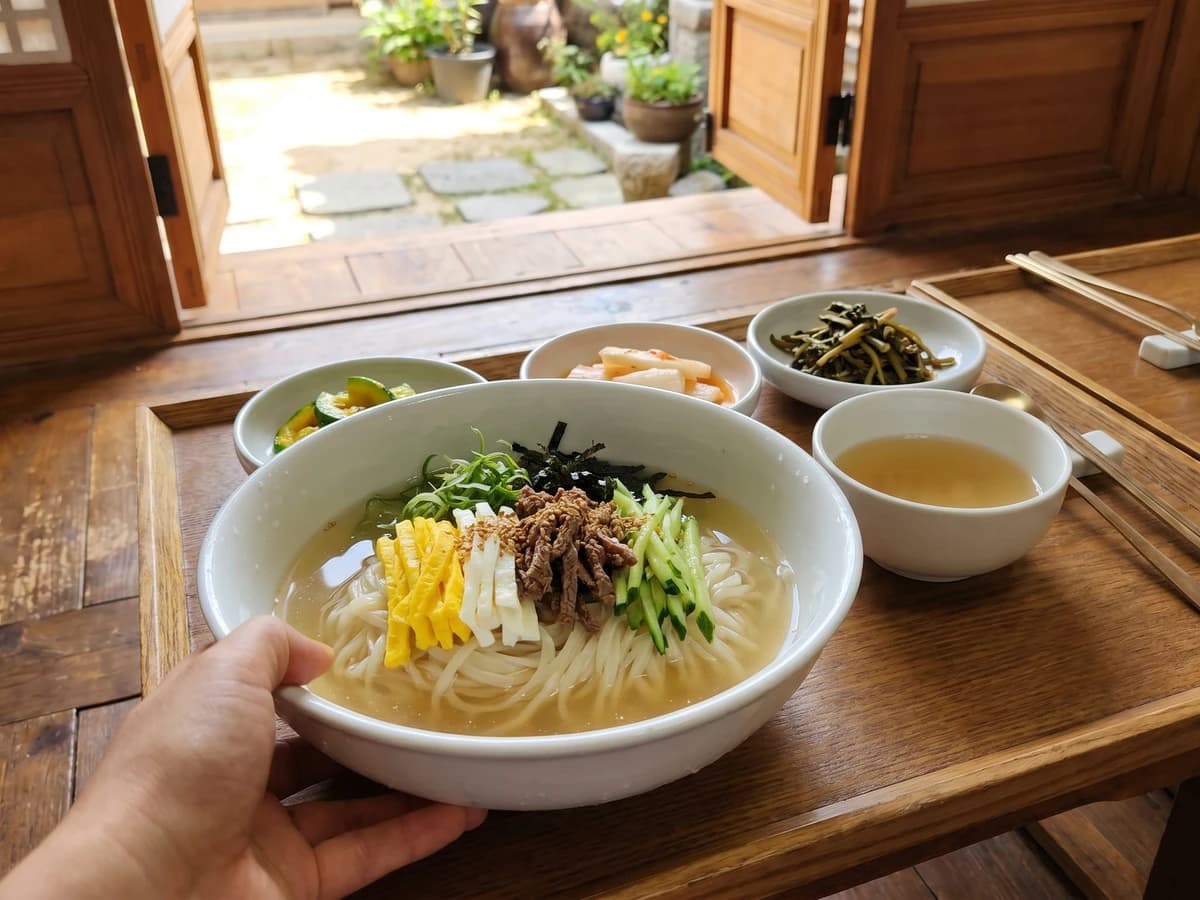
Andong's guest noodles, wheat and roasted soybean flour rolled thin, boiled and rinsed cold, then set in a clear chilled anchovy broth with careful strips of beef, egg, and cucumber.

Chef Jeong-sun
Andong's ritual-table rice served on an ordinary day: separate soy-sesame namul, warm rice, and clear radish soup, mixed without gochujang so every vegetable keeps its own voice.