
Chef Klaus
Badische Dinnele
The Baden flatbread that keeps its bread body: sour cream, onion, and Speck on a yeast dough baked hard and hot until the edges blister.
A cooking platform built around craft, culture, and the stories behind what we eat.
Created by
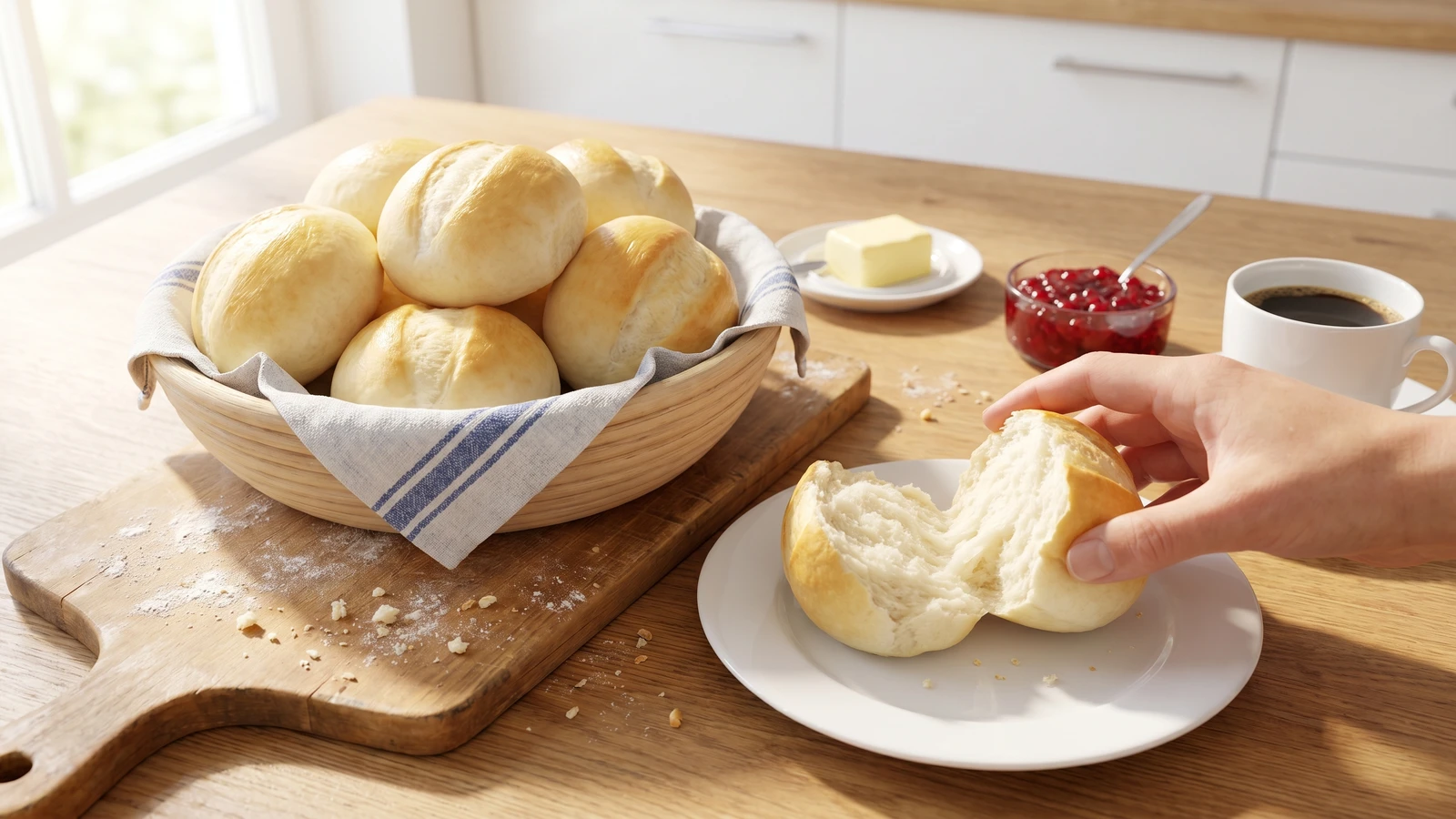
The soft milk roll of German breakfast tables and bakery counters, built on patient kneading, warm milk, and just enough butter to make the crumb pull apart in soft wads.
Milchbrötchen sit at the German breakfast table, in the school bag, and beside Sunday coffee. No feast owns them and no season shuts them. They are Kleingebäck, small bread goods, for the days when a crusty roll would be too hard for jam, honey, or a child's hand.
In the north and west the name is usually Milchbrötchen. In the south you'll hear Milchwecken or Milchsemmeln, often a little glossier from a milk or egg wash. In the Rhineland and Ruhr the same dough may take raisins and become Rosinenbrötchen, raisin rolls. Im Norden anders, im Süden anders, different in the north, different in the south.
The roll only works if you keep the dough soft and knead it until it smooths. Add flour every time it sticks and you steal the tenderness; the gluten needs moisture to stretch, and the butter goes in after the dough has found some strength because fat coats flour and slows that fine web from forming. Erst verstehen, dann kochen.
There is thrift here too, only quieter than in a roast pot. A stale Milchbrötchen becomes Arme Ritter, German poor knights, or Semmelbrösel, breadcrumbs, for a cake tin. Weggeworfen wird nichts, nothing gets thrown away. Make them properly once and the packet rolls look like what they are.
The Deutsche Lebensmittelbuch-Kommission, created in 1962, later set out Leitsätze for Brot und Kleingebäck, the guidance that distinguishes a Milchbrötchen from a plain wheat roll by tying the name to milk in the dough. The older bakery habit behind it belongs to nineteenth-century city bread culture, when fine wheat flour, pressed yeast, and regular milk delivery made soft enriched breakfast rolls dependable enough for daily sale rather than feast baking. Regional naming stayed local: northern and western shops usually sell Milchbrötchen, southern bakers more often say Milchwecken or Milchsemmel, and the raisin version stands apart as Rosinenbrötchen.
Quantity
500g
plus a little for dusting
Quantity
250ml
lukewarm
Quantity
21g fresh / 7g instant
Quantity
50g
Quantity
1
room temperature
Quantity
8g
Quantity
60g
softened
Quantity
1 tablespoon
for brushing
Quantity
15g
melted, for brushing after baking
Quantity
80g
soaked 10 minutes and drained
| Ingredient | Quantity |
|---|---|
| German Type 550 wheat flour or strong all-purpose flourplus a little for dusting | 500g |
| whole milklukewarm | 250ml |
| fresh yeast or instant yeast | 21g fresh / 7g instant |
| sugar | 50g |
| large eggroom temperature | 1 |
| fine salt | 8g |
| unsalted buttersoftened | 60g |
| whole milkfor brushing | 1 tablespoon |
| unsalted buttermelted, for brushing after baking | 15g |
| raisins (optional)soaked 10 minutes and drained | 80g |
Warm the 250ml milk to 35 to 38C, just warm against your finger. Stir in the yeast and one teaspoon of the sugar and leave it 5 to 10 minutes until creamy; instant yeast doesn't need the wait, but the warm milk still matters. Hot milk kills yeast, and cold milk makes this buttered dough crawl.
Put the flour, the remaining sugar, and the salt in a large bowl. Add the yeast milk and the egg, then mix until no dry flour remains and the dough looks rough and shaggy. Cover it and leave it 10 minutes. That rest lets the flour drink the milk, so you see the true texture before you reach for more flour.
Knead the dough for 4 to 5 minutes, then add the softened butter a piece at a time. Butter goes in after the dough has some strength; add it too early and the fat coats the flour, slowing the gluten and giving you a short, cakey crumb. Knead 8 to 10 minutes more, until the dough is smooth, elastic, and still slightly tacky. If using raisins, fold them in at the end so they don't tear the dough while it is weak.
Set the dough in a lightly buttered bowl, cover it, and leave it until doubled, 60 to 90 minutes. Sugar and butter slow yeast, so the clock is only a servant here. Use a warm corner, not a hot oven; too much heat melts the butter out and leaves the dough greasy. Das braucht seine Zeit.
Turn the dough onto a barely floured bench and press it gently to even it out. Divide it into 12 pieces, about 75g each. Tuck the edges underneath each piece and roll it under a cupped hand into a tight ball or short oval. That tight surface makes the rolls rise upward; loose shapes spread sideways and bake flat.
Set the rolls seam side down on a parchment-lined baking sheet, leaving room between them. Cover and proof 35 to 45 minutes, until they look puffy and a light finger dent fills back slowly. Brush with the tablespoon of milk, then cut a shallow line along the top if you want the bakery split. The proof gives lift, and the shallow cut controls the opening; a deep cut dumps the gas you just waited for.
Bake at 190C, or 170C fan, for 15 to 18 minutes, rotating the tray if the back browns first. Pull them when they are pale gold, not chestnut brown. Enriched dough keeps colouring once the crust has set, and a dark crust eats the tenderness. If you use a thermometer, the centre should read 92 to 94C.
Brush the rolls with the melted butter as soon as they come out, then move them to a rack. The butter softens the crust while the rack keeps the bottoms dry. Let them settle 15 to 20 minutes before splitting; cut too early and the crumb tears into paste instead of pulling apart. Serve with butter, honey, jam, or a slice of mild cheese.
1 serving (about 80g)
Culinary guides, cultural storytelling, and the editorial depth that makes cooking meaningful.
Discover Culinary ExplorerChef Klaus
The Baden flatbread that keeps its bread body: sour cream, onion, and Speck on a yeast dough baked hard and hot until the edges blister.

Chef Klaus
The farmhouse loaf that made sense of a weekly oven firing: rye for keeping, wheat for lift, sourdough for the crumb, and a dark crust that earns its crack.

Chef Klaus
The Bavarian pretzel lives by its lye bath: a pale dough goes in, a dark glossy Breze comes out, with thin arms, a proud belly, and salt that bites clean.

Chef Klaus
A Bavarian wheat-rye loaf for the Brotzeit board, mild from ripe sourdough, dark-crusted from a fierce first heat, and firm enough to carry cold cuts without sagging.