
Chef Juliana
Beiju Chica de Santarém Novo
You don't need the right grandmother or a festival oven to learn the logic: grate mandioca fine, squeeze it damp, mix in coconut, and bake thin. Two ingredients, no packet, real crunch.
A cooking platform built around craft, culture, and the stories behind what we eat.
Created by
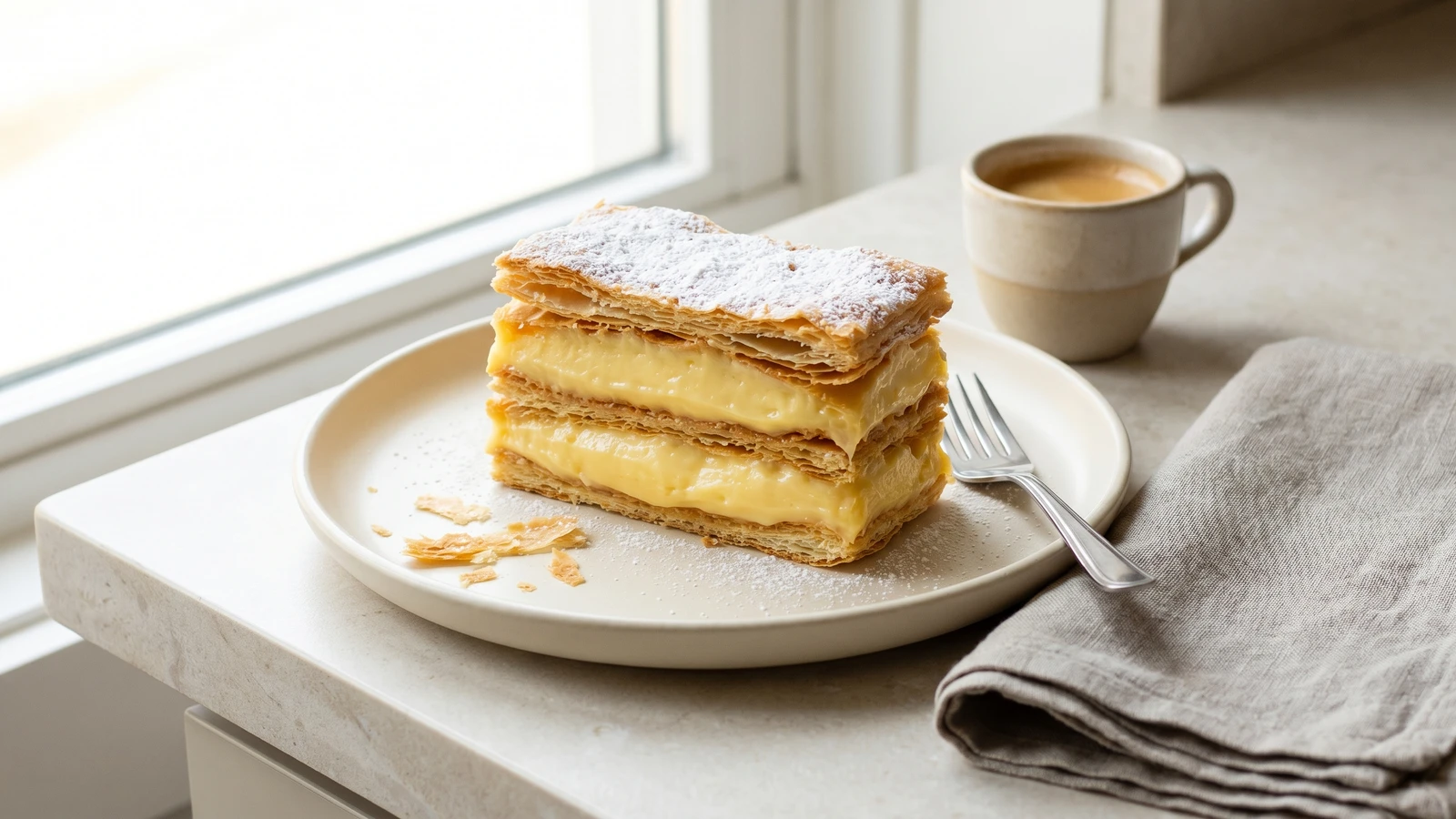
You think laminated pastry is a locked door. It isn't. Bake the pastry flat, make a real creme de confeiteiro, stack three layers, and the padaria comes home.
You looked at those thin pastry layers in the bakery case and thought, isso não é pra mim. I know. I used to look at puff pastry like it had gone to university without me. Then I learned the boring truth, which is the best kind of truth in the kitchen: it is not magic, it is a sequence.
Mil-folhas sits on the celebration side of the Brazilian table, not the everyday pê-efe, but it belongs to the same fight. Rice, beans, meat or egg, something green, then a sweet when there is a birthday, a Sunday lunch, a dinner with people you love. Comida de verdade was never a punishment, and dessert was never the enemy. The enemy is the packet pretending to be cream.
A gente is going to desgourmetizar this. You can make your own puff pastry if you want a project, but tonight we use good all-butter puff pastry and spend our attention where it matters: baking it crisp and flat, then cooking a real creme de confeiteiro until it thickens in the pan. No powdered filling. Milk, eggs, sugar, cornstarch, and the patience to whisk.
The method is plain. Keep the pastry cold so the butter makes separate layers. Weight it while it bakes so it doesn't balloon like a pillow. Cook the cream until it bubbles and loses the raw starch taste. Chill it until it holds. Then stack, dust, slice, and put it on the table like someone who has learned something. Because you have.
Mil-folhas comes from the French mille-feuille, a layered pastry of puff pastry and cream that traveled into Brazilian padarias and confeitarias through European baking traditions in the nineteenth and twentieth centuries. In Brazil, the common bakery version is usually simpler than the French showcase piece: three pastry layers, two layers of creme de confeiteiro, and powdered sugar or a thin glaze on top. Its Brazilian life is less about restaurant ceremony and more about the glass bakery case, the birthday tray, and the sweet brought to someone's house after lunch.
Quantity
1 sheet, about 14 ounces (400g)
thawed but cold
Quantity
2 tablespoons
for the pastry
Quantity
2 cups
Quantity
1/2 cup
Quantity
4 large
Quantity
1/4 cup
Quantity
1 tablespoon
Quantity
2 teaspoons
Quantity
1/4 teaspoon
Quantity
1/3 cup
for finishing
| Ingredient | Quantity |
|---|---|
| all-butter puff pastrythawed but cold | 1 sheet, about 14 ounces (400g) |
| granulated sugarfor the pastry | 2 tablespoons |
| whole milk | 2 cups |
| granulated sugar | 1/2 cup |
| egg yolks | 4 large |
| cornstarch | 1/4 cup |
| unsalted butter | 1 tablespoon |
| vanilla extract | 2 teaspoons |
| salt | 1/4 teaspoon |
| powdered sugarfor finishing | 1/3 cup |
Heat the oven to 200°C (400°F). Line a baking sheet with parchment. Keep the puff pastry in the fridge until the oven is ready, because warm pastry smears instead of rising into clean, crisp layers. Butter needs to hit the heat cold. Anota aí.
Set the cold pastry on the parchment and roll it gently into a rectangle about 10 by 14 inches. Sprinkle the top with 2 tablespoons sugar and press it in with the rolling pin. You want a thin, even sheet, not a wrestling match. Even thickness bakes evenly, and uneven pastry gives you one burnt corner and one soft corner sulking on the same tray.
Cover the pastry with another sheet of parchment and set a second baking sheet on top as a weight. Bake for 18 minutes, then remove the top tray and parchment. Bake 8 to 12 minutes more, until the pastry is deeply golden, dry to the touch, and crisp at the edges. The weight keeps it from puffing into a pillow, because mil-folhas needs crisp sheets you can stack, not a balloon you have to chase around the counter.
Let the pastry cool for 10 minutes, then trim the edges with a serrated knife and cut it into 3 equal rectangles. Use a gentle sawing motion, not a heavy press. Press down hard and you'll crush the layers you just worked to keep crisp.
Pour the milk into a medium saucepan and warm it over medium heat until tiny bubbles gather at the edge. Don't boil it hard. Hot milk loosens the egg mixture and helps the cream thicken smoothly, while boiling milk makes the whole thing feel rushed and bossy.
In a bowl, whisk the egg yolks, 1/2 cup sugar, cornstarch, and salt until thick, pale, and smooth. Whisk until you don't see dry cornstarch hiding at the bottom. Dry pockets turn into lumps in the pan, and then you start blaming the recipe. Not today.
Pour about 1/2 cup of the hot milk into the yolk mixture while whisking constantly, then whisk in another 1/2 cup. Pour the warmed yolk mixture back into the saucepan with the rest of the milk. This slow mixing teaches the eggs the heat before they meet the pan, so they thicken into cream instead of scrambling into sweet little bits. I have made the sweet little bits. We move on.
Cook over medium heat, whisking all the time, until the cream thickens, bubbles in slow heavy pops, and the whisk leaves tracks that hold for a second. Keep cooking for 1 full minute after it bubbles. That minute matters because cornstarch needs heat to lose its raw taste and set properly. Off the heat, whisk in the butter and vanilla until glossy.
Scrape the cream into a shallow bowl and press plastic wrap directly onto the surface. Chill until cold and firm, at least 1 hour. The wrap keeps a skin from forming, and the shallow bowl cools it fast. Warm cream slides out of the pastry like it has somewhere better to be.
Whisk the cold cream until smooth. Set one pastry rectangle on a board, spread half the cream evenly to the edges, top with the second rectangle, spread the rest of the cream, and finish with the third rectangle. Spread evenly, not thick in the middle, because the knife will push any hill into a landslide.
Chill the assembled mil-folhas for 30 minutes so the cream settles and the layers grip. Dust the top generously with powdered sugar just before serving. Slice with a serrated knife, using short gentle strokes. The top will crack a little. Good. That's pastry, not plastic.
1 serving (about 130g)
Culinary guides, cultural storytelling, and the editorial depth that makes cooking meaningful.
Discover Culinary ExplorerChef Juliana
You don't need the right grandmother or a festival oven to learn the logic: grate mandioca fine, squeeze it damp, mix in coconut, and bake thin. Two ingredients, no packet, real crunch.

Chef Juliana
You think tiny wrapped wedding sweets are for people with magic hands. They're not. They're sponge, filling, glaze, and patience, taught in plain steps until they behave.

Chef Juliana
You think this is bakery magic. It isn't. Scald sour cassava starch, beat in eggs, pipe rings, and let a hot oven crack them into crisp, hollow biscuits.

Chef Juliana
You don't need bakery courage for this. Polvilho, queijo Minas, milk, butter, and your hands make crisp little sticks for coffee, lunchboxes, or the snack that keeps dinner sane.