Culinary Explorer

A cooking platform built around craft, culture, and the stories behind what we eat.
Discover Culinary Explorer
Michoacán Clay-Pot Coffee (Café de Olla)

Michoacán Clay-Pot Coffee (Café de Olla)

Created by

Uruapan's café de olla is high-grown Michoacán arabica steeped in a barro pot with piloncillo, Mexican canela, clove, and orange peel, made for cold mornings and Christmas kitchens.

Beverages
Mexican
Comfort Food
Holiday
Christmas
10 min
Active Time
15 min cook25 min total
Yield6 servings

Michoacán first. Uruapan and the high, damp country around the Meseta Purépecha give this café de olla its backbone: coffee with mountain acidity, piloncillo with mineral depth, and the clay pot that rounds the edges without making the drink heavy.

This is not espresso with cinnamon thrown in after the fact. The coffee steeps inside the sweetened spice water, in a barro olla, the way women have made it for market mornings, posadas, wakes, long breakfasts, and cold December nights when the kitchen is the warmest room in the house. The defining ingredient is piloncillo, not brown sugar. Brown sugar is flat. Piloncillo tastes like cane, smoke, and earth.

I learned this version near Uruapan from a señora who sold corundas in the morning and coffee all day from a blackened clay pot. She didn't measure the canela. She broke it by hand, smelled the pot, and told me, 'cuando huele a casa, ya está.' When it smells like home, it is ready. That is not sentiment. That is technique learned through repetition.

Use a lead-free olla de barro and coarse coffee. If your coffee is ground for an espresso machine, it will turn muddy. If your orange peel has pith, it will turn bitter. Simple drink, serious decisions. Saber cocinar es saber vivir.

Café de olla became strongly associated with the Mexican Revolution of 1910, when soldaderas prepared sweet spiced coffee in clay pots for soldiers moving through cold camps and mountain roads. The drink spread nationally, but its character changes by region: Veracruz versions often lean brighter with local coffee, while central and western versions, including Michoacán, commonly use piloncillo, canela, clove, and citrus peel. Michoacán's coffee production is smaller than Veracruz or Chiapas, but the highland zones around Uruapan, Tancítaro, and Tacámbaro have long supplied local markets with arabica grown in volcanic soils.

The technique, the tradition, and the story behind every dish.

Discover Culinary Explorer

Ingredients

water

Quantity

6 cups

piloncillo

Quantity

4 ounces, or one small cone

chopped

Mexican cinnamon sticks (canela)

Quantity

2 sticks, about 3 inches each

orange peel

Quantity

2 wide strips

white pith removed

whole cloves

Quantity

2

star anise (optional)

Quantity

1 small

high-grown Michoacán arabica coffee

Quantity

6 tablespoons

coarsely ground

sea salt

Quantity

1 pinch

Equipment Needed

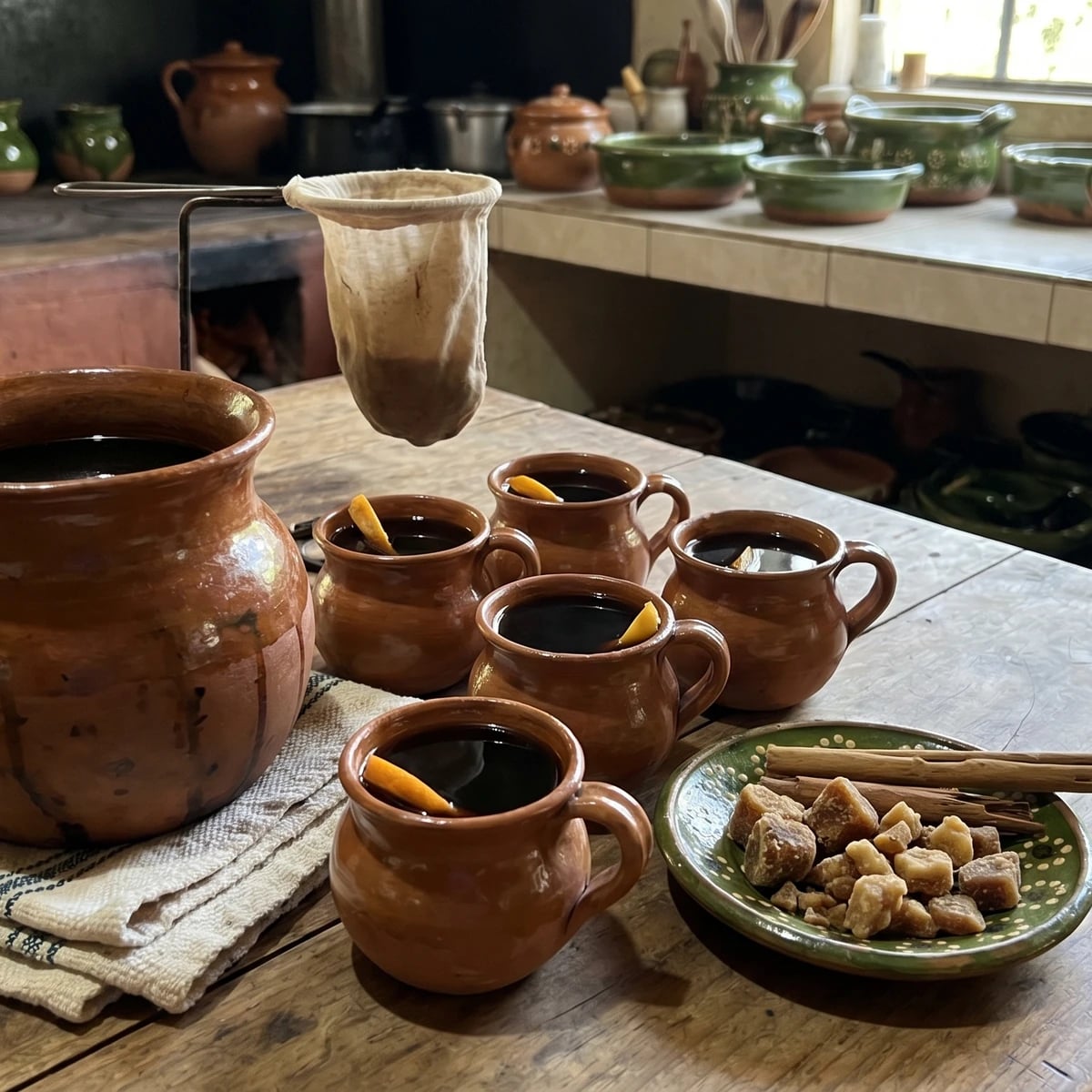
  • Lead-free barro olla, 2-quart capacity
  • Wooden spoon
  • Fine-mesh strainer or cotton coffee sock
  • Small barro jarritos for serving

Instructions

  1. 1

    Warm the olla

    Set a lead-free barro olla over medium-low heat and add the water. Let the clay warm gradually. Do not shock it over a hard flame like you are trying to punish it. Clay holds heat differently from metal, and that slow warmth is part of the flavor.

  2. 2

    Dissolve the piloncillo

    Add the chopped piloncillo, canela, orange peel, cloves, star anise if using, and the pinch of salt. Stir with a wooden spoon until the piloncillo dissolves completely and the water turns amber. The smell should be dark sugar, cinnamon bark, and orange oil. If it smells like candy, you used too much spice.

  3. 3

    Simmer the spices

    Bring the sweetened water to a gentle simmer and cook for 8 minutes. You want the canela to open and the orange peel to perfume the pot without turning bitter. Keep the heat moderate. Café de olla is not boiled coffee. Boiled coffee tastes tired before it reaches the cup.

    Remove every bit of white pith from the orange peel. The colored skin gives perfume. The pith gives bitterness. Pregúntale a las señoras del mercado.
  4. 4

    Add the coffee

    Turn off the heat. Add the coarsely ground Michoacán arabica and stir once, just enough to wet every grain. Cover the olla and let it steep for 5 minutes. Do not put this through a coffee machine. No me vengas con atajos. The grounds steep in the spiced piloncillo water, and that is the dish.

  5. 5

    Settle and strain

    Lift the lid and let the coffee sit uncovered for 1 minute so the grounds sink. Strain through a fine-mesh strainer or a cotton coffee sock into warm clay jarritos. The coffee should be deep brown, lightly glossy at the surface from the orange peel oils, and sweet but not syrupy.

  6. 6

    Serve in barro

    Serve immediately in small barro jarritos. No milk. No whipped cream. This is café de olla from Michoacán, not dessert in a paper cup. If someone wants it sweeter, pass more piloncillo syrup on the side, but the pot itself should stay balanced. Así se hace y punto.

Chef Tips

  • Use lead-free barro. Old clay pots can contain lead glaze. Tradition is not an excuse for poisoning your family. Buy from a reliable potter or use a certified lead-free olla.
  • The coffee must be coarse. Fine grind makes the cup muddy and over-extracted. Ask for molienda gruesa, coarse grind, the same way you would for a French press.
  • If you cannot find Michoacán coffee, use a good Mexican arabica from Chiapas, Oaxaca, or Veracruz. That is a compromise, not an upgrade. The structure of the drink remains, but the regional identity changes.
  • Mexican canela is softer and more fragrant than hard cassia cinnamon. If the stick is thick, hard, and smells sharp, use less. Real canela breaks easily between your fingers.
  • Piloncillo matters. It is unrefined cane sugar pressed into cones, and it gives the coffee its dark sweetness. Brown sugar will sweeten the pot, but it will not give the same depth.

Advance Preparation

  • The piloncillo spice base can be simmered up to one day ahead, strained, and refrigerated. Reheat it gently in the barro olla before adding the coffee.
  • Do not make the finished coffee hours ahead. Once the grounds steep, the flavor keeps darkening and turning bitter. Make it close to serving.

Frequently Asked Questions

Nutrition Information

1 serving (about 240g)

Calories
75 calories
Total Fat
0 g
Saturated Fat
0 g
Trans Fat
0 g
Unsaturated Fat
0 g
Cholesterol
0 mg
Sodium
25 mg
Total Carbohydrates
19 g
Dietary Fiber
0 g
Sugars
18 g
Protein
0 g

Note: Chef personas and recipes are created with AI assistance. Cook with care: follow safe food-handling practices, check doneness with a thermometer when needed, and adapt for allergies and your kitchen.

Where cooking meets culture.

Culinary guides, cultural storytelling, and the editorial depth that makes cooking meaningful.

Discover Culinary Explorer

More from Occidente Beverages

Browse the full collection