Chef Joost
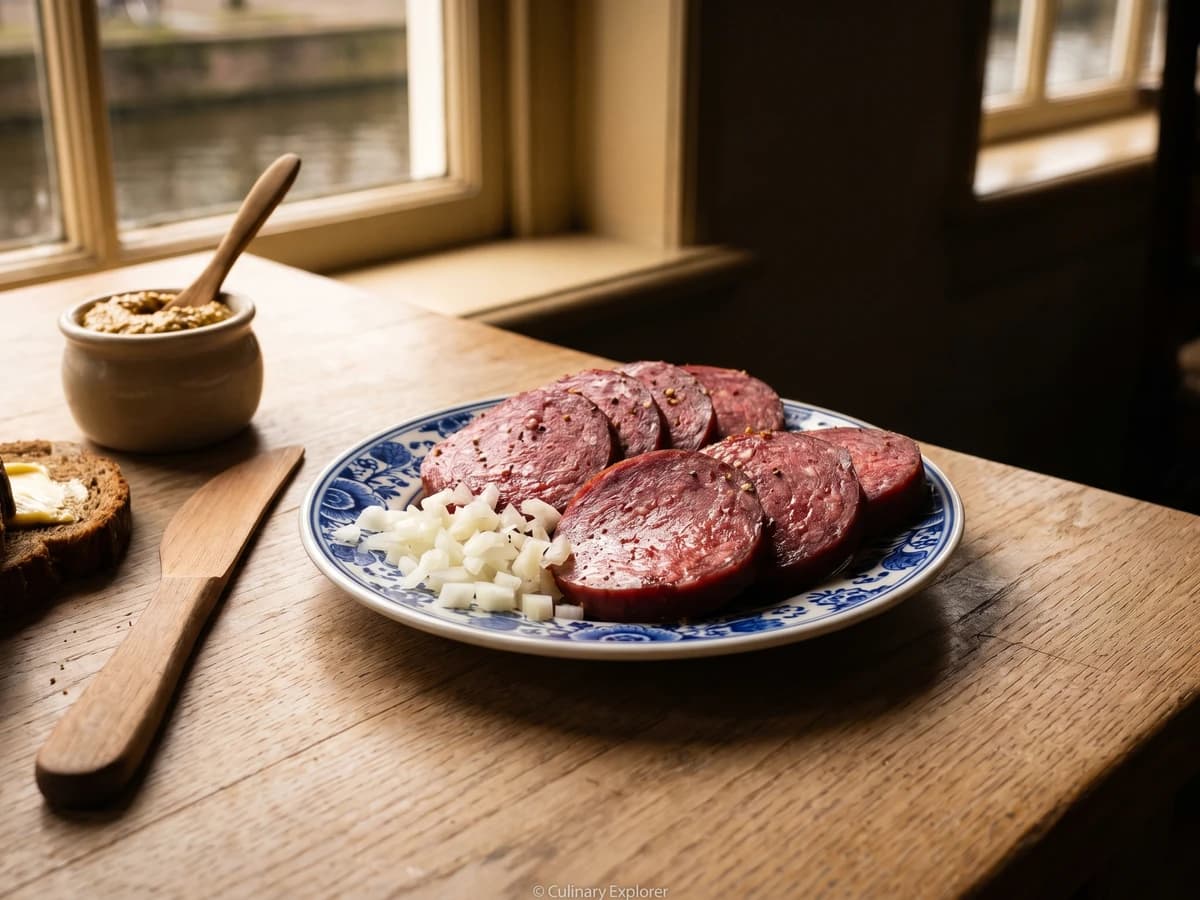
Amsterdamse Ossenworst
The name means ox sausage, but the real story is Amsterdam itself: cattle trade, Jewish butchers, VOC spices, and raw beef sliced thin with onion.
A cooking platform built around craft, culture, and the stories behind what we eat.

Created by
The snackbar's spicy outsider is Dutch to its bones: flat, ribbed, paprika-hot minced meat, fried until crisp and dragged through curry sauce.
The Mexicano is what happens when the Dutch snackbar, that fluorescent little republic of hunger, decides it wants drama but still wants it for a few coins. Flat, ridged, orange-red with paprika and pepper, it sits between the frikandel and the kroket like the cousin who came back from holiday with stories. The name already tells you what people wanted to taste: not Mexico itself, but the idea of heat, colour, and distance in a country that had long made spices ordinary.
But let me tell you a secret. This thing is Dutch. Not old Dutch, not grandmother's notebook Dutch, but petrol-station, football-evening, after-school Dutch. We have a habit of pretending our food became interesting only when it looked abroad, while the truth is stranger and better: the Dutch snack bar took industrial minced meat, paprika, curry powder, sambal, and the deep fryer, then made a new folk food out of them. Exuberant cookery in a frugal country, with a paper tray.
The ribs matter. They are not decoration. They make edges, and edges crisp; they catch sauce; they let a thin meat snack fry quickly without turning heavy. Hou het altijd simpel, always keep it simple: mix the meat cold, season it boldly, press it flat, score the grooves deep, chill it until firm, then fry hard and briefly. Eat it with curry sauce, and don't pretend you reached for a knife and fork.
The Mexicano appeared in Dutch snack bars in the late twentieth century and is commonly associated with De Vries Snacks of Dordrecht, which helped popularize the ribbed, spicy minced-meat shape in the 1980s. Its name does not record a Mexican recipe so much as the Dutch snackbar's postwar appetite for paprika heat, curry ketchup, and borrowed culinary glamour. Like the frikandel, it belongs to the modern Dutch fried-snack canon: inexpensive, factory-born, nationally recognized, and more culturally revealing than polite people first admit.
Quantity
500g
well chilled
Quantity
60g
Quantity
1
Quantity
2 tablespoons
Quantity
2 teaspoons
Quantity
1 teaspoon
Quantity
1 teaspoon
Quantity
1 teaspoon
Quantity
1/2 teaspoon
Quantity
1/2 teaspoon
Quantity
1/2 teaspoon
Quantity
1/2 teaspoon
Quantity
1 teaspoon
Quantity
1/2 teaspoon
Quantity
1 tablespoon
Quantity
1 tablespoon
Quantity
for deep-frying
Quantity
to serve
| Ingredient | Quantity |
|---|---|
| minced chicken, pork, or mixed minced meatwell chilled | 500g |
| fine dry breadcrumbs | 60g |
| egg | 1 |
| milk | 2 tablespoons |
| smoked paprika | 2 teaspoons |
| sweet paprika | 1 teaspoon |
| curry powder | 1 teaspoon |
| ground coriander | 1 teaspoon |
| ground cumin | 1/2 teaspoon |
| garlic powder | 1/2 teaspoon |
| onion powder | 1/2 teaspoon |
| cayenne pepper (optional) | 1/2 teaspoon |
| fine salt | 1 teaspoon |
| freshly ground black pepper | 1/2 teaspoon |
| sambal oelek | 1 tablespoon |
| tomato ketchup | 1 tablespoon |
| neutral oil | for deep-frying |
| curry sauce or curry ketchup | to serve |
Put the cold minced meat, breadcrumbs, egg, milk, spices, salt, pepper, sambal, and ketchup into a bowl. Mix with your hand until the mixture turns sticky and holds together. That stickiness is the protein binding itself; stop too early and the snacks crumble in the oil, mix too long and they become rubbery.
Divide the mixture into eight equal portions. With wet hands, press each portion into a flat oval or rounded rectangle about 10cm long and 1.5cm thick. Lay them on baking paper, then press deep ribs across the top with the handle of a wooden spoon or the back of a butter knife.
Refrigerate the shaped snacks for at least 1 hour, uncovered or loosely covered. Cold meat keeps its shape in hot oil, and the grooves stay grooves instead of smoothing themselves into apology.
Heat the oil to 175C in a deep pan or fryer. Fry the Mexicanos in batches for 4 to 5 minutes, turning once, until deep reddish-brown and crisp at the ridges. The centre should reach 74C if you are using poultry, or 70C for pork or mixed meat. Drain on a rack, not kitchen paper, so the ridges stay crisp.
Serve hot with curry sauce or curry ketchup alongside. A soft white roll is not wrong, and neither is eating one standing at the counter. Gezellig, convivial, does not always require a tablecloth.
1 serving (about 105g)
Culinary guides, cultural storytelling, and the editorial depth that makes cooking meaningful.
Discover Culinary ExplorerChef Joost
The name means ox sausage, but the real story is Amsterdam itself: cattle trade, Jewish butchers, VOC spices, and raw beef sliced thin with onion.

Chef Joost
The little yellow onion on the Amsterdam borrel board looks modest, until vinegar, turmeric, and patience turn it into the sharp bite that wakes cheese, herring, and sausage.

Chef Joost
The bear's claw of the northern snackbar: a seasoned gehaktbal, Dutch meatball, cut into thick discs, skewered with onion, fried until the edges catch, then dragged through peanut sauce.

Chef Joost
The name points to the drink, not the mood: bitterballen are crisp little balls of beef ragout made for the borrel table, mustard beside them, fingers slightly burned by impatience.