
Chef Lupita
Acitrón de Cidra Conventual
Puebla's convent-style acitrón, made from cidra peel instead of endangered biznaga, built through repeated syrup soakings until the cubes turn firm, translucent, and ready for rosca or chiles en nogada.
A cooking platform built around craft, culture, and the stories behind what we eat.
Created by
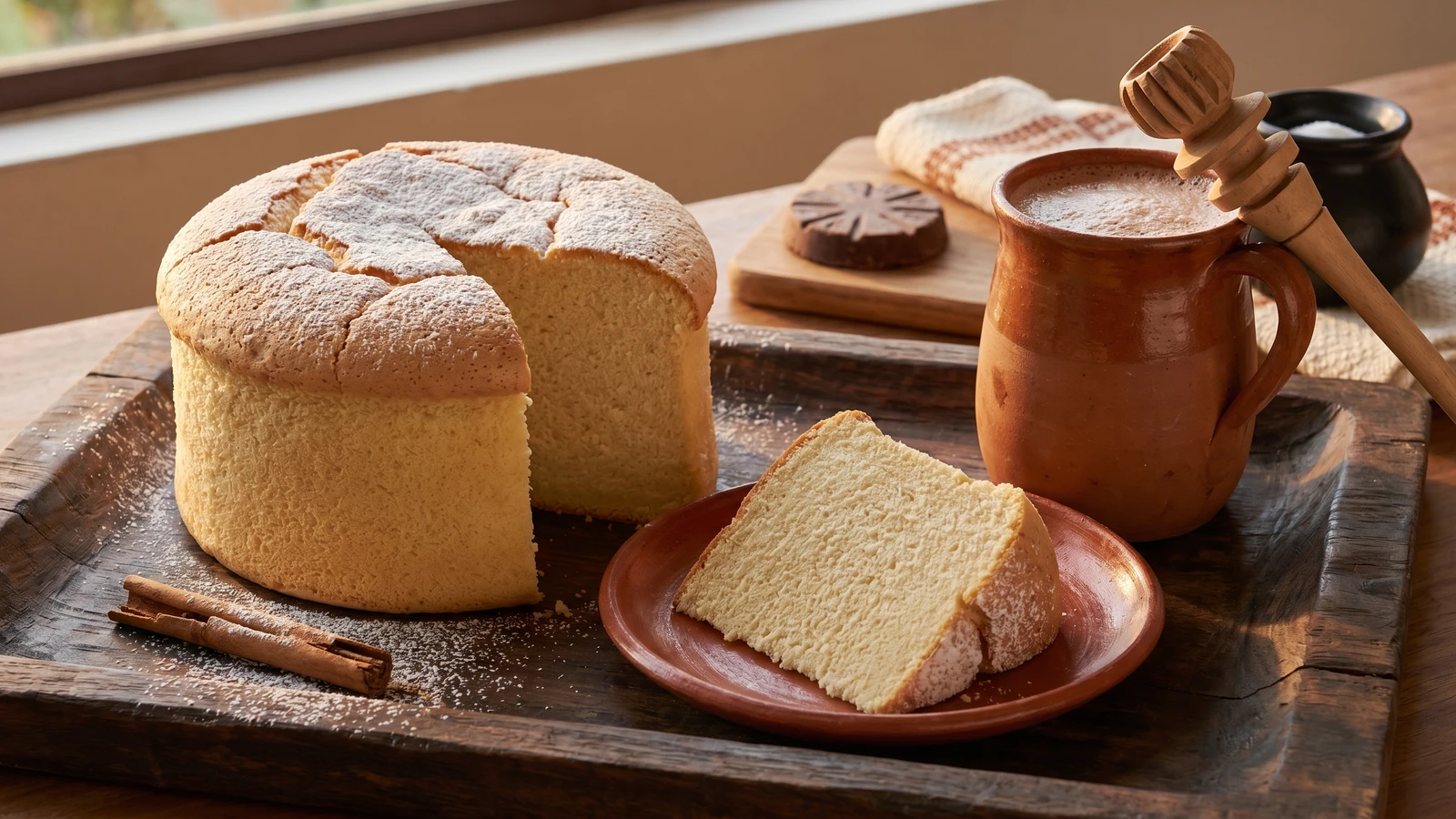
Oaxaca's convent egg sponge, whipped airy with wheat and cornstarch and baked dry on purpose, built to soak up a tall mug of frothed Oaxacan chocolate at weddings, baptisms, and nine-day wakes.
Marquesote belongs to Oaxaca. Not Mexico generally. Oaxaca. You find it in the dulcerias around the Centro Historico, in the comedor stalls at the 20 de Noviembre market, and on the table at every serious life event in a Oaxacan family: a wedding, a baptism, a quinceañera, the nine days of a velorio when the chocolate keeps coming and the people keep arriving. This is a celebration cake and a mourning cake at the same time, which is very Oaxacan.
The recipe came down through the convents. Spanish nuns brought European sponge-cake technique with them in the 17th century, and the women of Oaxaca took it apart and rebuilt it. Wheat flour cut with cornstarch, eggs whipped separately to push the volume as high as it will go, the whole thing baked until it is dry, almost biscuity. Outside Oaxaca, this would read as a flaw. In Oaxaca, it is the whole engineering of the dish. A dry sponge soaks up hot chocolate without collapsing. A wet sponge dissolves in your cup like a tragedy.
The senora at Jardín Sócrates who taught me her version watched me beat the yolks for two minutes and stopped me. 'Otros cinco,' she said. Five more. Then she watched me fold and slowed my hand down. The marquesote does not forgive a heavy hand or a short attention span. It is a cake of patience and air. Cada estado, su propia cocina, and this one is Oaxaca's reply to anyone who thinks Mexican baking begins and ends with tres leches.
Marquesote arrived in New Spain through the convent kitchens of the 17th century, where Spanish and criolla nuns adapted Iberian bizcocho techniques, themselves descended from medieval Arab egg-and-sugar confections, to local ingredients and altitudes. Oaxaca's Convento de Santa Catalina and the Dominican houses of the Valles Centrales were particularly influential in codifying the local version, which substituted a portion of the wheat flour with cornstarch (fecula de maiz) to produce the characteristic dry, friable crumb suited to dipping in chocolate. The cake's role at velorios and life-cycle celebrations was reinforced by its keeping qualities: a dried sponge sealed in tin would last the full nine days of a traditional novenario, when neighbors arrived continuously with their own pots of chocolate and expected something to dunk.
Quantity
8
separated, at room temperature
Quantity
1 cup
Quantity
1 teaspoon
finely grated
Quantity
1/2 teaspoon
Quantity
3/4 cup
Quantity
1/2 cup
Quantity
1/4 teaspoon
Quantity
1 tablespoon
softened, for the pan
Quantity
2 tablespoons
for the pan
Quantity
for dusting
Quantity
for serving
| Ingredient | Quantity |
|---|---|
| large eggsseparated, at room temperature | 8 |
| granulated sugar | 1 cup |
| Mexican lime zestfinely grated | 1 teaspoon |
| ground canela (Mexican cinnamon) | 1/2 teaspoon |
| all-purpose wheat flour | 3/4 cup |
| cornstarch (fecula de maiz) | 1/2 cup |
| fine sea salt | 1/4 teaspoon |
| unsalted buttersoftened, for the pan | 1 tablespoon |
| all-purpose flourfor the pan | 2 tablespoons |
| powdered sugar (optional) | for dusting |
| hot Oaxacan chocolate | for serving |
Heat the oven to 350F. Butter the inside of a 9-inch round cake pan, sides and bottom. Dust with the two tablespoons of flour, tap out the excess. The marquesote is a delicate sponge and it cannot be coaxed out of a sticky pan without breaking. Some senoras in Oaxaca line the bottom with parchment too. If you are not confident in your pan, do it.
In a large bowl, beat the egg yolks with three-quarters of the sugar, the lime zest, and the canela on high speed for five to seven minutes. The mixture should triple in volume and turn pale yellow, almost ivory. When you lift the beater, the ribbon of yolk should fall back on itself and hold its shape for a count of three before disappearing. That ribbon is the structure of the cake. Underwhip it and the marquesote falls flat in the oven.
In a clean, dry bowl with a clean beater, whip the egg whites with the salt on medium until they turn foamy. Raise the speed to high and rain in the remaining quarter cup of sugar a tablespoon at a time. Whip until the whites hold firm peaks that stand straight up when you lift the beater, but still look glossy, not dry. Dry, broken whites cannot be folded into a sponge. They will leave white streaks no matter how patient you are.
Sift the wheat flour and cornstarch together onto a sheet of parchment. Sift them again. Twice. The cornstarch is what makes a marquesote different from a regular sponge. It lightens the crumb and gives the cake the dry, almost crumbly bite that lets it drink up hot chocolate without falling apart in the cup. La cocina no es decoracion, es trabajo. The double sift earns its place.
Add a third of the whipped whites to the yolk mixture and fold them in with a spatula. This first addition lightens the heavy yolks. Now sift a third of the flour mixture over the top and fold it in with long, slow strokes from the bottom up. Add another third of the whites, fold. Another third of the flour, fold. The last whites, fold. The last flour, fold. The batter should look pale, airy, and uniform. No streaks. Pour it into the prepared pan and smooth the top with the back of the spatula.
Bake on the middle rack for 30 to 35 minutes. The top should be the color of toasted piloncillo, the cake should pull slightly away from the sides of the pan, and a wooden skewer pushed into the center should come out clean and dry. The marquesote is supposed to be dry. That is the point. A moist, fudgy cake will dissolve into the chocolate. A dry sponge holds its shape long enough to soak up the chocolate and deliver it to your mouth in one bite. Asi se hace y punto.
Cool the marquesote in the pan on a wire rack for ten minutes. Run a thin knife around the edge to release it. Invert onto the rack, then flip right-side-up onto a serving plate. Let it cool completely before serving. A warm marquesote is fragile. A cool one is sturdy enough to handle and to dunk.
Cut the marquesote into thick wedges. Serve each piece on a small plate with a tall mug of Oaxacan chocolate beaten to a foam with a molinillo. The eater tears off a piece, dips it into the chocolate until the cake is heavy with it, and eats it before it falls apart in their fingers. That is the whole point of marquesote. The cake is a vehicle for the chocolate. Recetas probadas y garantizadas.
1 serving (about 72g)
Culinary guides, cultural storytelling, and the editorial depth that makes cooking meaningful.
Discover Culinary ExplorerChef Lupita
Puebla's convent-style acitrón, made from cidra peel instead of endangered biznaga, built through repeated syrup soakings until the cubes turn firm, translucent, and ready for rosca or chiles en nogada.

Chef Lupita
Ciudad de México's Tulyehualco alegría is popped huautli folded into piloncillo honey, pressed with peanuts, pepitas, and raisins, then cut into the rectangular bars that built a pueblo's identity.

Chef Lupita
Oaxaca's pre-Columbian amaranth bar, popped on a hot comal and bound with piloncillo, honey, and the sacred Zapotec grain that the Spanish tried, and failed, to outlaw.

Chef Lupita
Querétaro's mercado candy of popped amaranto pressed with dark piloncillo syrup, pepitas, pecans, and cacahuate, a Bajío sweet that respects the seed before it decorates the table.