
Chef Dimitra
Agrafa Batzina (Μπατζίνα), Courgette and Feta Pie
Agrafa's batzina is the no-phyllo pie of Karditsa: grated courgette, feta, eggs, milk, and flour poured thin into a hot oiled tapsi.
A cooking platform built around craft, culture, and the stories behind what we eat.
Created by
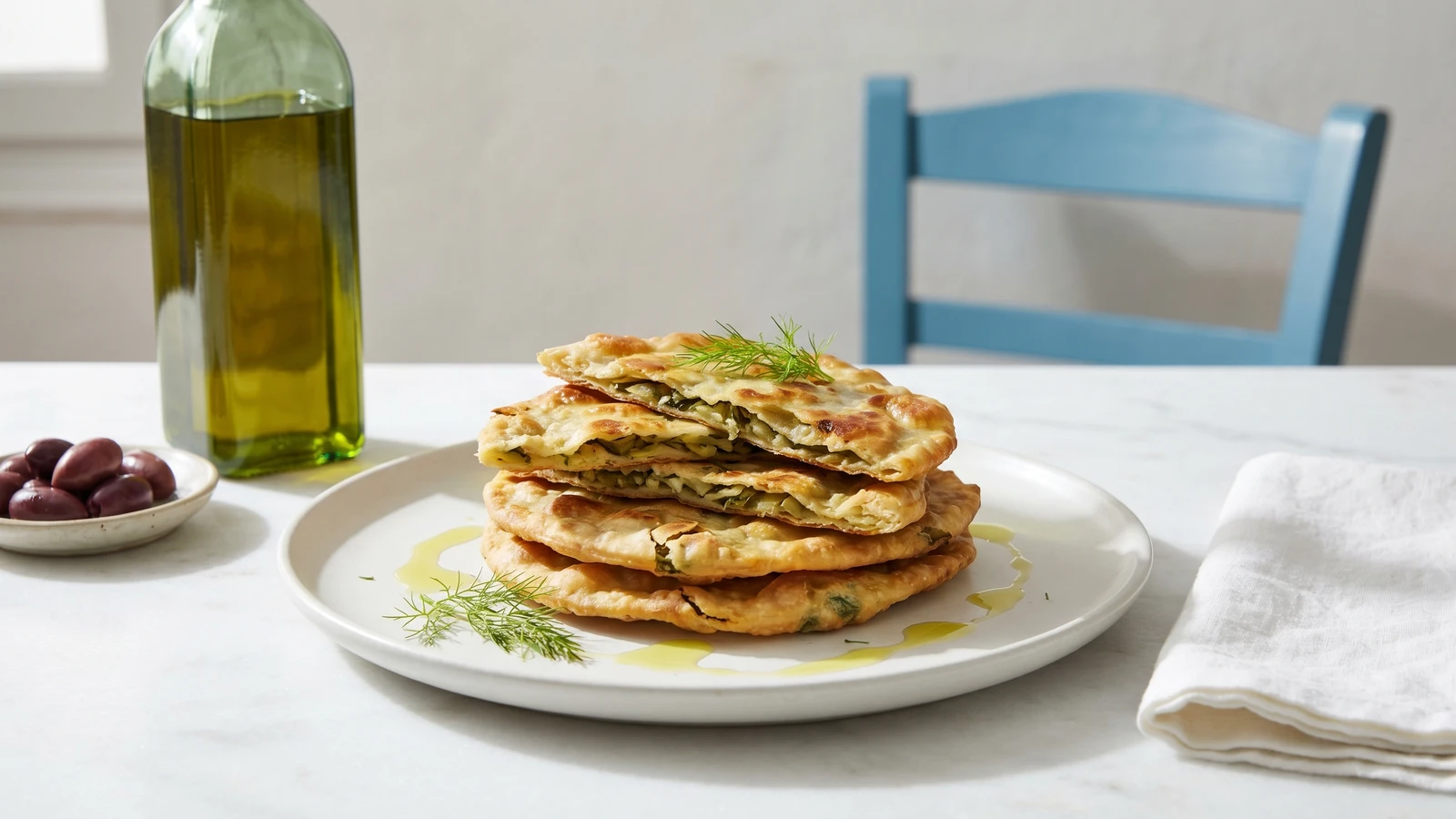
Crete's marathopita is a thin pan-fried pie filled with wild fennel, spring onion, and olive oil, made for Lent and for any day the fields are green.
Marathopita Kritis belongs to Crete: a thin, pan-fried pie filled with maratho, the wild fennel that perfumes the island after rain. It isn't a cheese pie with herbs tucked in for color. It is fennel first, chopped fine, held in a simple olive-oil dough, fried until the outside turns crisp and spotted gold.
The whole pie depends on the knife work. Chop the fennel finely enough that it becomes part of the filling rather than a bundle of stems. If the pieces are too long, they pull through the dough when you roll the pie flat, and the skillet finds every tear. Fine greens, rested dough, moderate heat. That's the trick.
This is nistisimo, fasting food, but nobody should hear that as deprivation. Crete knows how to make a meal from flour, field greens, and oil because the island had to know. Λίγα και καλά: a few things, and good ones. When a Cretan cook makes marathopita well, you taste the hillside more than the pantry.
I write it down plainly because this is exactly the sort of recipe that disappears when the woman who knew the dough by touch stops making it. Your grandmother cooked by eye because she'd made it a thousand times. Here are the numbers until you have.
Marathopita is a Cretan wild-greens pie, especially tied to western Crete, where foraged maratho grows after winter rains and into spring. It belongs to the island's nistisima repertoire: flour, greens, and olive oil made into a filling meal during Orthodox fasting periods without needing cheese or eggs. Unlike layered pites baked in a tapsi, marathopita is rolled thin and fried in the pan, a method suited to quick household cooking and to greens gathered the same day.
Quantity
350g
plus extra for rolling
Quantity
180ml
Quantity
30ml
for the dough, plus 80ml for frying
Quantity
15ml
Quantity
6g
for the dough
Quantity
250g
tough stems removed, finely chopped
Quantity
120g
finely sliced
Quantity
80g
finely chopped
Quantity
30ml
for the filling
Quantity
1g
Quantity
2g
for the filling
| Ingredient | Quantity |
|---|---|
| all-purpose flourplus extra for rolling | 350g |
| lukewarm water | 180ml |
| extra virgin olive oilfor the dough, plus 80ml for frying | 30ml |
| raki or white wine vinegar | 15ml |
| fine sea saltfor the dough | 6g |
| wild fennel fronds (maratho, μάραθο)tough stems removed, finely chopped | 250g |
| spring onionsfinely sliced | 120g |
| leekfinely chopped | 80g |
| extra virgin olive oilfor the filling | 30ml |
| freshly ground black pepper | 1g |
| fine sea saltfor the filling | 2g |
Put the flour and 6g salt in a bowl. Add the water, 30ml olive oil, and raki or vinegar, then mix until a rough dough forms. Knead for 6 to 8 minutes, until smooth and elastic but not hard. Cover and rest for 30 minutes.
Wash the maratho well and dry it thoroughly. Chop it very fine, including only the tender stems. This is the step that decides the pie: coarse fennel tears the dough and makes lumps, while fine fennel folds into the dough and crisps evenly in the pan.
Warm 30ml olive oil in a wide pan over medium heat. Add the spring onions and leek with 2g salt and cook for 5 minutes, until soft but not browned. Stir in the chopped maratho and black pepper, cook for 2 minutes just to relax the greens, then take off the heat and cool completely.
Divide the dough into 8 equal pieces. Roll each piece into a thin circle, about 18cm wide, dusting lightly with flour. Keep the other pieces covered while you work so the dough stays supple.
Spoon one eighth of the cooled filling over half of each circle, leaving a narrow rim. Fold the dough over, press the edge closed, then roll gently with the pin to flatten the pie thinly without forcing the filling through. It should be almost flat, not stuffed like a turnover.
Heat a thin film of olive oil in a heavy skillet over medium heat. Fry the pies one or two at a time for 2 to 3 minutes per side, until golden patches appear and the edges crisp. Add a little more oil as needed, but don't drown them.
Move the marathopites to a rack or paper-lined plate for 5 minutes. Serve warm or at room temperature, when the fennel is fragrant and the dough still has its crisp bite.
1 serving (about 105g)
Culinary guides, cultural storytelling, and the editorial depth that makes cooking meaningful.
Discover Culinary ExplorerChef Dimitra
Agrafa's batzina is the no-phyllo pie of Karditsa: grated courgette, feta, eggs, milk, and flour poured thin into a hot oiled tapsi.

Chef Dimitra
Zagori's flour pie skips phyllo completely: a loose egg-and-flour batter, crumbled feta, and a hot buttered tapsi that makes the edges crisp.

Chef Dimitra
Hydra and Andros give amygdalota their island surname: ground almond, sugar, egg white, and rosewater, baked pale so the center stays soft as marzipan.

Chef Dimitra
Asia Minor ekmek kataifi is built in three clear layers: crisp syruped kataifi, thick semolina custard, and cold kaimaki cream under pistachios.