
Chef Jeong-sun
Bokbunja-ju (Black Raspberry Wine)
Summer bokbunja steeped with sugar and strong damgeum soju until the berries give up their deep tart color, a make-ahead Korean fruit wine for small cold cups and a slow table.
A cooking platform built around craft, culture, and the stories behind what we eat.
Created by
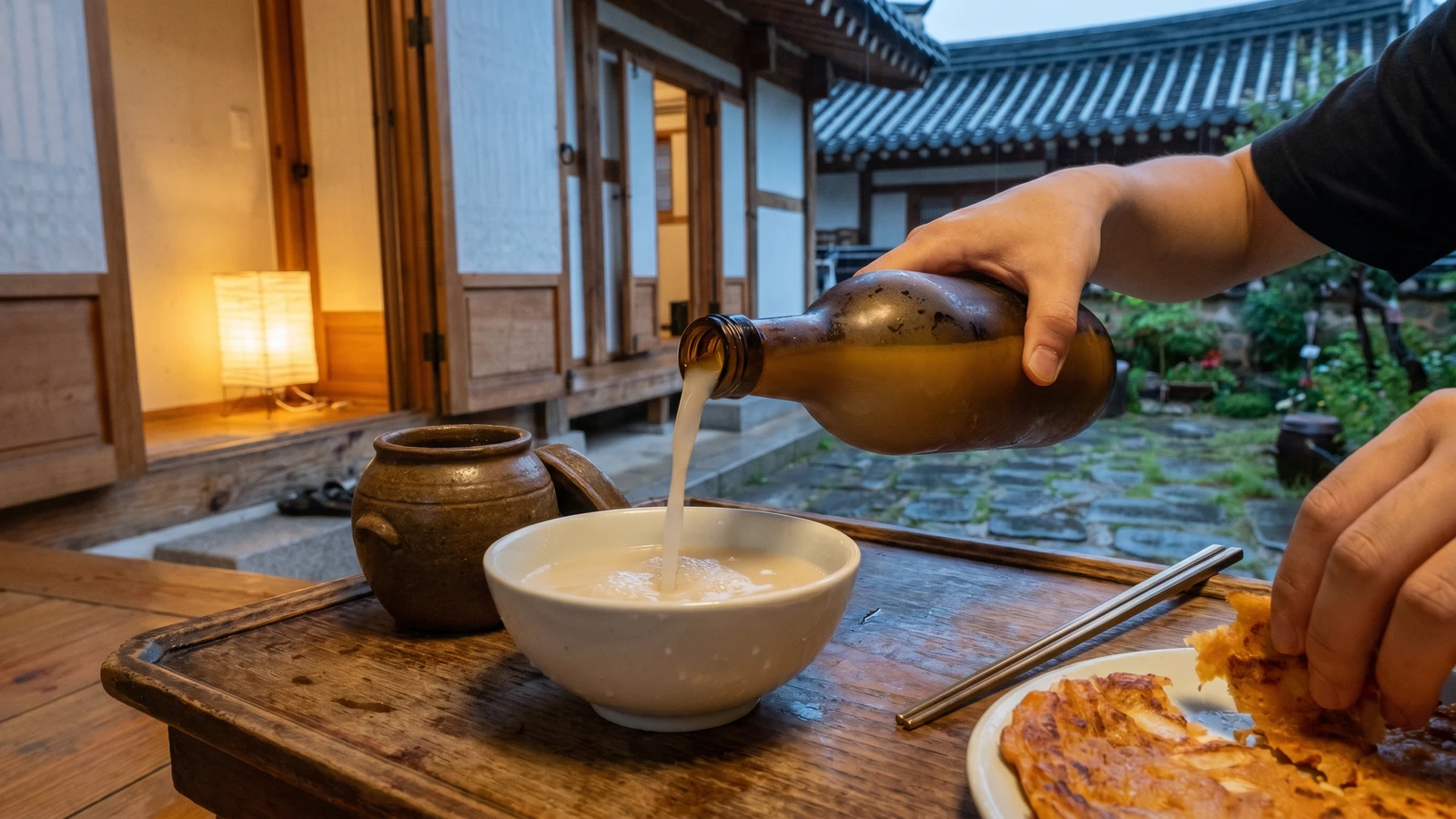
The farmhouse rice wine raised by nuruk, water, and patience: cloudy, lightly sparkling, tart-sweet when young, and good beside jeon, kimchi, and any table that has room for one more cup.
Makgeolli lives or dies by cleanliness, temperature, and the nuruk. People talk as if rice wine is mysterious. It is not mysterious. It is alive. Treat it carelessly and it punishes you; keep the jar clean, the rice cooled, the room steady, and it rewards you with a drink that belongs to rain, pancakes, and friends leaning too close over the table.
My teacher made us wash the rice until our wrists got tired, then told us to do it once more. I thought she was being severe. She was saving the brew. Too much surface starch makes a heavy, sour drink; hot rice kills the organisms in the nuruk; a sealed jar during active fermentation can burst. These are not small details. These are the dish.
Use weighed rice and weighed nuruk. Old instructions say a bowl of this and a handful of that, but nuruk varies by maker, and a handful belongs only to the hand that held it. Notebook 41 says 1 kilogram rice to 180 grams nuruk and 1.2 liters water for a good home makgeolli: active, tart, and milky after straining. Write it down. Memory is a borrowed bowl.
This is make-ahead food, not instant comfort. Tonight you wash and soak rice, tomorrow you steam and mix, and for the next week you watch the jar like a quiet patient. When it is ready, chill it hard, swirl before pouring, and drink it in small bowls with something salty beside it.
Makgeolli is one of Korea's oldest common alcoholic drinks, made from rice, water, and nuruk, the wheat-based fermentation starter that carries molds, yeasts, and lactic acid bacteria. Its name is often understood from mak, meaning roughly or freshly, and georeuda, to strain, pointing to a drink filtered coarsely rather than refined clear like cheongju. In the twentieth century, rice shortages and brewing restrictions changed makgeolli production, but small breweries and home brewers have brought back regional nuruk character and fresh, unpasteurized styles.
Quantity
1 kg
Quantity
180 g
broken up and sifted
Quantity
1.2 liters
cooled, for brewing
Quantity
200 to 500 ml
for diluting after straining
Quantity
1 tablespoon
only at serving
| Ingredient | Quantity |
|---|---|
| short-grain white rice | 1 kg |
| nuruk (Korean fermentation starter)broken up and sifted | 180 g |
| chlorine-free watercooled, for brewing | 1.2 liters |
| cold chlorine-free waterfor diluting after straining | 200 to 500 ml |
| sugar (optional)only at serving | 1 tablespoon |
Rinse the rice in a large bowl, rubbing it between your palms, then drain. Repeat 6 to 8 times, until the water runs mostly clear rather than milky. This removes loose starch that can make the brew heavy and harsh. Soak the rice in clean water 8 to 12 hours, then drain in a colander for 1 hour.
Line a steamer with damp cotton cloth and spread the drained rice evenly. Steam over strong heat for 40 to 45 minutes, until the grains are cooked through but separate and firm. Do not boil it like table rice. Makgeolli rice needs structure so the nuruk can work through it without turning the whole jar to paste.
Spread the hot rice on a clean tray and cool it to 25 to 30 C. Turn it once or twice with clean hands or a rice paddle. Hot rice kills the life in the nuruk; cold rice ferments slowly. This range is not fussiness. It is how you give the starter a fair beginning.
Put the cooled rice, 180 g nuruk, and 1.2 liters chlorine-free water into a sanitized 4-liter glass jar or onggi. Mix with a sanitized spoon or clean gloved hand for 5 full minutes, squeezing gently so the nuruk and water touch every grain. The mixture should look like loose porridge with distinct rice grains.
Cover the jar with clean cloth or a lid set on loosely, never sealed tight. Set it at 20 to 24 C for 5 to 7 days. Stir once daily for the first 3 days with a sanitized spoon, then leave it alone. You should see bubbles, hear a faint fizz when stirred, and smell rice, yogurt, fruit, and grain. If you see fuzzy mold in blue, green, black, or pink, throw the batch away without tasting.
After day 5, taste a spoonful with a clean spoon. It should be lightly sweet, tart, yeasty, and alcoholic, with no rotten or chemical smell. If it is still very sweet and thick, give it another day. If it is sharply sour but clean, strain it now. Wild fermentation has a clock, but it also has weather.
Set a fine mesh strainer lined with clean cheesecloth over a large bowl. Pour in the fermented mash and press gently until the liquid runs milky. Do not wring hard enough to force gritty solids through. Add 200 to 500 ml cold chlorine-free water until the texture is drinkable and the flavor is balanced: tart, lightly sweet, and grainy, not pasty.
Pour the makgeolli into clean plastic bottles or swing-top bottles rated for carbonation, leaving at least 5 cm headspace. Chill immediately. If you bottle in glass, keep it refrigerated and open once daily for the first 2 days to release pressure. The drink is alive, and a tight bottle can build pressure fast.
Serve cold within 1 to 2 weeks. Swirl the bottle gently before pouring so the rice sediment returns to the drink. Taste before sweetening. If you want the softer market-stall style, stir 1 tablespoon sugar into 1 liter makgeolli just before serving, not before storage, because sugar wakes the fermentation again.
1 serving (about 250g)
Culinary guides, cultural storytelling, and the editorial depth that makes cooking meaningful.
Discover Culinary ExplorerChef Jeong-sun
Summer bokbunja steeped with sugar and strong damgeum soju until the berries give up their deep tart color, a make-ahead Korean fruit wine for small cold cups and a slow table.

Chef Jeong-sun
A cloudy Korean rice wine brewed with sweet rice, nuruk, and water, strained just enough to drink while pale grains bob on top, the celebration cup that asks for patience more than equipment.

Chef Jeong-sun
A measured home version of Myeoncheon's spring rice wine, made from steamed glutinous rice, nuruk, and edible azalea petals cleaned one by one, then strained clear for a table that waited.

Chef Jeong-sun
A late-autumn Korean rice wine made from hard-steamed glutinous rice, nuruk, chrysanthemum, goji, and rehmannia, fermented slowly until the cup turns pale gold and gently medicinal.