
Chef Zohra
Batbout Farci (بطبوط)
Small semolina breads cooked in a pan until they puff, then split and filled generously. Batbout farci is the sandwich you make for picnics, school bags, and one more guest.
A cooking platform built around craft, culture, and the stories behind what we eat.

Created by
A Tafilalet bread sealed around spiced meat, onions, almonds, and herbs, baked until the crust turns gold and the filling perfumes the whole table.
The whole dish lives in the sealing of the dough. Press the edges badly and the filling escapes; seal it well and the bread becomes its own little oven, holding the meat, onions, almonds, and spices until everything inside turns fragrant and soft.
Madfouna means buried, and in Tafilalet it remembers the old way: a filled round of dough baked in hot ashes, close to the ground and close to the people waiting for it. At home today, a hot stone or heavy tray gives you the honest answer. You want a thin crust, not a thick loaf, and a filling chopped fine enough to cook through before the bread hardens.
This is food of welcome from the southeast, Rissani, Erfoud, the date country and the caravan roads. Cut it into wedges at the table while it's still glossy with a little oil. One round never feels like enough. A table is a door you leave open, so make two if the house is breathing.
Madfouna Filaliya belongs to Tafilalet, especially around Rissani and Erfoud, a Saharan-edge region shaped by date agriculture and caravan routes linking Morocco to the wider desert trade. Its name, from the Arabic for buried, points to the older hearth method of cooking the sealed bread under hot ashes, though exact dating is oral and contested rather than written. The dish carries Amazigh, Arab, and oasis-household practices together, one of des cuisines marocaines rather than a single national pattern.
Quantity
500g
plus more for dusting
Quantity
1 tsp
for the dough
Quantity
1 tsp
Quantity
300ml
added gradually
Quantity
2 tbsp
plus more for brushing
Quantity
350g
Quantity
1 large
finely chopped
Quantity
2 tbsp
finely chopped
Quantity
2 tbsp
finely chopped
Quantity
60g
toasted and roughly chopped
Quantity
1 tbsp
from a trusted spice merchant
Quantity
1 tsp
Quantity
1 tsp
Quantity
1/2 tsp
Quantity
1/2 tsp
Quantity
1 pinch
bloomed in 2 tbsp warm water
Quantity
1/2
finely chopped
Quantity
1 tbsp
for the filling
Quantity
1 tsp
for the filling
Quantity
1/2 tsp
| Ingredient | Quantity |
|---|---|
| fine semolina or bread flourplus more for dusting | 500g |
| fine sea saltfor the dough | 1 tsp |
| instant yeast | 1 tsp |
| warm wateradded gradually | 300ml |
| olive oilplus more for brushing | 2 tbsp |
| minced lamb or beef | 350g |
| onionfinely chopped | 1 large |
| flat-leaf parsleyfinely chopped | 2 tbsp |
| fresh corianderfinely chopped | 2 tbsp |
| blanched almondstoasted and roughly chopped | 60g |
| ras el hanoutfrom a trusted spice merchant | 1 tbsp |
| ground cumin | 1 tsp |
| sweet paprika | 1 tsp |
| ground ginger | 1/2 tsp |
| ground turmeric | 1/2 tsp |
| saffron threadsbloomed in 2 tbsp warm water | 1 pinch |
| preserved lemon peelfinely chopped | 1/2 |
| olive oilfor the filling | 1 tbsp |
| fine sea saltfor the filling | 1 tsp |
| black pepper | 1/2 tsp |
Mix the semolina or flour with the salt and yeast, then add the warm water little by little, working with your hand until a soft dough gathers. Knead 8 to 10 minutes, adding the olive oil near the end, until the dough feels supple and no longer tears when you stretch it.
Cover the dough and let it rest for 30 minutes. This rest is not decoration: it relaxes the gluten, so you can roll the rounds thin without fighting them.
In a bowl, mix the minced meat, onion, parsley, coriander, almonds, ras el hanout, cumin, paprika, ginger, turmeric, bloomed saffron, preserved lemon, olive oil, salt, and pepper. Use your hand and mix until the onions shine with spice and the meat is evenly seasoned. La balance est dans les yeux, but with ras el hanout, you don't cheat.
Divide the dough in two, then divide each half again so you have four pieces. Roll two pieces into thin rounds, about 28cm wide, dusting lightly so they don't stick. Keep the center a little stronger than the edge, because it must carry the filling.
Spread half the filling over one round, leaving a clean border of about 2cm. Lay the second round over it and press the edges firmly together, then fold and pinch the rim all around. Prick the top a few times with a fork so the bread can breathe without bursting.
Heat the oven to 240C with a baking stone or heavy tray inside. Slide the madfouna onto the hot surface and bake 12 to 15 minutes, turning once if your oven browns unevenly, until the crust is golden with darker freckles and the underside sounds firm when tapped. Repeat with the second bread.
Brush the hot breads lightly with olive oil and let them stand 5 minutes before cutting. The filling needs that short rest to settle, so the wedges open cleanly instead of spilling all over the board.
1 serving (about 220g)
Culinary guides, cultural storytelling, and the editorial depth that makes cooking meaningful.
Discover Culinary ExplorerChef Zohra
Small semolina breads cooked in a pan until they puff, then split and filled generously. Batbout farci is the sandwich you make for picnics, school bags, and one more guest.
Chef Zohra
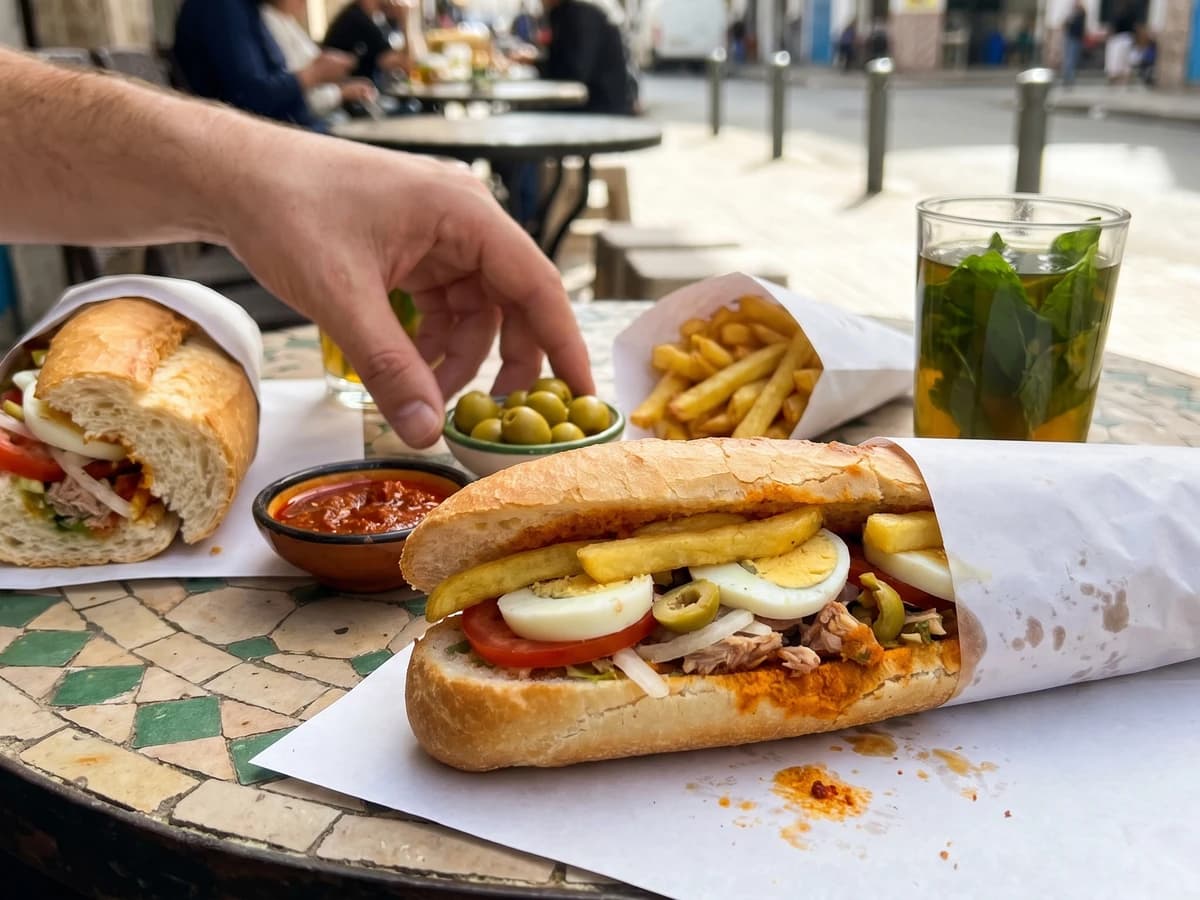
The northern street sandwich: crisp bread opened wide, harissa rubbed into the crumb, tuna or kefta, egg, olives, and hot fries pushed right in so supper can travel in one hand.

Chef Zohra
A northern street sandwich with a Spanish name and a Moroccan hand: harissa, tuna or kefta, sliced egg, olives, salad, and hot fries pressed into one generous baguette.

Chef Zohra
From Rissani comes a buried bread for guests: thin dough sealed around spiced meat, onions, herbs, and almonds, baked hot so the crust browns while the filling stays generous.