
Chef Dimitra
Agrafa Batzina (Μπατζίνα), Courgette and Feta Pie
Agrafa's batzina is the no-phyllo pie of Karditsa: grated courgette, feta, eggs, milk, and flour poured thin into a hot oiled tapsi.
A cooking platform built around craft, culture, and the stories behind what we eat.
Created by
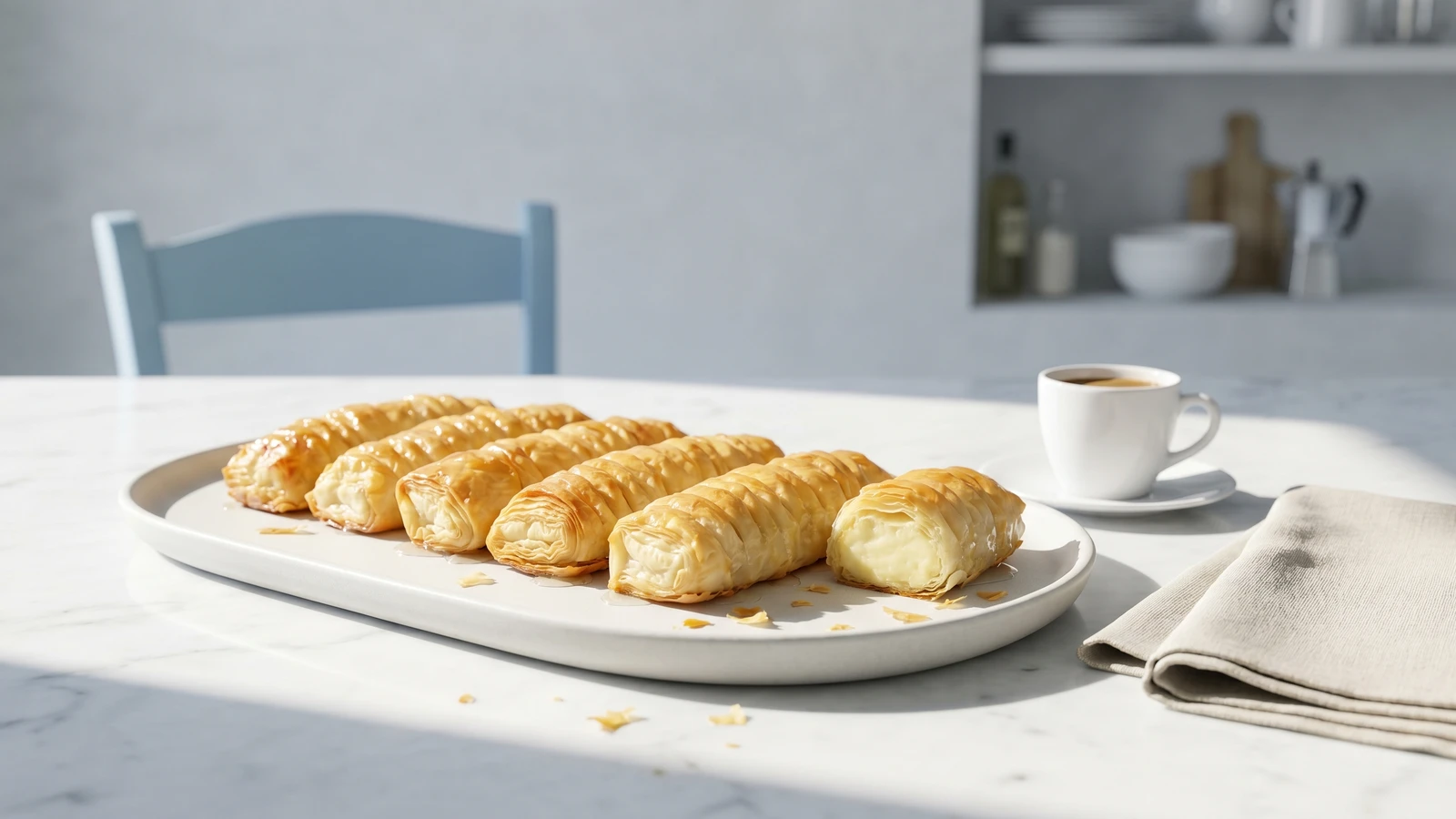
Thessaloniki's custard flogeres are phyllo flutes for the celebration tray: tight rolls of vanilla cream, real butter, and cold syrup poured over hot pastry so they stay crisp.
Macedonian flogeres are custard phyllo flutes from Thessaloniki's pastry-shop table: narrow rolls, buttered sheet by sheet, baked deep gold, then given syrup while they're still hot. They are not bougatsa and not galaktoboureko. The shape is the difference, a flute you can lift with your fingers, with vanilla cream held inside a crisp sleeve.
The rule that decides them is temperature. Make the syrup first and let it go cold, then pour it over the hot baked rolls. Cold syrup meets hot buttered phyllo quickly; the pastry drinks without collapsing, and the outside keeps its bite. Warm syrup on warm rolls makes them heavy and slack. That's not a tragedy, but it's not flogeres.
Use proper thin phyllo, real butter, and a custard thick enough to mound on a spoon. Once the cream is cool, the rolling is calm work: fold the sides, roll tight, line them in the tapsi, and bake. In my Thessaloniki notebook this sits under celebration sweets, because one tray waits well, travels well, and disappears with coffee before anyone admits taking the last one.
Flogera means a flute in Greek, and the pastry takes its name from the long narrow shape rather than from a single village. In Greek Macedonia, especially Thessaloniki after the city joined the Greek state in 1912, urban confectioners kept the Ottoman-era family of syruped phyllo sweets while home cooks adapted them into individual rolls filled with nuts or milk custard. The custard version sits beside galaktoboureko in northern pastry shops, but its rolled form changes the eating: more crisp edge, less soft center.
Quantity
400g
for the syrup
Quantity
300ml
for the syrup
Quantity
1 wide strip
Quantity
15ml
Quantity
600ml
Quantity
100g
for the custard
Quantity
65g
Quantity
2
Quantity
2
Quantity
1/4 teaspoon
Quantity
2 teaspoons or 2 capsules
Quantity
1 teaspoon
finely grated
Quantity
30g
for the custard
Quantity
450g
thawed in the refrigerator
Quantity
180g
warm, for brushing
| Ingredient | Quantity |
|---|---|
| granulated sugarfor the syrup | 400g |
| waterfor the syrup | 300ml |
| lemon peel | 1 wide strip |
| fresh lemon juice | 15ml |
| whole milk | 600ml |
| granulated sugarfor the custard | 100g |
| fine semolina (simigdali psilo) | 65g |
| large eggs | 2 |
| large egg yolks | 2 |
| fine sea salt | 1/4 teaspoon |
| vanilla extract or Greek vanilla powder capsules | 2 teaspoons or 2 capsules |
| lemon zestfinely grated | 1 teaspoon |
| unsalted butterfor the custard | 30g |
| thin phyllo pastrythawed in the refrigerator | 450g |
| clarified butter or melted unsalted butterwarm, for brushing | 180g |
Put the 400g sugar, water, and lemon peel in a small saucepan. Bring to a boil, stir once, then simmer for 7 minutes until clear and lightly thickened. Stir in the lemon juice, remove the peel, and let the syrup cool completely. Cold syrup is ready for hot pastry. That contrast is what lets the phyllo drink without turning slack.
In a heavy saucepan, whisk the milk, 100g sugar, semolina, eggs, yolks, and salt while everything is still cold. Set over medium-low heat and whisk steadily for 7 to 9 minutes, until the cream is thick enough to hold the tracks of the whisk. Take it off the heat and whisk in the vanilla, lemon zest, and 30g butter. Spread the custard into a shallow dish, press parchment directly on the surface, and cool completely.
Heat the oven to 180C conventional, or 170C fan. Butter a 33 x 23 cm metal tapsi or baking dish. Unroll the phyllo and cover it with a dry towel, then a barely damp towel on top. Phyllo waits for nobody. Once it dries, it cracks before you can roll it.
Lay one phyllo sheet on the counter and brush it edge to edge with warm butter. Lay a second sheet on top and butter that too. Cut the stack lengthwise into 3 long strips. Put 30 to 35g custard, about 2 tablespoons, at the short end of each strip. Fold the long sides in by 1cm, then roll snugly into a narrow flute. Set seam-side down in the tapsi. Repeat with the remaining phyllo and custard, then brush the tops generously with butter.
Bake for 30 to 35 minutes, rotating the pan once, until the flogeres are deep golden on top and firm along the sides. The ends should look dry and crisp, not pale. If the top colors too quickly, move the pan one rack lower for the final minutes.
As soon as the flogeres come out of the oven, spoon the cold syrup evenly over the hot rolls, especially along the seams and ends. Use most of it at first, wait 5 minutes, then add the rest if the pan has room. Let them stand for at least 45 minutes so the syrup settles into the layers without drowning them.
Serve slightly warm or at room temperature, with a little syrup from the pan spooned over each piece. Because this is a custard pastry, refrigerate leftovers within 2 hours, loosely covered. They keep for 2 days, though the first day has the best bite.
1 serving (about 290g)
Culinary guides, cultural storytelling, and the editorial depth that makes cooking meaningful.
Discover Culinary ExplorerChef Dimitra
Agrafa's batzina is the no-phyllo pie of Karditsa: grated courgette, feta, eggs, milk, and flour poured thin into a hot oiled tapsi.

Chef Dimitra
Zagori's flour pie skips phyllo completely: a loose egg-and-flour batter, crumbled feta, and a hot buttered tapsi that makes the edges crisp.

Chef Dimitra
Hydra and Andros give amygdalota their island surname: ground almond, sugar, egg white, and rosewater, baked pale so the center stays soft as marzipan.

Chef Dimitra
Asia Minor ekmek kataifi is built in three clear layers: crisp syruped kataifi, thick semolina custard, and cold kaimaki cream under pistachios.