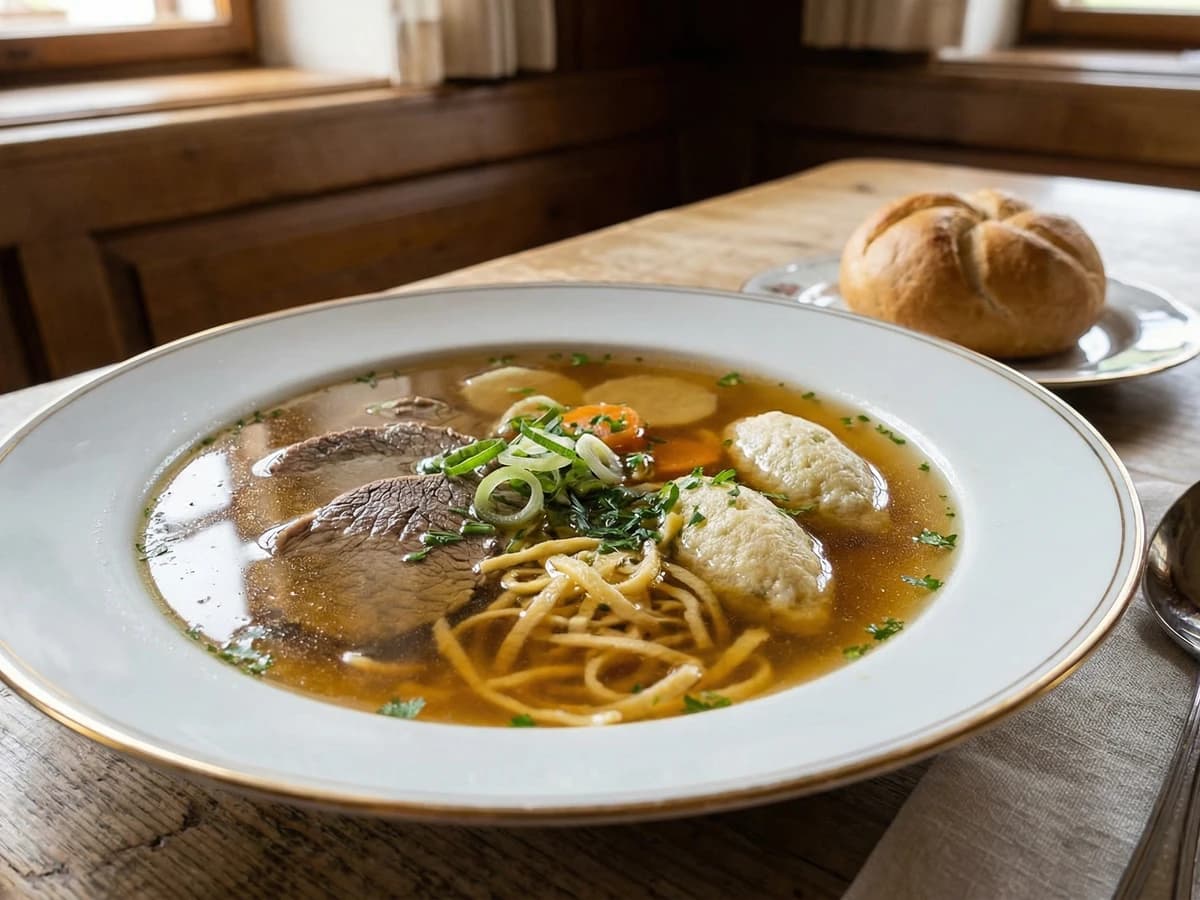
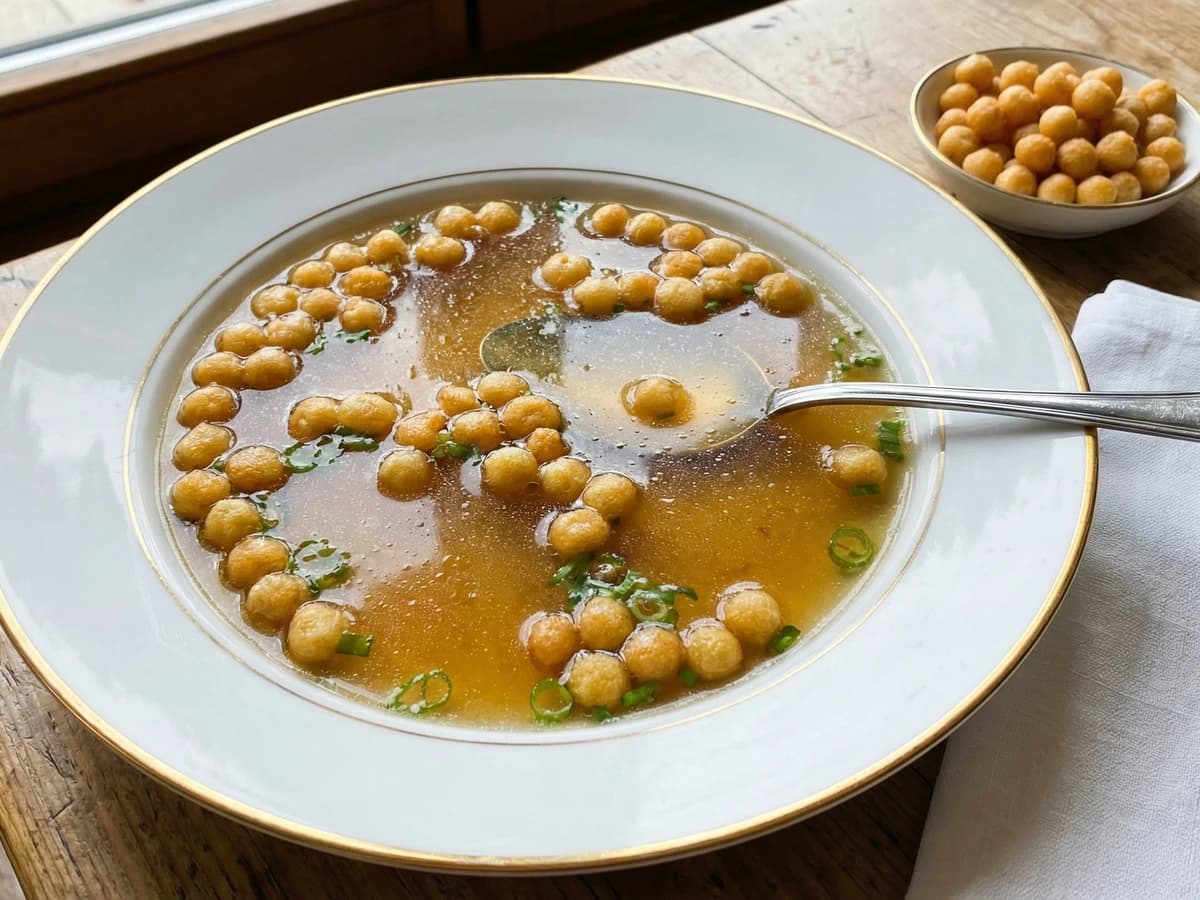
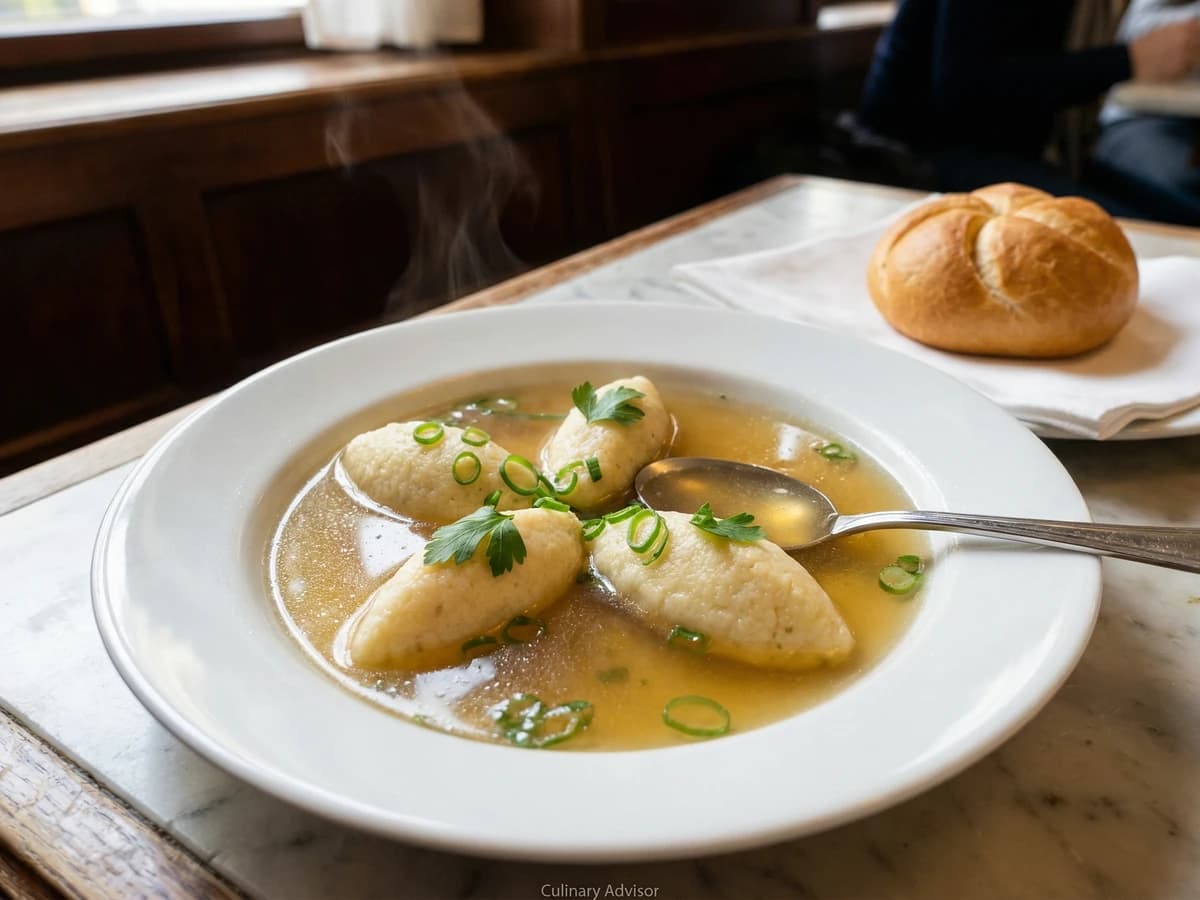
Hand-stretched strudel filled with herbed veal lung, poached whole in golden Rindssuppe and sliced into rounds that open like little pinwheels in the broth. Vienna's most beautiful Suppeneinlage.
Soups & Stews
Austrian
Special Occasion
Dinner Party
1 hr
Active Time
3 hr cook•4 hr total
Yield6 servings
Gretel always said that the way a Viennese cook treats her Suppeneinlagen tells you everything about how seriously she takes her kitchen. The broth is the foundation, yes. But the garnish is where personality lives. And of all the dozens of soup garnishes in the Austrian tradition, from Frittaten to Leberknödel to Grießnockerl, Lungenstrudel is the one that makes people stop and look into their bowl.
I remember watching Gretel slice a Lungenstrudel at my grandmother Eva's kitchen table in Kent. She'd poached it whole in the broth, wrapped in muslin, and when she unwound it and began cutting, each round fell open to reveal this tight spiral of thin dough and speckled filling. I was maybe nine years old and I thought it was the most beautiful thing I'd ever seen come out of a pot. She put three slices in my bowl, ladled the clear golden Rindssuppe over them, and told me this was what real Viennese cooks made when they wanted to show what they could do.
Lungenstrudel is nose-to-tail cooking, Viennese style. Veal lung is mild, almost delicate, nothing like the strong offal flavor people fear. You simmer it tender, mince it fine, sauté it with onion and marjoram, bind it with egg and a handful of Semmelbrösel, then spread it across hand-stretched strudel dough and roll it up like a savoury Apfelstrudel. The whole roll poaches gently in the broth, absorbing that golden beef flavor through every layer. When you slice it, the spirals hold together beautifully, the dough silky and translucent, the filling fragrant with herbs. Float three or four rounds in a bowl of clear Rindssuppe, scatter some chives on top, and you've made something that belongs on any table in Vienna.
This is not a weeknight recipe. This is for a Sunday when you have time and want to cook something that makes people feel looked after. The technique is honest. Nothing here is difficult if you take it step by step. But it asks for your attention and your afternoon, and it rewards both.
Lungenstrudel belongs to the Viennese tradition of Suppeneinlagen, the elaborate soup garnishes that developed in 19th-century Bürgerlich kitchens where a proper meal always opened with clear broth and a carefully made garnish. The use of veal lung reflects Vienna's deep nose-to-tail tradition: Beuschel (lung and heart in cream sauce) was everyday food, not poverty cooking, and wrapping offal in strudel dough to serve in broth elevated it to company fare. Gretel Beer documented Lungenstrudel in her work preserving Viennese recipes, noting it as one of the garnishes that separated a serious home cook from someone who just dropped a Semmelknödel in the pot.
The technique, the tradition, and the story behind every dish.
•Muslin or cotton towel and kitchen string (for wrapping the strudel)
•Meat grinder or sharp knife (for mincing)
•Rolling pin
•Wide pan (for the filling)
Instructions
1
Build the Rindssuppe
Place the beef bones and shin in your largest pot and cover with three liters of cold water. Cold, not warm, not hot. Cold water draws the proteins out slowly, which is how you get a clear, golden broth instead of murky grey liquid. Bring to a gentle simmer over medium heat. Gray foam will rise to the surface. Skim it off patiently with a ladle, again and again, until the foam turns white and stops coming. This takes about twenty minutes and you cannot skip it.
Gretel always said the difference between phony soup and real soup is patience. Real soup starts cold, simmers low, and gets skimmed until there's nothing left to skim. If you rush this step, no amount of straining later will save the clarity.
2
Add the soup vegetables
Once the foam is clear, add the carrots, parsnip, celeriac, charred onion, leek, peppercorns, bay leaves, parsley, and salt. The charred onion is what gives Rindssuppe its golden color. Reduce the heat until the surface barely trembles, just a lazy bubble every few seconds. Let it simmer uncovered for two and a half hours. Don't stir. Don't fuss. Let the pot do its work.
3
Simmer the veal lung
While the broth builds, put the trimmed veal lung in a separate pot with the small onion, bay leaf, and peppercorns. Cover with cold water and bring to a gentle simmer. Cook for about an hour, until the lung is completely tender when you pierce it with a knife. There should be no resistance at all. Lift it out and let it cool enough to handle, then mince it finely with a sharp knife or pass it through the coarse disc of a meat grinder. You want a texture like a rough pâté, not a paste.
Ask your butcher to trim the lung for you. The windpipe and any cartilage should be removed before cooking. A good butcher who works with offal will know exactly what you need. If they look at you blankly, find another butcher.
4
Make the strudel dough
Mound the griffiges Mehl on a clean work surface and make a well in the center. Add the egg, oil, salt, and lukewarm water. Work it together with your hands, pulling the flour in gradually from the edges, then knead for a full ten minutes. The dough will start out shaggy and reluctant. Keep going. By the end it should be smooth, elastic, and slightly tacky, like your earlobe when you pinch it. Shape it into a ball, brush the surface lightly with oil, cover with a warm inverted bowl, and let it rest for thirty minutes. The gluten needs to relax or the dough will tear when you try to stretch it.
Use griffiges Mehl if you can source it. Austrian coarse flour has a lower protein content than standard all-purpose, which gives a more tender, supple strudel dough. If you can't find it, use all-purpose flour and add a small splash more oil to keep the dough pliable.
5
Make the filling
Melt the butter in a wide pan over medium heat. Add the diced onion and cook gently until soft and translucent, about five minutes. You don't want color here, just sweetness. Add the garlic and cook another minute until fragrant. Tip the minced lung into the pan and stir it through the buttery onion. Add the chopped parsley and marjoram. Season with salt, pepper, and a good grating of nutmeg. Cook together for two or three minutes so the flavors marry, then take the pan off the heat and let it cool for ten minutes. Stir in the beaten egg and the Semmelbrösel. The breadcrumbs absorb excess moisture and help the filling hold together when you slice the strudel later. The mixture should be moist but cohesive. If it feels too wet, add another spoonful of breadcrumbs.
6
Stretch the strudel dough
Lay a clean kitchen cloth on your table and dust it lightly with flour. Place the rested dough in the center and roll it out as thin as you can manage with a rolling pin. Then slide the backs of your hands under the dough, knuckles down, and begin stretching it from the center outward, working your way around the edges. Walk around the table. Let gravity help. The dough should stretch thin enough to read a newspaper through, though for Lungenstrudel it can be slightly thicker than for Apfelstrudel since it needs to hold a savory filling. Aim for translucent but not paper-thin. Trim any thick edges with scissors.
Take off your rings and watch before stretching. Work with the backs of your hands, never your fingertips. Fingertips poke holes. The backs of your hands distribute the tension evenly. If the dough tears in a spot or two, don't panic. Pinch it closed and carry on. Small repairs disappear once the strudel is rolled.
7
Fill and roll the strudel
Spread the lung filling evenly over the stretched dough, leaving a three-centimeter border on all sides. Don't pile it in the center. An even layer means even slices later. Using the cloth underneath as a guide, roll the strudel up tightly from one long side, tucking the filling in snugly as you go. Pinch the ends closed and tuck them under. The roll should be about the length of your forearm and firm enough to hold its shape.
8
Wrap and poach
Wrap the strudel roll in a piece of clean muslin or a cotton kitchen towel, tying the ends with kitchen string like a large bonbon. This holds it together during poaching so it doesn't unravel. By now your Rindssuppe should be nearly done. Strain the finished broth through a fine-mesh sieve lined with muslin into a clean pot. It should be clear and deeply golden. Bring it back to a gentle simmer. Lower the wrapped Lungenstrudel into the broth carefully. It needs to be submerged. Poach at a bare simmer for thirty to thirty-five minutes. No rolling boil. A rolling boil will make the dough tough and the filling grainy. You want lazy bubbles, nothing more.
If your pot isn't long enough to fit the strudel straight, curve it gently along the bottom. It's forgiving. Some cooks poach in salted water and serve in separately made broth, but poaching directly in the Rindssuppe lets the strudel absorb that deep beef flavor all the way through. This is the better method.
9
Slice and serve
Lift the strudel out carefully using two slotted spoons. Unwrap it on a cutting board and let it rest for five minutes. This rest firms it up so the slices hold their spiral shape. Using a sharp knife, cut it into rounds about two centimeters thick. Each slice will show a beautiful pinwheel of translucent dough and speckled filling. Place three or four slices in each warm soup bowl. Ladle the hot, clear Rindssuppe over them gently so you don't disturb the spirals. Scatter fresh chives across the surface. Serve immediately. Mahlzeit!
Chef Tips
•Veal lung has a mild, almost neutral flavor when properly cooked. If you've never worked with it before, don't let the idea put you off. This is not strong offal. It tastes clean and delicate, more like a light veal forcemeat than anything you'd call adventurous. The texture after mincing is soft and spreadable, which is exactly what you want inside the strudel.
•The marjoram is not interchangeable. Marjoram and veal lung have an old friendship in Viennese cooking. Oregano is a cousin, not a substitute. If you can find fresh marjoram, use twice the amount listed and chop it at the last moment.
•Your broth must be clear. If it's cloudy, you either boiled it too hard or didn't skim enough. You can rescue a slightly murky broth by whisking in two egg whites, bringing it to a gentle simmer, and straining through muslin. The whites trap the particles. It's an old restaurant trick and it works every time.
•Slice the Lungenstrudel with a sharp, thin knife in one clean motion per cut. Sawing back and forth will crush the spiral and tear the dough layers. A single confident stroke gives you those clean pinwheels that make this dish so striking in the bowl.
Advance Preparation
•The Rindssuppe can be made up to three days ahead and refrigerated. The fat will solidify on top, forming a natural seal. Remove it before reheating.
•The veal lung can be simmered and minced a day ahead, then refrigerated. Bring it to room temperature before making the filling.
•The strudel dough must be made and stretched fresh on the day. It does not keep.
•The assembled Lungenstrudel can be wrapped and refrigerated for up to four hours before poaching, but no longer. The dough will absorb moisture from the filling and become difficult to slice cleanly.
Frequently Asked Questions
Nutrition Information
1 serving (about 530g)
Calories
370 calories
Total Fat
14 g
Saturated Fat
6 g
Trans Fat
0 g
Unsaturated Fat
8 g
Cholesterol
250 mg
Sodium
1300 mg
Total Carbohydrates
33 g
Dietary Fiber
2 g
Sugars
3 g
Protein
24 g
Where cooking meets culture.
Culinary guides, cultural storytelling, and the editorial depth that makes cooking meaningful.