Culinary Explorer

A cooking platform built around craft, culture, and the stories behind what we eat.
Discover Culinary Explorer
Louisiana Seafood Stock

Louisiana Seafood Stock

Created by Chef Remy

The secret foundation of every great Cajun seafood dish, a golden stock built from shells and bones that transforms simple ingredients into something that tastes like the Gulf itself.

Sauces & Condiments
Cajun
Make Ahead
Batch Cooking
30 min
Active Time
1 hr 30 min cook2 hr total
YieldAbout 3 quarts

You cannot make proper seafood gumbo, bisque, or étouffée without good stock. That's the truth. Every time you peel shrimp or crack crab, you're throwing away liquid gold if you toss those shells in the trash. My grandmother Evangeline kept a pot simmering on the back of her stove all through shrimp season, building flavor day after day.

The shells hold all the sweetness. The heads, if you can get them, contain that rich orange fat that gives bisque its color and depth. Fish bones release gelatin that gives body to your finished dishes. You simmer these gifts from the Gulf with the holy trinity and aromatics until the kitchen smells like home.

At Lagniappe, we make stock every single day. Sixty gallons a week, minimum. That stock becomes our gumbo, our bisque, our court-bouillon. It's the difference between restaurant-quality Cajun food and something that tastes like it came from a can. Once you taste what homemade stock does for your cooking, you'll never go back to the grocery store stuff.

The technique, the tradition, and the story behind every dish.

Discover Culinary Explorer

Ingredients

shrimp shells and heads

Quantity

2 pounds

from about 4 pounds head-on shrimp

crab shells and bodies

Quantity

1 pound

from about 2-3 crabs

fish bones and heads

Quantity

1 pound

from non-oily fish like redfish, snapper, or drum

cold water

Quantity

4 quarts

yellow onions

Quantity

2 large

roughly chopped

celery stalks

Quantity

4

roughly chopped

green bell pepper

Quantity

1 large

roughly chopped

head of garlic

Quantity

1

halved crosswise

bay leaves

Quantity

4

whole black peppercorns

Quantity

1 teaspoon

fresh thyme

Quantity

6 sprigs

fresh parsley

Quantity

4 sprigs

kosher salt

Quantity

1 teaspoon

lemon

Quantity

1

halved

Equipment Needed

  • Large stockpot (8-quart minimum)
  • Fine-mesh strainer
  • Cheesecloth (optional, for clearer stock)
  • Large ladle
  • Heatproof storage containers

Instructions

  1. 1

    Rinse the shells

    Rinse shrimp shells, crab bodies, and fish bones under cold running water until the water runs clear. This removes any grit, blood, or impurities that would cloud your stock. Pat everything dry with paper towels. The cleaner you start, the cleaner you finish.

    If using fish heads, remove the gills first. Gills make stock bitter and murky.
  2. 2

    Toast the shells

    Heat a large stockpot or Dutch oven over medium-high heat. Add the shrimp shells and heads in a single layer, working in batches if needed. Let them toast without stirring for two to three minutes until they turn pink and fragrant. You'll smell the ocean and something slightly sweet. This step builds depth you can't get any other way.

    Those shrimp heads contain fat that renders out and adds incredible richness. Don't skip them if you can get head-on shrimp.
  3. 3

    Add remaining shells

    Add the crab bodies and fish bones to the pot. Stir everything together and let it toast for another two minutes. The kitchen will smell like a fish camp in the best possible way. The shells should be dry and starting to color slightly.

  4. 4

    Add the trinity and aromatics

    Add the chopped onions, celery, and bell pepper to the pot. Stir them into the shells and cook for five minutes until the vegetables begin to soften and release their moisture. Toss in the garlic halves, bay leaves, peppercorns, thyme, and parsley. Give everything a good stir.

  5. 5

    Cover with cold water

    Pour the cold water over everything. Cold water is essential because it extracts flavor slowly and evenly. Hot water would shock the proteins and give you a cloudy, less flavorful stock. The water should cover the shells by at least two inches. Squeeze in the lemon halves and drop them into the pot. Add the salt.

    The lemon adds brightness and helps balance the richness of the seafood. Don't skip it.
  6. 6

    Bring to a gentle simmer

    Set the pot over medium-high heat and bring to a simmer. Watch it carefully. The moment you see bubbles breaking the surface, reduce the heat to maintain a lazy simmer. You want bubbles rising every few seconds, not a rolling boil. A hard boil makes cloudy stock and extracts bitter compounds from the shells.

  7. 7

    Skim and simmer

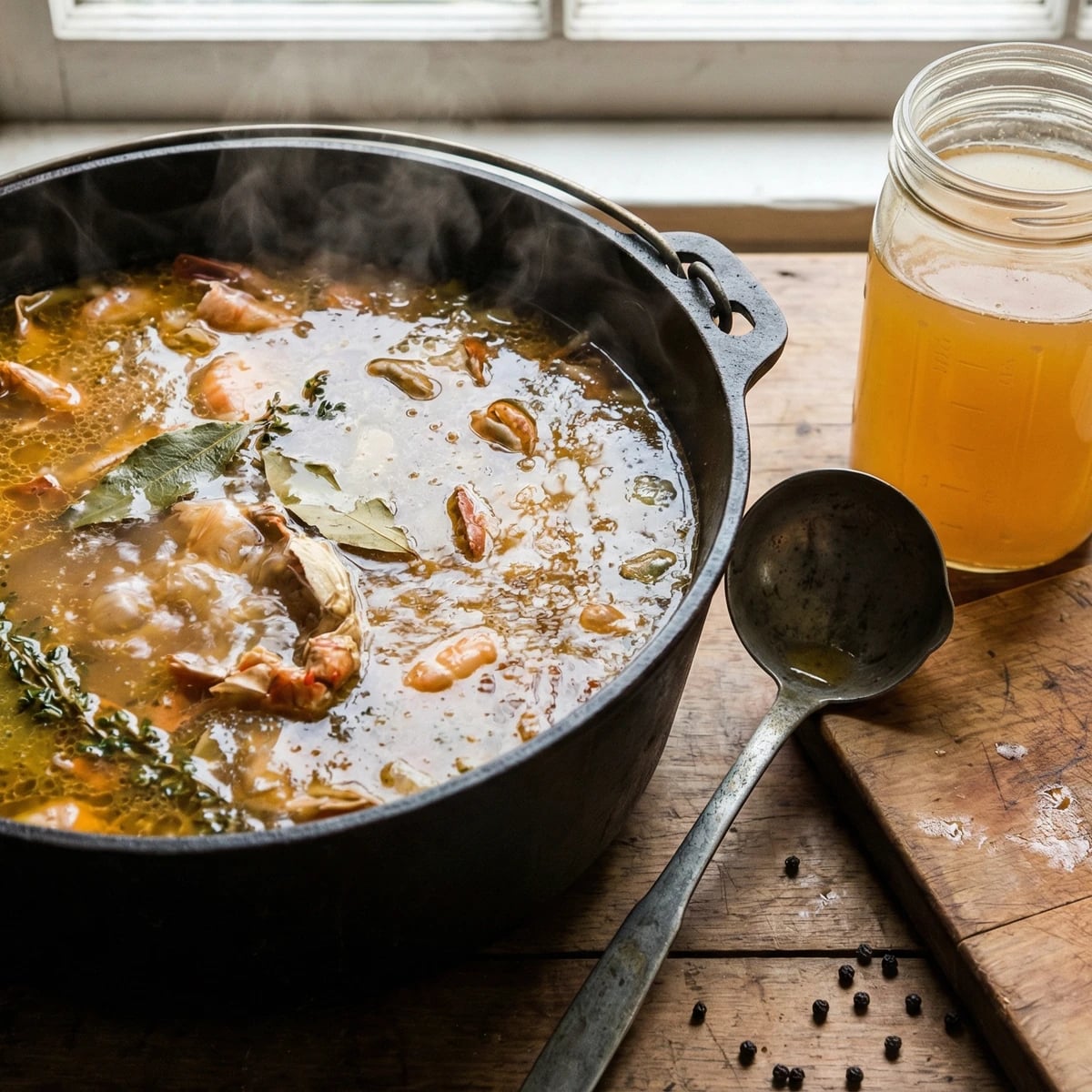
    As the stock simmers, foam and impurities will rise to the surface. Skim this off with a large spoon every ten minutes or so for the first half hour. After that, let it simmer undisturbed for about one hour total. The stock should turn a beautiful golden color with hints of orange from the shrimp fat.

    Never stir the stock while it simmers. Stirring distributes the impurities throughout and clouds the liquid.
  8. 8

    Strain carefully

    Set a fine-mesh strainer over a large pot or heatproof container. Line it with cheesecloth if you want crystal-clear stock. Ladle the stock through the strainer gently. Do not press on the solids, tempting as it is. Pressing releases bitter compounds and particles. Let gravity do the work. You should have about three quarts of beautiful, aromatic stock.

  9. 9

    Cool and store

    Let the stock cool to room temperature before refrigerating. To cool quickly, set the container in an ice bath and stir occasionally. Once cool, transfer to storage containers leaving an inch of headspace. The stock will keep refrigerated for four days or frozen for three months. A thin layer of fat may solidify on top when cold. Leave it there: it protects the stock until you're ready to use it.

Chef Tips

  • Save your shrimp shells in a freezer bag every time you peel shrimp. Once you have two pounds, you're ready to make stock. Same goes for crab shells after a boil. That's the bayou way: waste nothing.
  • Avoid oily fish like mackerel, bluefish, or salmon for stock. Their fat goes rancid quickly and overpowers the delicate sweetness you're trying to build. Stick to Gulf fish: redfish, snapper, drum, flounder.
  • The stock should taste like the ocean, clean and sweet. If it tastes fishy or muddy, your shells weren't fresh or you boiled it too hard. Taste, taste, taste.
  • At Lagniappe, we reduce our stock by half after straining for an even more concentrated flavor. Takes another hour but it's worth it for bisque.

Advance Preparation

  • Shrimp shells and heads can be frozen for up to three months before making stock. No need to thaw before using.
  • Finished stock keeps refrigerated for four days. The layer of fat that forms on top acts as a seal to keep it fresh.
  • Freeze stock in ice cube trays, then transfer to freezer bags for easy portioning. Each cube is about two tablespoons.
  • For maximum shelf life, freeze in one-quart containers. Stock keeps frozen for three months without losing quality.

Frequently Asked Questions

Nutrition Information

1 serving (about 240g)

Calories
20 calories
Total Fat
1 g
Saturated Fat
0 g
Trans Fat
0 g
Unsaturated Fat
1 g
Cholesterol
20 mg
Sodium
200 mg
Total Carbohydrates
2 g
Dietary Fiber
0 g
Sugars
1 g
Protein
3 g

Note: Chef personas and recipes are created with AI assistance. Cook with care: follow safe food-handling practices, check doneness with a thermometer when needed, and adapt for allergies and your kitchen.

Where cooking meets culture.

Culinary guides, cultural storytelling, and the editorial depth that makes cooking meaningful.

Discover Culinary Explorer

More from Chef Remy's Sauces and Condiments

Browse the full collection