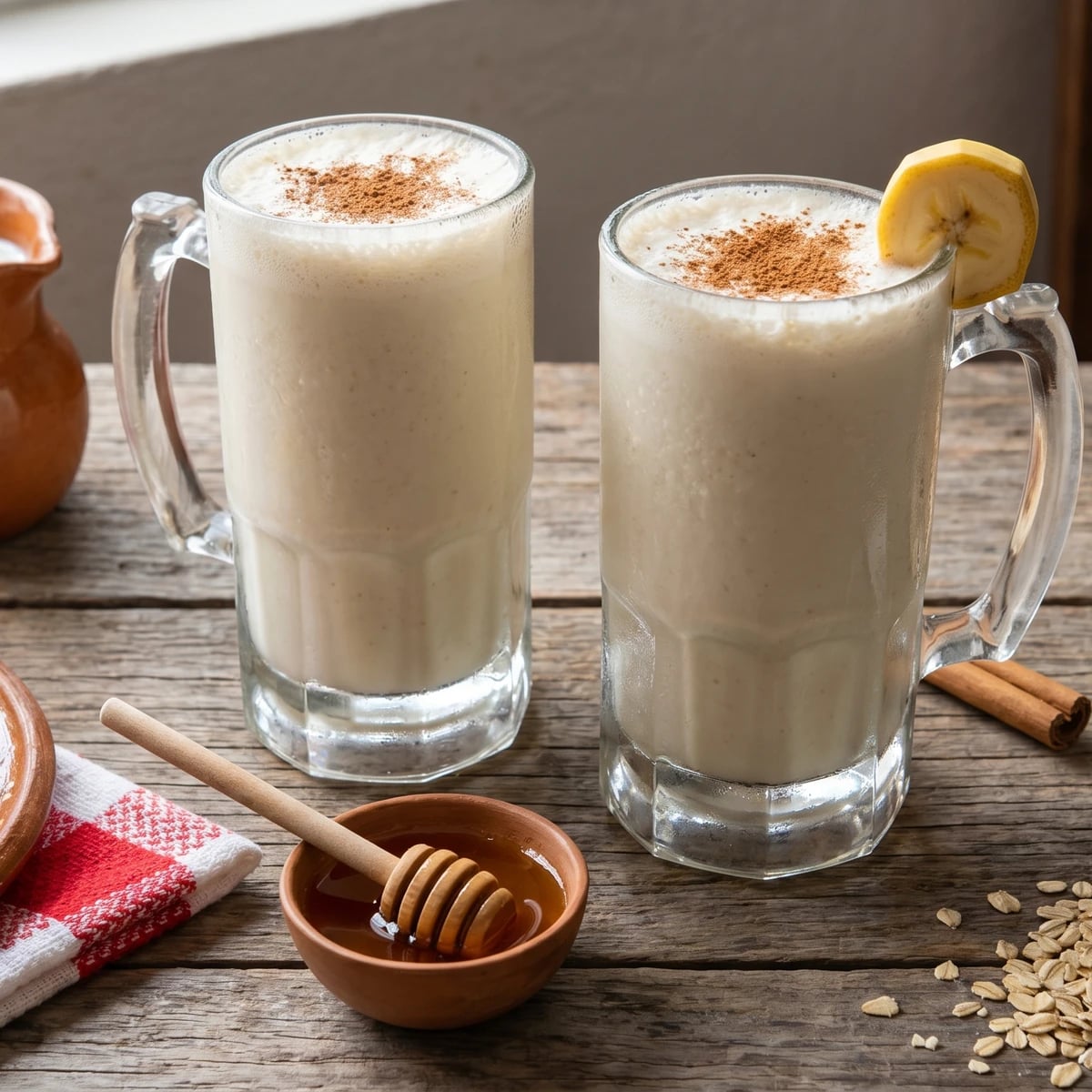
Sonora's ranchero breakfast in a glass: ripe banana, rolled oats, cold whole milk, Mexican canela, and a spoonful of sierra honey, blended thick enough to carry a man through a morning of field work.
Beverages
Mexican
Weeknight
Quick Meal
Meal Prep
5 min
Active Time
0 min cook•5 min total
Yield2 large glasses
This is a Sonoran breakfast. Not a smoothie. Not a wellness drink. A licuado, which is the word Mexico uses for the blended milk drinks that have fed working families since the blender arrived in Mexican kitchens in the mid-20th century. In Sonora, the cattle and dairy state in the northwest, the licuado is breakfast for ranchers, schoolchildren, mothers feeding kids before school, and abuelos who never learned to like coffee.
The ingredients are practical and tied to the geography. Sonora has dairy. The whole milk in this drink comes from cows raised in the Valle de Sonora, where the grass is thin but the herds are big. The honey comes from the sierra, where small producers in towns like Yécora and Sahuaripa keep hives in the high country. The oats came with the wheat economy that defines the north. Wheat tortillas, not corn, live here, and oats are part of that same northern grain tradition. The canela is Mexican Canela de Ceylán, the soft, true cinnamon, not the hard cassia bark sold as cinnamon in the United States. If you use cassia, the licuado will taste medicinal. Use the real thing.
My mother was from Jalisco and she did not make this. But I learned it on a trip through Hermosillo and Cananea years ago, sitting at the kitchen table of a woman whose husband ran cattle outside Magdalena. She handed me a glass at six in the morning and said: este es el desayuno aquí, esto y un burrito de machaca. This is breakfast here, this and a machaca burrito. Then she sent her husband out the door with a thermos of the same. La cocina no es decoración, es trabajo. This drink is the proof.
The technique is simple but the order matters. Soak the oats in the cold milk before you blend. Use a very ripe banana, not a green one. A pinch of salt to lift the sweetness. Blend it thick. Serve it cold. No me vengas con atajos.
The licuado as a Mexican breakfast genre emerged in the 1940s and 1950s after household blenders, the licuadora, became affordable in urban and rural kitchens, transforming what had been a labor-intensive practice of mashing fruit by hand into a fast morning meal. Sonora's particular version reflects the state's distinct northern food economy, which diverged from central Mexico's corn-based culture: the 18th-century Spanish missions introduced wheat, cattle, and dairy to the region, and by the 19th century Sonora had become Mexico's leading producer of beef and wheat, traditions still visible today in the dominance of flour tortillas, machaca, and dairy-based breakfasts across the state. The combination of avena and plátano in a milk drink is a 20th-century home-cook innovation, drawing on the global availability of bananas through Mexican Pacific shipping routes and the long-standing presence of oats in northern Mexican pantries.
The technique, the tradition, and the story behind every dish.
ice cubes (optional)only if your milk is not very cold
a few
ground canela for dusting (optional)
for serving
Equipment Needed
•Standard household blender (licuadora)
•Two tall heavy glass tumblers (vasos jarocheros)
•Measuring cup and measuring spoons
Instructions
1
Soften the oats
Pour the rolled oats into the blender jar first. Add half the cold milk over them. Let them sit for three to four minutes. This is the step most people skip and it is the difference between a smooth licuado and one that feels like sand on your teeth. Use avena en hojuelas, the rolled oats. No instant. Not the powdered kind.
If you have five extra minutes, soak the oats for ten. The licuado will be silkier and the oats will have given up their starch to the milk. That starch is what gives the drink its body.
2
Pick the right banana
The banana must be very ripe. Yellow with brown freckles, soft to the touch, sweet enough to eat on its own. A green banana will give you a starchy, flat licuado. A barely yellow banana will not give you enough sweetness. Ask anyone at the mercado in Hermosillo and they will tell you: el plátano tiene que estar maduro. If your banana is not ready, wait a day.
3
Build the licuado
Add the banana chunks, the remaining milk, the honey, canela, vanilla, and the pinch of salt to the blender. The salt is not optional. A pinch of salt lifts the sweetness of the banana and the honey the way it does in every Mexican kitchen. My mother put salt in everything sweet. She was right.
4
Blend until smooth
Blend on high for 45 seconds to a full minute. You want the oats completely broken down and the banana fully emulsified into the milk. The licuado should pour thick but smooth from the blender jar, with a pale ivory color and a soft foam on top. If it is too thick to drink through a straw, add a splash of cold milk. If it is too thin, you used the wrong banana.
5
Taste and adjust
Taste it. The honey from the sierra varies depending on the season and the flowers the bees worked. Some honey is light, some is dark and almost smoky. Add another teaspoon if your licuado needs it. The drink should taste of banana first, milk second, canela third, honey rounding everything out. If you taste oats, you used too many.
6
Pour and serve cold
Pour into two tall heavy glass tumblers, the vasos jarocheros if you have them. Dust the top with a little more canela. Serve immediately. This is a breakfast drink in Sonora, eaten standing at the kitchen counter before the sun gets serious or sent out to the field in a thermos. It is not a dessert. It is fuel. Saber cocinar es saber vivir.
Chef Tips
•Use Mexican canela, the Canela de Ceylán with the soft, layered bark that crumbles when you press it. Cassia cinnamon, the hard, dark, curled-up sticks sold in most US supermarkets, is too sharp and tastes like dental work. Look for canela at any Mexican grocery. It is sold loose or in long thin sticks.
•If you can find honey from a small producer in the sierra of Sonora, Chihuahua, or any northern Mexican range, use it. The terroir is in the flowers and you will taste mesquite, palo verde, or wild herbs depending on where the bees worked. Industrial honey from a plastic bear is a compromise, not an upgrade.
•Whole milk is the only milk that belongs here. Skim and low-fat make a thin, sad licuado. If you must avoid dairy, use unsweetened oat milk or whole-fat coconut milk, but understand you are making a different drink. La grasa es el sabor, even with breakfast.
•Do not add ice unless your milk is not properly cold. Ice waters down the licuado and dulls the flavor. Refrigerate your milk and your glasses ahead of time if you want it cold.
Advance Preparation
•The licuado is best made and drunk immediately. The oats continue to absorb the milk and thicken the drink as it sits, and after 20 minutes the texture turns gluey.
•If you must prepare ahead, soak the oats in the cold milk in a covered jar in the refrigerator overnight, then blend with the banana and other ingredients in the morning. The drink will be even silkier this way.
Frequently Asked Questions
Nutrition Information
1 serving (about 405g)
Calories
400 calories
Total Fat
10 g
Saturated Fat
5 g
Trans Fat
0 g
Unsaturated Fat
4 g
Cholesterol
30 mg
Sodium
175 mg
Total Carbohydrates
70 g
Dietary Fiber
5 g
Sugars
44 g
Protein
13 g
Where cooking meets culture.
Culinary guides, cultural storytelling, and the editorial depth that makes cooking meaningful.