
Chef Fai
Isan Beef Larb (Larb Nua)
No sugar. That's the rule. Isan larb strips Thai cuisine down to three pillars: nam pla for salt, manao for sour, prik for heat, bound by the smoky crunch of freshly pounded khao khua. The absence defines the dish.
A cooking platform built around craft, culture, and the stories behind what we eat.
Created by
The governing rule of Isan larb: no sugar. Fish sauce for salt, lime for sour, khao khua for texture, prik pon for heat, fresh herbs as structure. This is the Isan table stripped to its principles.
No sugar. That's the rule. That's the line between Isan and Central Thai, and it defines everything on this table.
Ajarn always said the four pillars of Thai cuisine are fish sauce, palm sugar, tropical fruit acids, and the paste foundation. Isan larb breaks that framework in half and dares you to deal with it. No sugar. No paste. Just lime smashing into fish sauce with nothing to soften the blow. The sourness is sharp. The salinity is direct. There's nowhere to hide. That's the point.
Larb is not a dish. It's a technique. Chopped protein dressed with nam pla (fish sauce) for salt, nam manao (fresh lime juice) for sour, prik pon (roasted dried chili) for heat, and khao khua (toasted sticky rice powder) for that smoky, nutty crunch that ties everything together. Once you understand this, you can larb anything: pork, chicken, duck, mushrooms, catfish. The protein is the variable. The dressing is the principle.
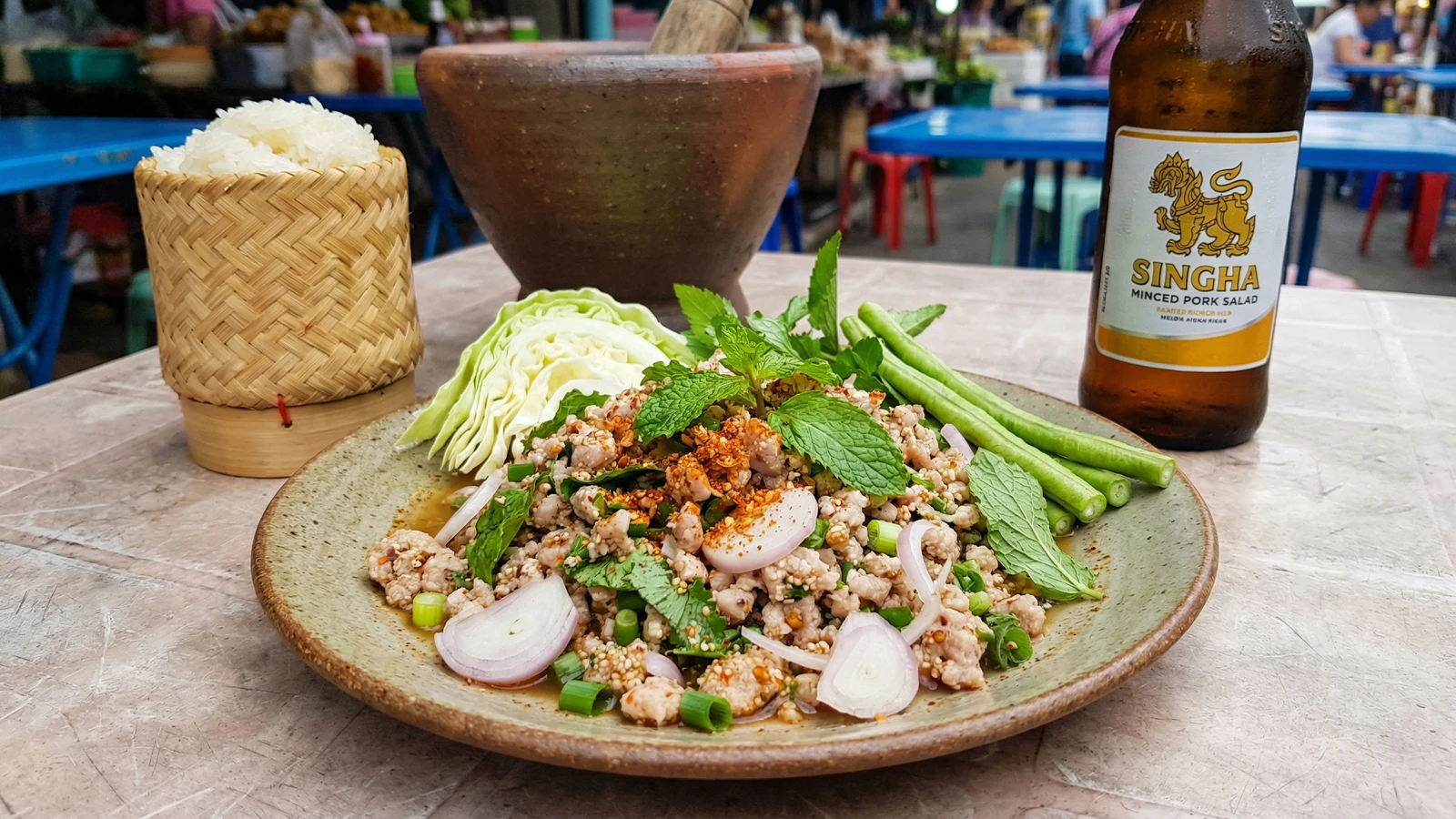
My mother's side is from Isan. She taught me that larb is always eaten with khao niew (sticky rice) and raw vegetables: cabbage wedges, long beans, mint sprigs, green onion. You tear off a piece of sticky rice, pinch some larb on top, add a leaf of mint. That's a bite. The combination is the design. Eating larb with a fork off a plate with jasmine rice misses the entire architecture of the dish.
The khao khua is what makes this Isan. You toast raw sticky rice grains in a dry pan until they're deep golden and fragrant, then pound them in a mortar to a coarse powder. Not fine. Coarse. You want that grit, that crunch, that roasted nuttiness in every bite. Store-bought rice powder is stale and flavorless. Toast it yourself. It takes five minutes and it changes everything. Krok ก่อน.
Larb is the de facto national dish of Laos and the signature preparation of Thailand's Isan (northeastern) region, which shares deep cultural and linguistic ties with Laos across the Mekong River. The word "larb" (ลาบ) likely predates any written recipe, rooted in Isan and Lao oral cooking traditions where meat was hand-chopped with a heavy cleaver on a wooden block, not ground through a machine. The critical distinction between Isan larb and the Central Thai version served in Bangkok restaurants is the complete absence of sugar: Isan seasoning relies on the binary tension of sour and salty, with khao khua (toasted sticky rice powder) providing the textural and aromatic dimension unique to the northeastern plateau.
Quantity
300g
not lean, you need some fat content
Quantity
3 tablespoons
Quantity
4 tablespoons (about 3-4 limes)
freshly squeezed
Quantity
3 tablespoons
for toasting into khao khua
Quantity
1 tablespoon
Quantity
4
sliced thin
Quantity
3
sliced into thin rounds
Quantity
1 large handful
torn
Quantity
1 handful
roughly torn
Quantity
1 handful
sliced thin crosswise
Quantity
2 tablespoons
Quantity
for serving
Quantity
for serving
Quantity
for serving
Quantity
for serving
| Ingredient | Quantity |
|---|---|
| minced porknot lean, you need some fat content | 300g |
| fish sauce (nam pla) | 3 tablespoons |
| fresh lime juice (nam manao)freshly squeezed | 4 tablespoons (about 3-4 limes) |
| raw sticky rice (khao niew)for toasting into khao khua | 3 tablespoons |
| dried roasted chili flakes (prik pon) | 1 tablespoon |
| shallots (hom daeng)sliced thin | 4 |
| green onions (ton hom)sliced into thin rounds | 3 |
| fresh mint leaves (bai saranae)torn | 1 large handful |
| fresh cilantro (pak chi)roughly torn | 1 handful |
| sawtooth coriander (pak chi farang)sliced thin crosswise | 1 handful |
| water or pork stock | 2 tablespoons |
| sticky rice (khao niew) | for serving |
| raw cabbage wedges | for serving |
| long beans | for serving |
| fresh mint sprigs | for serving |
Put the raw sticky rice grains in a dry wok or pan over medium heat. No oil. Shake the pan constantly. The grains will start to pop and turn from white to golden to deep amber. You want them the color of dark peanut skin, toasted through, smelling like roasted grain and smoke. This takes about 5 minutes. Don't rush it. Under-toasted rice powder tastes like nothing. Properly toasted khao khua smells like the best popcorn you've ever had.
Put the minced pork and the water or stock into a pan or wok over medium-high heat. Break it apart immediately with a spatula or spoon. You're not searing here. You're gently cooking the pork through, breaking it into small, even pieces. The water keeps it from clumping and frying. You want the texture of the mince to be loose and tender, not browned into hard pellets. Cook until there's no pink left, about 3-4 minutes. Pull the pan off the heat.
This is critical. Dress the pork while it's still warm. Not hot, not cold. Warm. Transfer it to a mixing bowl with whatever liquid is in the pan. Add the fish sauce first. Toss. Then the lime juice. Toss again. The warm pork absorbs the dressing into its fibers. Cold pork just sits in it. Taste. The balance should hit you immediately: salty and sour in equal force, with no sweetness anywhere. That's Isan. If your instinct tells you to add sugar, resist it. The sharpness is the point.
Sprinkle in the toasted rice powder and the dried roasted chili flakes. Toss to distribute. The khao khua should cling to the pork, not settle at the bottom. The prik pon should be evenly scattered, not dumped in one spot. One tablespoon of chili is moderate heat. Isan cooks use more. Adjust to yours, but don't be timid. Heat is a pillar, not a garnish.
Add the sliced shallots, green onions, torn mint, cilantro, and sawtooth coriander. Toss everything together with your hands or two spoons. The herbs are not garnish. They're structural ingredients. They should be distributed evenly through the entire larb, not sitting on top for decoration. Every bite should include mint, shallot, and that crunch of khao khua. Taste one more time. Adjust lime or fish sauce if needed. Plate immediately.
Mound the larb on a plate. Serve at room temperature or warm, never cold from the fridge. Set out sticky rice (khao niew) in a kratip basket alongside raw cabbage wedges, long beans, and extra mint sprigs. Tear off a ball of sticky rice, flatten it, pinch a mound of larb on top, wrap a mint leaf around it. That's a bite. That's the design. The sticky rice is your utensil and your starch. Jasmine rice has no place at an Isan table.
1 serving (about 230g)
Culinary guides, cultural storytelling, and the editorial depth that makes cooking meaningful.
Discover Culinary ExplorerChef Fai
No sugar. That's the rule. Isan larb strips Thai cuisine down to three pillars: nam pla for salt, manao for sour, prik for heat, bound by the smoky crunch of freshly pounded khao khua. The absence defines the dish.

Chef Fai
No sugar. That's the line between Isan and Central Thai larb. Grilled catfish flaked while warm, dressed with nam pla, manao, khao khua, prik pon, and a storm of fresh herbs. The plateau on a plate.

Chef Fai
No sugar. That's the rule. Isan larb strips Thai cuisine down to three pillars: nam pla for salt, manao for sour, prik for heat, with khao khua tying it together in a way nothing else can.

Chef Fai
Duck brings gamey depth to the Isan larb formula. No sugar. Lime, fish sauce, khao khua, prik pon, and a wall of fresh herbs. This is the celebration table standard, and the governing rule is restraint.