
Chef Dimitra
Agrafa Batzina (Μπατζίνα), Courgette and Feta Pie
Agrafa's batzina is the no-phyllo pie of Karditsa: grated courgette, feta, eggs, milk, and flour poured thin into a hot oiled tapsi.
A cooking platform built around craft, culture, and the stories behind what we eat.
Created by
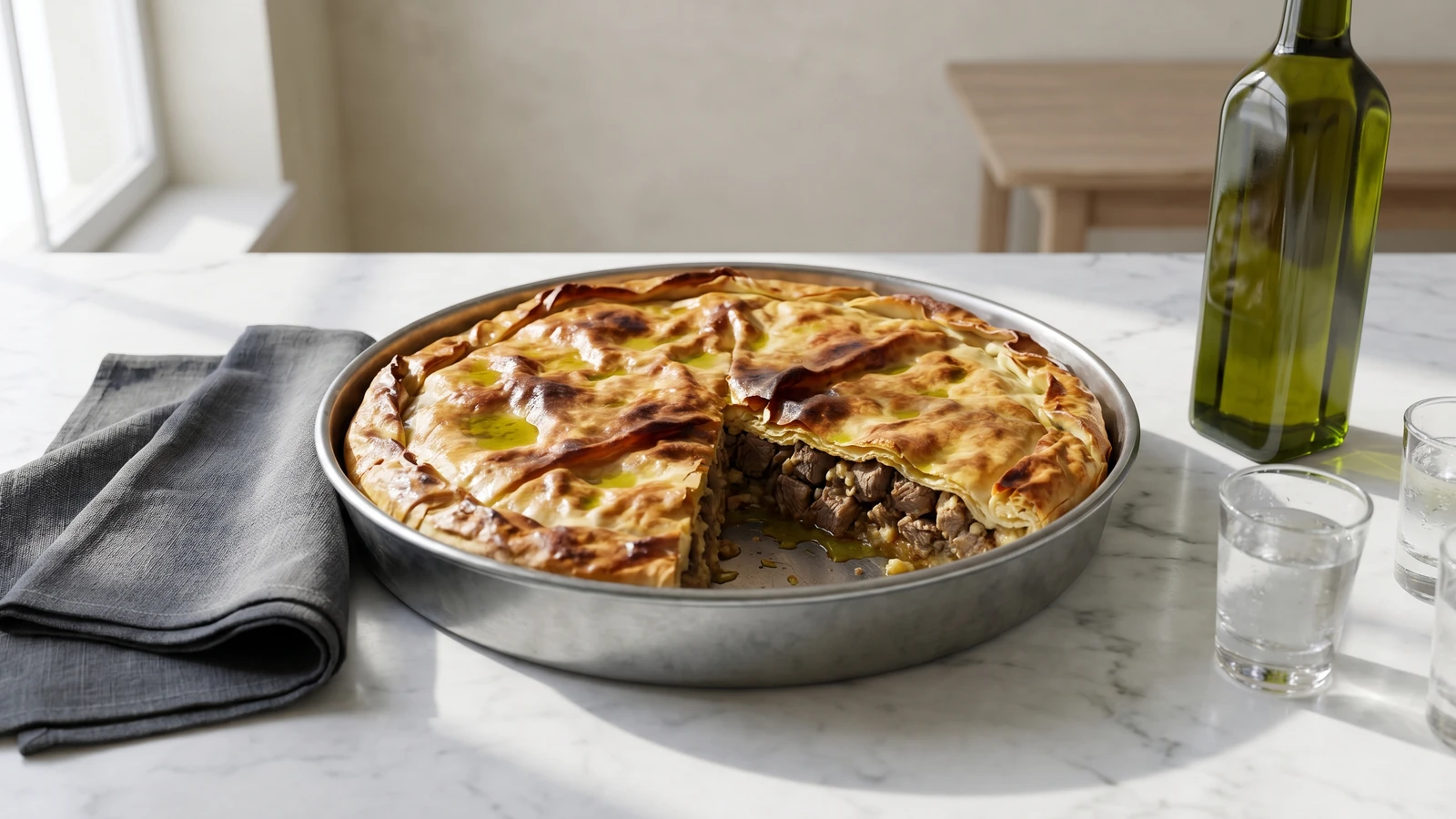
Epirus gives this meat pie its surname: hand-cut beef, onion, trahana, and sturdy village phyllo baked in a tapsi until the top is crisp and the filling stays rich.
Kreatopita Ipirotiki is the meat pie of Epirus, especially loved around Ioannina for New Year, when a deep tapsi comes to the table full of beef, onion, and trahana under handrolled phyllo. It is not a dainty pie. It is mountain food, rich and practical, made for cold weather and a full house.
The method that decides it is the trahana. Cook the hand-cut beef until tender, keep its broth, then stir in the sour trahana while the filling is still warm. The little grains drink the meat juices and swell, so the pie cuts into proper pieces instead of spilling across the plate. Leave them out and the filling runs. Add too much and you get paste. This is where the pie asks you to pay attention.
The phyllo should be village phyllo, thicker than the paper-thin pastry used for syrup sweets. You roll it with olive oil in the dough, lay it loose and generous in the pan, and let the edges wrinkle. Those folds bake crisp while the center stays strong enough to carry the meat. Your grandmother cooked by eye because she'd made it a thousand times. Here are the numbers until you have.
I don't invent it. I find it, I test it, I write it down. In Epirus, a meat pie like this is not just food for a feast, it is the feast made portable: meat stretched wisely, broth kept, grain used with respect, and nothing wasted.
Kreatopita belongs to the pita tradition of Epirus, where handrolled pies became a regional language because wheat, greens, dairy, and preserved grains could feed households through hard mountain winters. Around Ioannina, meat pies are strongly tied to New Year's tables, often with a coin hidden inside in the manner of vasilopita. Trahana in the filling is the old practical detail: a dried milk-and-wheat product that thickens the meat juices without wasting the broth.
Quantity
700g
plus extra for rolling
Quantity
10g
for the phyllo
Quantity
80ml
for the phyllo dough
Quantity
25ml
Quantity
300ml
plus 1-2 tablespoons if needed
Quantity
1.2kg
cut by hand into 1.5cm pieces
Quantity
2 medium, about 300g
finely chopped
Quantity
80ml
for the filling
Quantity
200ml
Quantity
650ml
Quantity
2
Quantity
1 small
Quantity
1/2 teaspoon
Quantity
1 teaspoon
plus more to taste
Quantity
1/2 teaspoon
Quantity
120g
Quantity
2
beaten
Quantity
60g
finely grated
Quantity
90ml
for brushing the phyllo
Quantity
30g
melted, optional for brushing the top
Quantity
1
optional for New Year; warn guests before serving
| Ingredient | Quantity |
|---|---|
| all-purpose flourplus extra for rolling | 700g |
| fine sea saltfor the phyllo | 10g |
| extra virgin olive oilfor the phyllo dough | 80ml |
| red wine vinegar | 25ml |
| lukewarm waterplus 1-2 tablespoons if needed | 300ml |
| beef chuck or shincut by hand into 1.5cm pieces | 1.2kg |
| yellow onionsfinely chopped | 2 medium, about 300g |
| extra virgin olive oilfor the filling | 80ml |
| dry white wine | 200ml |
| hot water or light beef broth | 650ml |
| bay leaves | 2 |
| cinnamon stick | 1 small |
| ground allspice | 1/2 teaspoon |
| fine sea saltplus more to taste | 1 teaspoon |
| freshly ground black pepper | 1/2 teaspoon |
| sour trahana (xinos trahanas) | 120g |
| large eggsbeaten | 2 |
| kefalotyri or gravierafinely grated | 60g |
| extra virgin olive oilfor brushing the phyllo | 90ml |
| unsalted butter (optional)melted, optional for brushing the top | 30g |
| clean coin wrapped tightly in foil (optional)optional for New Year; warn guests before serving | 1 |
Put the flour and salt in a wide bowl. Add the olive oil, vinegar, and 300ml lukewarm water, then mix until a rough dough forms. Knead for 8-10 minutes, adding only a spoonful or two of water if dry flour remains. The dough should feel smooth, elastic, and alive under your palm, not sticky.
Divide the dough into 8 balls, rub each lightly with olive oil, and cover them with an overturned bowl or a clean towel. Rest for at least 45 minutes. Rested dough rolls willingly. Unrested dough fights you, and nobody needs a fight before a feast.
Warm 80ml olive oil in a wide heavy pot over medium-high heat. Add the beef in two batches and brown it well, 6-8 minutes per batch. Do not crowd the pot. You want color on the meat and browned bits on the bottom, because that is the first flavor of the filling.
Return all the beef to the pot. Add the onions and cook until they soften, about 8 minutes. Pour in the wine and scrape the bottom clean. Add the hot water or broth, bay leaves, cinnamon stick, allspice, salt, and pepper. Cover and simmer gently for 1 hour 15 minutes to 1 hour 30 minutes, until the beef is tender but still in pieces.
Uncover the pot and remove the bay leaves and cinnamon stick. You should have about 300ml glossy broth left around the meat. If there is much more, boil uncovered for a few minutes. Stir in the trahana and cook 5 minutes, just until it begins to swell. Take the pot off the heat and let the filling cool until warm, not hot.
When the filling is warm enough that you can hold your finger in it comfortably, stir in the beaten eggs and grated cheese. Taste for salt. If using the New Year coin, tuck the foil-wrapped coin into the filling now and remember where it is before the pie goes into the oven.
Heat the oven to 190C. Oil a 36cm round metal tapsi. Roll 5 dough balls into thin sheets a little larger than the pan, dusting lightly with flour as needed. Lay them into the tapsi one at a time, brushing each with olive oil and letting the edges climb the sides. Keep the remaining dough covered while you work.
Spread the meat filling evenly over the bottom phyllo. Roll the remaining 3 sheets and lay them over the top, brushing each with olive oil. Fold the overhanging edges inward to make a rough rim. This pie should look generous, not polished flat.
Brush the top with the remaining olive oil, and with the melted butter too if you want a deeper brown top. Score the pie into 10-12 pieces, cutting through the top layers but not all the way to the bottom. Bake for 50-60 minutes, until the phyllo is deep golden, crisp at the folds, and the bottom lifts cleanly from the pan.
Let the kreatopita rest for 20-30 minutes before cutting. The trahana finishes setting the juices as the pie settles, and the pieces come away clean. Serve warm, with a green salad, olives, and a glass of tsipouro or dry white wine. If there is a coin inside, say it clearly at the table before anyone takes a bite.
1 serving (about 310g)
Culinary guides, cultural storytelling, and the editorial depth that makes cooking meaningful.
Discover Culinary ExplorerChef Dimitra
Agrafa's batzina is the no-phyllo pie of Karditsa: grated courgette, feta, eggs, milk, and flour poured thin into a hot oiled tapsi.

Chef Dimitra
Zagori's flour pie skips phyllo completely: a loose egg-and-flour batter, crumbled feta, and a hot buttered tapsi that makes the edges crisp.

Chef Dimitra
Hydra and Andros give amygdalota their island surname: ground almond, sugar, egg white, and rosewater, baked pale so the center stays soft as marzipan.

Chef Dimitra
Asia Minor ekmek kataifi is built in three clear layers: crisp syruped kataifi, thick semolina custard, and cold kaimaki cream under pistachios.