
Chef Jeong-sun
Albaechu-mul-kimchi (Baby Cabbage Water Kimchi)
Tender baby napa cabbage in a clear pear-garlic brine, lightly fermented until the broth turns clean and bright, the summer kimchi a beginner can make without a kimjang floor.
A cooking platform built around craft, culture, and the stories behind what we eat.
Created by
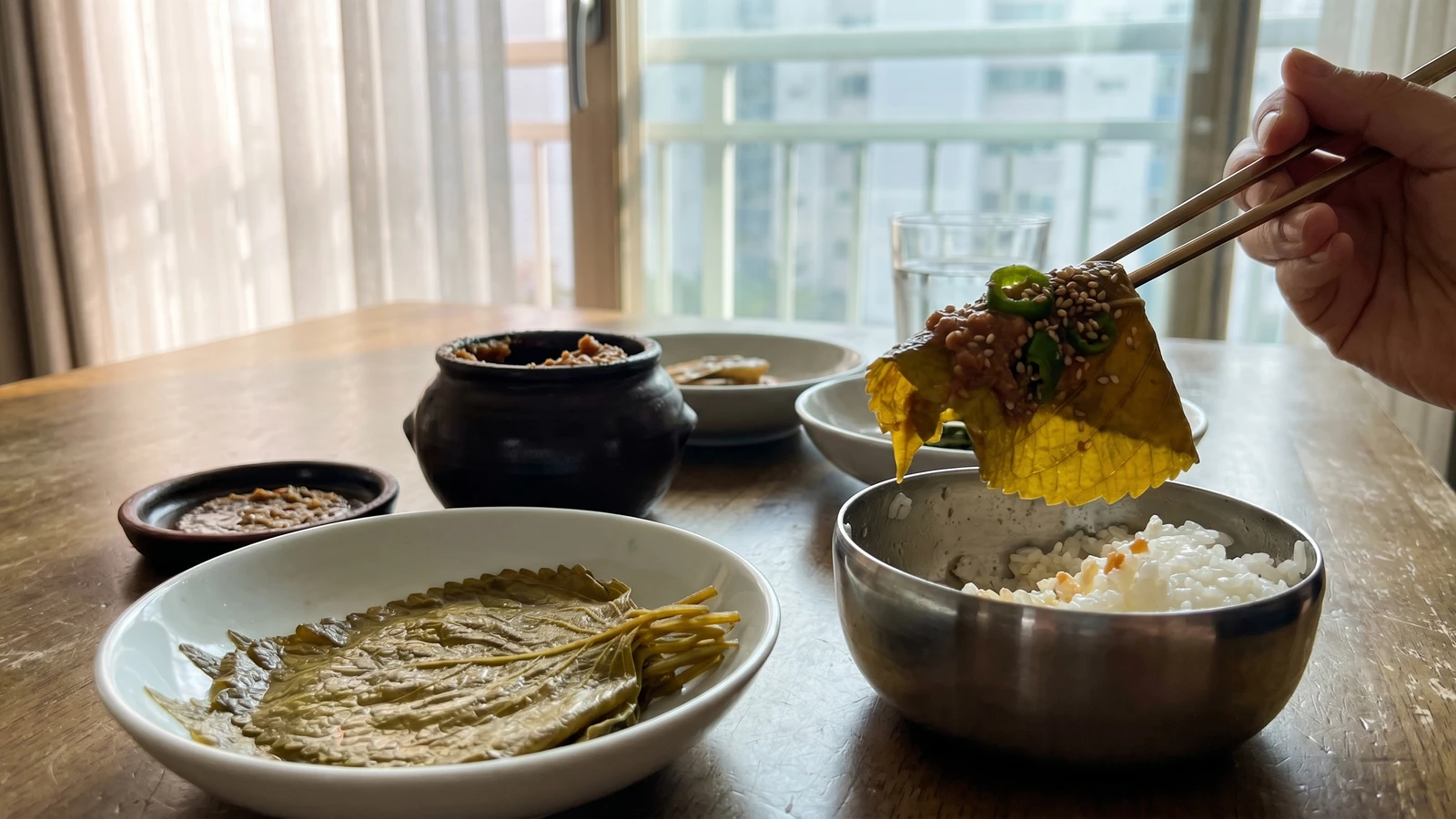
Late-season soybean leaves, brined until yellow and soft, then cured under a measured doenjang paste until one leaf can season a whole spoonful of rice.
Kongnip-jangajji lives or dies in the stack. Soybean leaves are not perilla leaves; they are tougher, quieter, and more stubborn under the tooth. A spoon of paste on the top will not travel by kindness. You brine the leaves until they bend, layer them evenly, and weight them so the doenjang reaches the middle, where lazy hands always leave a pale leaf behind.
Master Seong-nyeo made me open the stack from the center before she would taste it. If the middle leaf was still bare, the whole jar went back under weight. Notebook 41, Gyeongsang autumn, says 135 grams salt for 6 cups water and a full cup of doenjang for 70 to 80 leaves. Not a good handful. A handful changes with the cook; salt does not.
This is a rice thief, bap-doduk (a banchan so savory it steals rice), but it is not loud. The leaf should taste of green bitterness and fermented soybean paste, with garlic and chili in the background. Tonight it asks more patience than labor: wash, brine, press, paste, press again. Write it down. Memory is a borrowed bowl.
Kongnip-jangajji is most strongly associated with the Gyeongsang provinces, where late-season soybean leaves were saved from the field after the beans had begun to fill and preserved as a salty rice companion. Unlike kkaennip-jangajji (perilla leaf pickle), which is common across Korea, soybean leaf preserves remained regional enough that many markets outside the southeast do not carry the leaves unless a vendor has Gyeongsang customers. The doenjang-cured version belongs to household jangajji practice: salt the vegetable first, bury it in fermented paste, and turn a hard season's leaf into banchan for weeks.
Quantity
70 to 80 leaves (180 to 220g)
naturally yellowing if possible, washed, stems trimmed to 1/2 inch
Quantity
6 cups
Quantity
135g, about 1/2 cup depending on crystal size
Quantity
1 cup (260g)
Quantity
2 tablespoons
Quantity
2 tablespoons
Quantity
1 tablespoon
Quantity
4 cloves
finely minced
Quantity
1 teaspoon
grated
Quantity
1 to 2 tablespoons
only if needed to loosen the paste
Quantity
1/2 teaspoon per 10 leaves
for serving
Quantity
1 teaspoon
for serving
Quantity
1 small
thinly sliced, for serving
| Ingredient | Quantity |
|---|---|
| pesticide-free soybean leaves (kongnip)naturally yellowing if possible, washed, stems trimmed to 1/2 inch | 70 to 80 leaves (180 to 220g) |
| water | 6 cups |
| coarse sea salt (cheonilyeom) | 135g, about 1/2 cup depending on crystal size |
| doenjang (Korean fermented soybean paste) | 1 cup (260g) |
| Korean soy sauce (ganjang) | 2 tablespoons |
| rice syrup or maesil-cheong (green plum syrup) | 2 tablespoons |
| gochugaru (Korean chili flakes) (optional) | 1 tablespoon |
| garlicfinely minced | 4 cloves |
| fresh gingergrated | 1 teaspoon |
| soju or boiled and cooled water (optional)only if needed to loosen the paste | 1 to 2 tablespoons |
| toasted sesame oilfor serving | 1/2 teaspoon per 10 leaves |
| toasted sesame seedsfor serving | 1 teaspoon |
| green chili (optional)thinly sliced, for serving | 1 small |
Choose soybean leaves that are yellow-green or just beginning to yellow, still supple, not brown, dry, or torn. Use only leaves from unsprayed edible soybean plants. Wash them in two changes of cold water, rubbing gently around the veins where dust hides. Trim the stems to 1/2 inch, then stack the leaves in bundles of 10 with the stem ends lined up. Even stacks cure evenly; a tangled pile cures on the outside and stays raw in the middle.
Bring the 6 cups water and 135g coarse sea salt to a full boil, stirring until the salt dissolves. Put the leaf bundles in a heatproof nonreactive bowl or crock and pour the hot brine over them. Press them down at once with a small plate and a clean weight so every leaf stays under the brine. Let the bowl cool for 30 minutes, then cover and refrigerate for 3 days, turning the stack once each day. The hot brine wilts the leaves, and the salt pulls out the raw grassy edge so the doenjang can season instead of fight.
Lift the leaves from the brine and rinse them quickly under cold water. Soak them in fresh cold water for 30 minutes, then taste one leaf from the center of the stack. It should be salty but edible with rice. If it bites like seawater, soak 20 minutes more. Drain, squeeze the bundles gently between your palms, and spread them on a clean towel for 20 minutes. Do not skip the drying. Wet leaves make the paste slide off and dilute the cure.
Stir together the doenjang, soy sauce, rice syrup or maesil-cheong, gochugaru if using, garlic, and ginger. The paste should spread like thick peanut butter, not pour like sauce. If your doenjang is very stiff, loosen it with 1 tablespoon soju or boiled and cooled water, then add the second tablespoon only if it still tears the leaves as you spread it. Taste it. It should be salty first, then fermented and lightly sweet, with garlic in the back row.
Spread 1 tablespoon of doenjang paste on the bottom of a 1-quart jar, small onggi, or lidded glass container. Lay down 5 leaves, stems all facing the same direction, then spread 1 level tablespoon paste over the top, pushing a little more toward the thick stem ends. Repeat with the remaining leaves and paste, finishing with a full layer of paste on top. You do not need to paint both sides of every leaf; the salt has already opened the leaf, and the weight will move the paste through the stack.
Press a small plate, fermentation weight, or clean zip-top bag filled with brine over the stack so the leaves are firmly compressed. Cover the container and refrigerate at least 7 days, 14 days if you can wait. Every 2 days during the first week, open the container with clean hands or clean chopsticks, press the stack down, and spoon any loose paste back over the top. This is the whole discipline of the dish: doenjang must touch the middle leaves, not just the pretty outside ones.
Take out only what the table will eat, usually 8 to 10 leaves for a small meal. Scrape heavy paste back into the jar, then fold or cut the leaves into two-bite pieces. Dress that serving only with 1/2 teaspoon toasted sesame oil, a pinch of sesame seeds, and thin green chili if you like. Eat one leaf wrapped around a spoonful of rice. It should be salty, deep, and a little bitter, enough to season the rice without burying it.
Keep the remaining leaves pressed under the doenjang paste in the refrigerator for up to 2 months. Use clean chopsticks every time. Do not return dressed leaves to the jar, because sesame oil and table crumbs shorten the life of the preserve. Discard the batch if you see fuzzy mold, sliminess, or a harsh rotten smell. This is a refrigerator jangajji, not a shelf-stable canned pickle.
1 serving (about 40g)
Culinary guides, cultural storytelling, and the editorial depth that makes cooking meaningful.
Discover Culinary ExplorerChef Jeong-sun
Tender baby napa cabbage in a clear pear-garlic brine, lightly fermented until the broth turns clean and bright, the summer kimchi a beginner can make without a kimjang floor.

Chef Jeong-sun
The kimchi from before chili, salted napa cabbage packed with radish, pear, jujube, and pine nuts in a clear brine that turns quietly tart in the jar.

Chef Jeong-sun
A pale summer cucumber kimchi, split and stuffed with radish and chives, then held in a cool pear brine so the cucumber stays clean, crunchy, and plainly itself.

Chef Jeong-sun
Flat spring bomdong cabbage, lightly brined and tucked into a clear pear-radish kimchi broth, made without chili and eaten young while the leaves still taste like spring.