
Chef Klaus
Ahle Wurst
North Hesse's old sausage is cured, not cooked: coarse pork, pepper, garlic, and cold weeks in a chamber until the slice turns firm enough for rye and cider.
A cooking platform built around craft, culture, and the stories behind what we eat.

Created by
Hesse's cooked cheese is a thrift dish with one hard rule: low heat from start to finish, because sour curd turns glassy only when it isn't bullied.
Kochkäs belongs to Hesse, strongest in the Odenwald, the Bergstraße, and the old apple-wine tables around Darmstadt and Frankfurt. It isn't feast food. It's bread food, weeknight food, the thing you set down with rye, onions, and a glass of Apfelwein when the cupboard is doing its work.
The regions argue over the base. In southern Hesse, many cooks start with Handkäse or Harzer, the sour-milk cheese that already has bite. In the Odenwald, Quark, the fresh sour curd, gets treated with Natron, baking soda, then cooked down with butter until it loosens and shines. Across the Rhine, the Palatinate leans close but seasons differently. Im Norden anders, im Süden anders. Here we cook the Hessian way.
The rule is simple: low heat the whole way. Sour curd melts because the Natron changes the acidity enough for the proteins to relax; push the heat hard and those proteins tighten, split, and turn grainy. Runter mit der Temperatur. Stir until it looks glassy and slow-moving, not until it boils like soup.
This is larder cooking. Milk kept a little too long becomes curd, curd becomes cheese, cheese becomes supper. Weggeworfen wird nichts. Put it on dark bread with onions if you like it sharp, or spoon it over a Schnitzel in the Odenwald manner if you want the full argument at the table.
Kochkäse is rooted in the sour-milk cheese belt of Hesse, Rheinhessen, Franconia, and the Palatinate, where skimmed milk left after butter-making was turned into curd, then ripened or cooked so it would keep longer. In the Hessian Odenwald, Kochkäs became a local marker by the 19th century, served with farmhouse bread and later poured over Schnitzel in Gasthäuser. Its close relative Handkäse mit Musik, sour-milk cheese with onion marinade, shows the same thrift logic: skimmed milk, acid, time, and no waste.
Quantity
500g
Quantity
100g
finely chopped
Quantity
1 teaspoon
Quantity
60g
Quantity
80ml
Quantity
1 teaspoon
lightly crushed
Quantity
1/2 teaspoon, plus more to taste
Quantity
1 pinch
Quantity
1
finely diced
Quantity
to serve
| Ingredient | Quantity |
|---|---|
| Magerquark or well-drained low-fat quark | 500g |
| Harzer Roller or Handkäsefinely chopped | 100g |
| Natron (baking soda) | 1 teaspoon |
| unsalted butter | 60g |
| whole milk or cream | 80ml |
| caraway seedslightly crushed | 1 teaspoon |
| fine salt | 1/2 teaspoon, plus more to taste |
| white pepper | 1 pinch |
| small onion (optional)finely diced | 1 |
| dark rye bread | to serve |
Stir the Quark with the Natron in a bowl and let it stand for at least 2 hours, or up to overnight in the refrigerator. The Natron softens the curd's acidity so the proteins can loosen when warmed; skip this and the cheese fights the pan.
Put the butter in a heavy saucepan over low heat and let it melt without browning. Brown butter tastes good in the right place, but here it pushes ahead of the sour-milk flavour, and this dish is about the cheese.
Add the treated Quark and chopped Harzer or Handkäse to the butter and stir constantly over low heat. Keep it below a simmer. The cheese should loosen, then turn glossy and glassy; if it bubbles hard, the proteins tighten and the spread splits. Das braucht seine Zeit.
Stir in the milk or cream a little at a time until the Kochkäs falls slowly from the spoon. Add only what it needs, because the cheese firms as it cools and a loose pot becomes a runny bowl on the table.
Stir in the caraway, salt, and white pepper, then taste while it is still warm. Würzen, Fett, Salz zum Schluss: the salt reads differently once the sour cheese and butter have come together. Scrape into a bowl and let it cool until spreadable.
Serve the Kochkäs with dark rye bread and finely diced onion if you want the Hessian bite. Eat it at room temperature, not fridge-cold, because cold butter locks the texture and dulls the sour-milk edge. Schön ist, was schmeckt.
1 serving (about 160g)
Culinary guides, cultural storytelling, and the editorial depth that makes cooking meaningful.
Discover Culinary ExplorerChef Klaus
North Hesse's old sausage is cured, not cooked: coarse pork, pepper, garlic, and cold weeks in a chamber until the slice turns firm enough for rye and cider.

Chef Klaus
Baden's Vesper spread is nothing more than quark, cream, onion, and chives, but the whole dish depends on controlling the whey so the bowl stays spoonable beside hot potatoes.
Chef Klaus
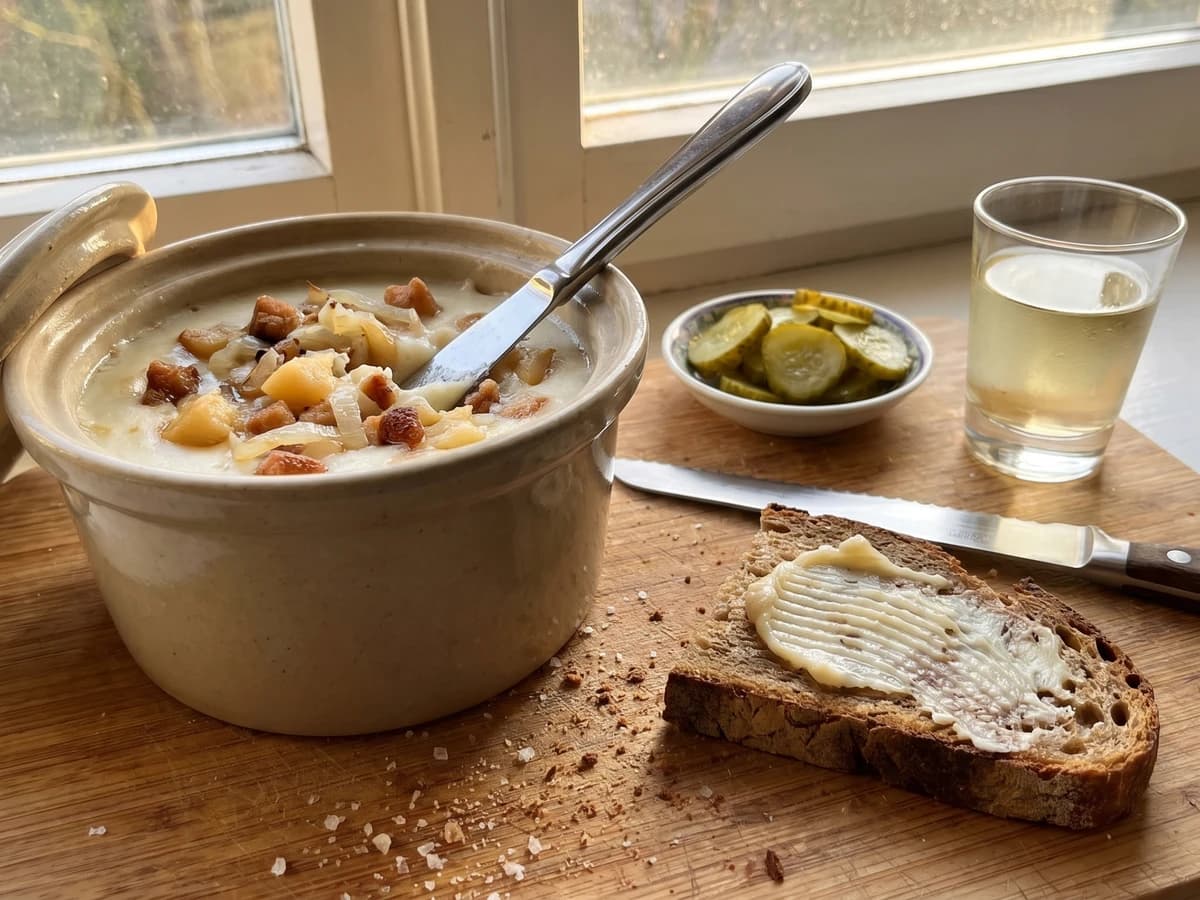
Baden's lard spread is thrift in a crock: pork fat rendered slowly, onion and apple added when the water is gone, and the crisp Grieben stirred back before it sets.

Chef Klaus
The Bavarian beer-garden salad that lives by the cut: thin sausage strips, raw onion, vinegar and oil, no cheese, rested long enough to taste like supper.