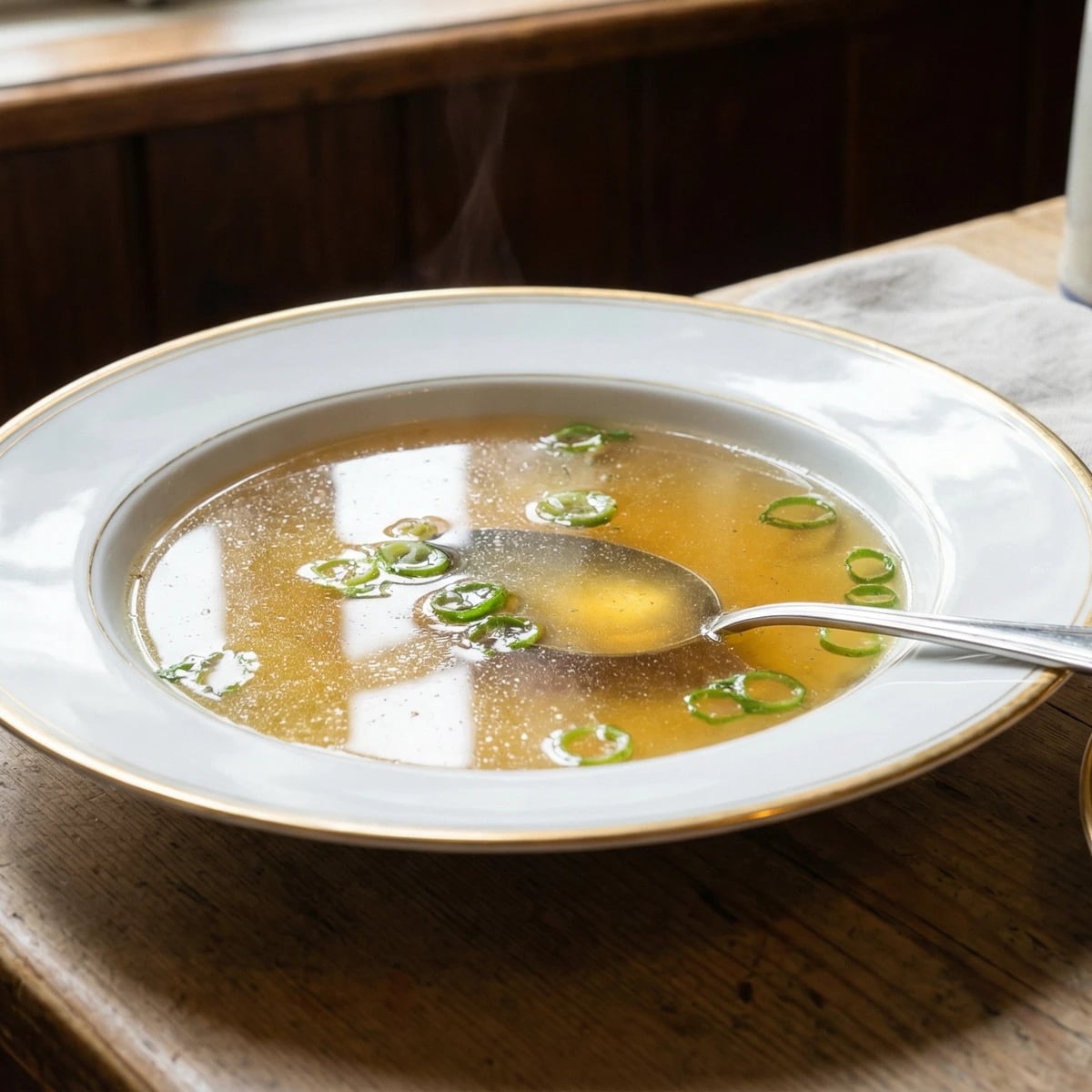
The golden, clear beef broth that opens every proper Austrian meal, simmered for three quiet hours from marrow bones and Suppengrün until it becomes the foundation that dozens of Einlagen call home.
Soups & Stews
Austrian
Comfort Food
Dinner Party
Make Ahead
30 min
Active Time
3 hr cook•3 hr 30 min total
Yield8 servings (approximately 2.5 liters)
Gretel always said you can judge a cook by their broth. Not by their pastry, not by their Schnitzel. By their broth. She'd hold a spoonful up to the light in my grandmother Eva's kitchen in Kent, checking the color, the clarity, whether it had that deep amber glow that means the bones gave up everything they had to give. Phony soup came from a cube. Real soup came from time.
Klare Rindssuppe is the soup that every Austrian meal is supposed to begin with, and in the best kitchens, it still does. It's not consommé in the French sense, clarified with egg whites into something almost clinical. Viennese broth keeps its warmth. It's clear but not sterile, golden but not dark, and it carries the taste of good beef and root vegetables in every spoonful. The clarity comes from patience: cold water, slow heat, careful skimming. No tricks. No shortcuts that actually work.
What makes Austrian broth culture extraordinary is what happens after the broth is made. The Viennese developed dozens of Einlagen, soup garnishes that turn a single clear broth into a different dish every night of the week. Frittaten, Leberknödel, Griesnockerl, Backerbsen, Nudeln, Milzschnitten. I grew up watching Gretel and Eva debate which Einlage suited which day, as if the choice carried real weight. It did. The broth is the stage. The Einlage is the performance. But without a good stage, no performance can save you.
Make this on a Sunday when you have nowhere to be. The preparation takes thirty minutes. The simmering takes three hours and asks almost nothing of you. Your kitchen will smell like something worth coming home to.
The tradition of Klare Rindssuppe as the opening course of a formal Austrian meal dates to the Bürgerliche Küche (bourgeois kitchen) of the 19th century, when a multi-course Sunday lunch always began with a clear broth and its chosen Einlage. The Viennese system of soup garnishes, with its dozens of named variations from Frittaten to Leberknödel to Griesnockerl, is unmatched in European cooking. Gretel Beer documented more than thirty distinct Einlagen in her work, each with specific regional loyalties. The broth itself reflects Vienna's position at the crossroads of the Habsburg empire: the root vegetables echo Central European traditions, the allspice traces Ottoman trade routes, and the insistence on beef rather than chicken sets it apart from the broths of France and Italy.
The technique, the tradition, and the story behind every dish.
yellow onionhalved crosswise and charred cut-side down
1 medium
leekcleaned and halved lengthwise
1 small
fresh parsley with stems
1 small bunch
bay leaves
2
whole black peppercorns
8
whole allspice berries
4
coarse salt
1 tablespoon
lovage (Liebstöckel) (optional)
1 small piece
fresh chivesfinely cut
for serving
Equipment Needed
•Large stockpot (10-liter minimum)
•Fine-mesh sieve
•Muslin cloth or double-layer cheesecloth
•Ladle for skimming
•Large clean pot or container for straining into
Instructions
1
Start with cold water
Place the marrow bones and beef in your largest pot. Cover with four liters of cold water. This must be cold. Starting with cold water pulls the proteins out of the bones gradually, which means they coagulate slowly and rise to the surface as foam you can skim away. Hot water shocks them into the broth and you end up with cloudy, murky liquid that no amount of straining will fix. Set the pot over medium heat and bring it to a slow simmer. Do not rush this. It should take a good twenty to twenty-five minutes to reach a simmer.
Gretel always said the difference between phony soup and real soup starts before the pot is even warm. Cold water, cold bones, patience. That's the whole secret.
2
Skim the foam
As the water heats, gray-brown foam will begin to gather on the surface. Skim it off with a ladle or a wide spoon, gently, without stirring the liquid underneath. Keep skimming as new foam appears. This takes about fifteen to twenty minutes and it is the step most people skip because it feels tedious. Don't skip it. Every bit of scum you remove now is clarity you'll see later. When the foam turns from gray to pale white, you've done enough. The broth beneath should already look promising.
3
Char the onion
While you skim, char the onion halves. Place them cut-side down directly on a gas flame, under a hot grill, or in a dry cast iron pan over high heat. Let them blacken until the surface is deeply caramelized, almost burnt. This looks extreme but it's doing two things for your broth: the Maillard reaction on the onion surface gives the liquid its deep golden color, and the slight bitterness from the char balances the sweetness of the root vegetables. Without it, your broth will be pale and one-dimensional.
4
Add the Suppengrün
Once the broth is skimmed clean, add the carrots, parsnip, celeriac, charred onion, leek, parsley, bay leaves, peppercorns, allspice, salt, and lovage if you have it. These root vegetables are what Austrians call Suppengrün, the soup greens, and they form the aromatic backbone of every serious Austrian broth. Don't chop them small. Large pieces give up their flavor slowly and are easier to strain out later. Reduce the heat until the surface barely trembles. You want to see a lazy bubble rise every few seconds, nothing more.
Lovage (Liebstöckel) is the herb that makes Austrian broth taste like Austrian broth. It's somewhere between celery and parsley with a savory depth all its own. If you can't find it fresh, a celery top with leaves is the closest substitute, but it's worth growing a pot of lovage on your windowsill if you make this broth regularly.
5
Simmer with patience
Let the broth simmer, uncovered, for two and a half to three hours. The surface should never boil. If you see rolling bubbles, your heat is too high and the fat will emulsify into the liquid, making it cloudy. Turn the flame down until the pot looks almost still. Check it now and then, not to stir (never stir a clear broth), but to make sure the simmer hasn't crept up on you. The kitchen will fill with a smell that is unmistakably Sunday. About halfway through, taste the broth. It will be thin and a little flat. By the time three hours have passed, it will be something else entirely: rich, golden, deep, the kind of broth that makes you close your eyes.
6
Strain for clarity
Set a fine-mesh sieve over a large clean pot and line it with a double layer of muslin or cheesecloth, dampened first so it clings to the sieve. Ladle the broth through carefully. Don't pour it, and don't press down on the vegetables. Pressing squeezes out cloudy particles. Let gravity do the work. The strained broth should be clear enough that you can see the bottom of the pot through it. If it's not, strain it once more through fresh muslin.
7
Season and degrease
Taste the strained broth and adjust the salt. It should taste clean, beefy, and full, with no single flavor shouting over the others. If you're serving it today, let it sit for five minutes off the heat, then skim the fat from the surface with a spoon. A very thin film of golden fat is traditional and adds richness, but you don't want pools of it floating in the bowl. If you're making this ahead, refrigerate it overnight and peel off the solidified fat cap in the morning.
Save that skimmed beef fat. Strained and refrigerated, it's liquid gold for roasting potatoes or frying onions. Austrian cooks waste nothing.
8
Serve with your chosen Einlage
Reheat the broth gently. Ladle it into warm soup plates. Scatter finely cut chives over the surface. This is your Klare Rindssuppe in its purest form, and it is beautiful on its own. But it's also the foundation for every Austrian soup garnish: Frittaten (sliced pancake strips), Leberknödel (liver dumplings), Griesnockerl (semolina dumplings), Backerbsen (tiny fried dough puffs), or simply a handful of fine egg noodles. The Einlage you choose is the second decision. The first decision, making this broth properly, is the one that matters. Mahlzeit!
Chef Tips
•Ask your butcher specifically for marrow bones. The marrow melts into the broth as it simmers and gives it a body and richness that meat alone can't produce. If the bones are very large, have the butcher cut them into pieces so more surface area is exposed to the water.
•Never let this broth boil. A rolling boil breaks fat into tiny droplets that suspend in the liquid and make it permanently cloudy. The French have a word for it, but all you need to know is: keep the surface trembling, not bubbling. If you walked away and it got away from you, the broth is still delicious. It just won't be clear.
•The spent Tafelspitz meat from the pot is not waste. Slice it against the grain, serve it warm with apple-horseradish sauce and chive sauce on the side, and you've got a second meal. Austrians have been doing this for centuries. The broth is the first course. The boiled beef is the second.
•If you want the deepest color without any cloudiness, roast half the bones in a hot oven (220°C) for thirty minutes before adding them to the pot. The roasted bones darken the broth beautifully. Just make sure you still start with cold water.
Advance Preparation
•This broth is better the next day. Make it a full day ahead, refrigerate overnight, and peel off the solidified fat cap before reheating. The fat cap actually seals the broth and helps preserve it.
•Klare Rindssuppe freezes beautifully for up to three months. Portion it into containers or ice cube trays for smaller amounts. Having this broth in your freezer means you're always twenty minutes away from a proper Austrian soup.
•The Suppengrün (soup vegetables) should be fresh, not frozen, for the best flavor. Prep them while the bones come to a simmer so they're ready the moment the broth is skimmed clean.
Frequently Asked Questions
Nutrition Information
1 serving (about 310g)
Calories
70 calories
Total Fat
3 g
Saturated Fat
1 g
Trans Fat
0 g
Unsaturated Fat
2 g
Cholesterol
15 mg
Sodium
750 mg
Total Carbohydrates
2 g
Dietary Fiber
0 g
Sugars
1 g
Protein
7 g
Where cooking meets culture.
Culinary guides, cultural storytelling, and the editorial depth that makes cooking meaningful.