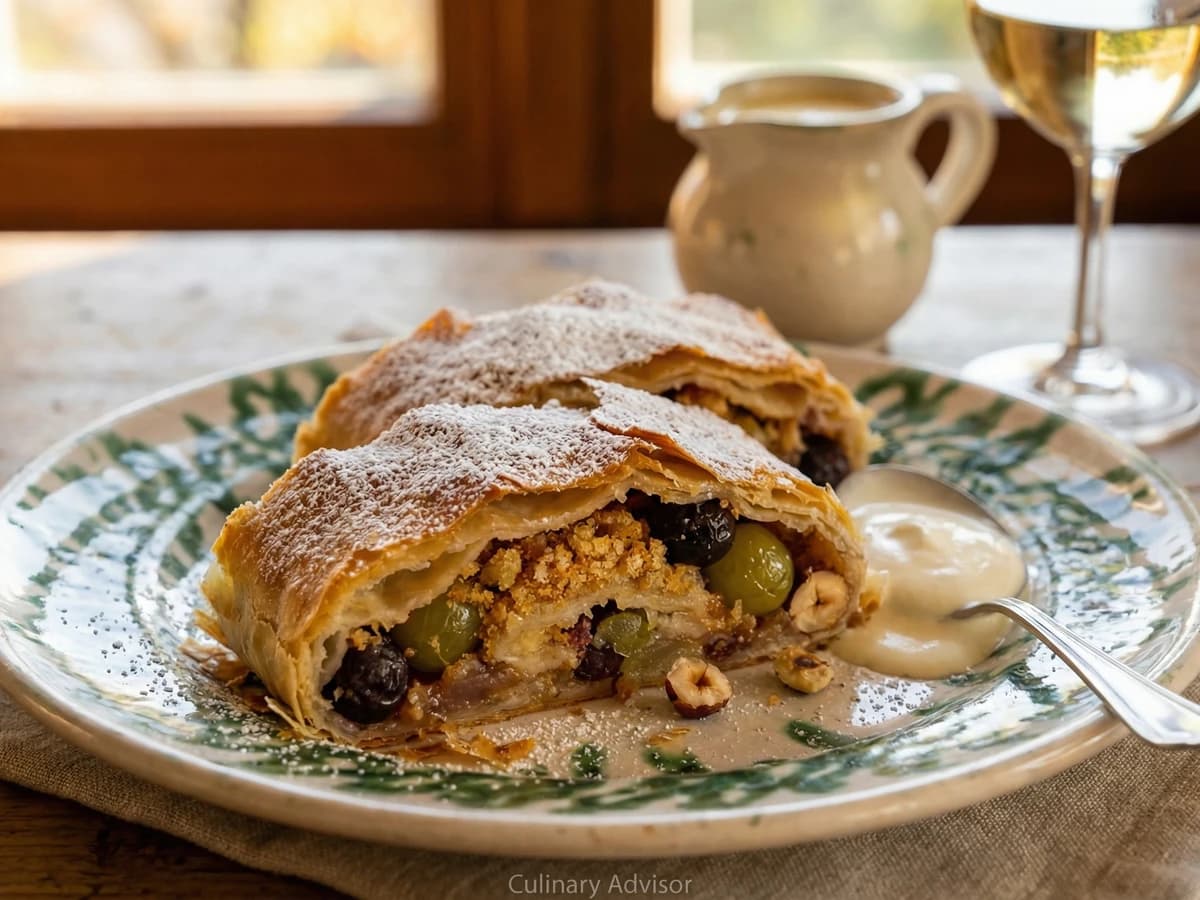
Hand-stretched strudel filled with sweet summer cherries, butter-toasted breadcrumbs, cinnamon, and lemon zest, baked golden and dusted with powdered sugar while it's still warm from the oven.
Pastries & Cookies
Austrian
Weeknight
Comfort Food
50 min
Active Time
35 min cook•1 hr 25 min total
Yield6 servings
Sweet cherries arrive in Austrian markets around late June, and for about six weeks, they're everywhere. Deep red, almost black when they're at their best, warm from the sun if you buy them at the Grünmarkt early enough in the morning. Kirschstrudel is what you make when you come home with too many. Not sour Weichseln, which have their own strudel and their own following, but the sweet ones that stain your fingers while you're pitting them and tempt you to eat half the bowl before you've started cooking.
Gretel always said the filling should be simple when the fruit is good. Toasted breadcrumbs to soak up the juice so the dough stays crisp, a little sugar, a whisper of cinnamon, lemon zest to keep the sweetness honest. That's it. The cherries do the rest. If you start adding almond paste or liqueurs or chocolate, you're telling the fruit it isn't enough, and good sweet cherries are always enough.
The dough is the same hand-stretched strudel dough I use for every strudel in my restaurant. Flour, warm water, a splash of oil, a few drops of vinegar. You knead it until it's smooth as silk, rest it under a warm bowl, then stretch it on a floured cloth until you can read a newspaper through it. This is the part that intimidates people, but I've watched first-time cooks stretch perfect dough after one try. The resting does the work. If your dough tears, it didn't rest long enough. Trust the gluten. It knows what to do.
This is a summer strudel, and I mean that seriously. Make it when cherries are in season, when they're firm and sweet and smell like July. If all you can find are those pale, hard, imported cherries that taste like nothing, wait. Make an Apfelstrudel instead. Austrian cooking is seasonal. That's part of what makes it honest.
Strudel arrived in Austria through Ottoman and Hungarian influence, with the earliest known recipe appearing in a handwritten Viennese manuscript from 1696. While Apfelstrudel became the international symbol of Austrian baking, fruit strudels made with seasonal stone fruit were the everyday reality in home kitchens, changing with the harvest from cherries in summer to plums in autumn. Kirschstrudel with sweet cherries (Süßkirschen) has always been the gentler, more approachable cousin of the tart Weichselstrudel made with sour Morello cherries, and in the cherry-growing regions of Lower Austria and Burgenland, families often made both side by side to let the table decide which it preferred.
The technique, the tradition, and the story behind every dish.
•Large clean cotton cloth (a tablecloth works perfectly) for stretching
•Rolling pin
•Cherry pitter or sturdy chopstick
•Wide pan (24cm) for toasting breadcrumbs
•Pastry brush
•Large baking sheet lined with parchment
Instructions
1
Make the strudel dough
Mound the flour on a clean work surface and make a well in the center. Pour in the warm water, oil, vinegar, and a pinch of salt. Work the wet ingredients into the flour with your fingers, pulling from the edges until a shaggy dough forms. Then knead. Really knead, for a good ten minutes, slapping the dough against the counter, folding it over, pressing it flat, again and again. The dough will go from rough and sticky to smooth, supple, and almost silky. When you press a finger into it and the indentation springs back slowly, you're there.
The vinegar isn't for flavor. The acid relaxes the gluten, which is what lets you stretch the dough paper-thin later without it tearing. Don't skip it.
Use griffiges Mehl if you can find it. Austrian coarse flour has a different texture from standard all-purpose, and it makes a more pliable, forgiving dough. If you're using regular plain flour, add a splash more oil.
2
Rest the dough
Brush the surface of the dough lightly with oil. Place it on the counter and cover it with a warm, inverted bowl. Let it rest for at least thirty minutes. An hour is better if you have the time. The gluten needs to relax completely or the dough will fight you when you try to stretch it. This is not a step you can rush. Go pit your cherries.
Warm the bowl with hot water before inverting it over the dough. A warm, slightly humid environment helps the gluten relax faster. Gretel always did this.
3
Pit the cherries
While the dough rests, pit the cherries. A cherry pitter saves time, but the back of a chopstick pressed through the stem end works if you don't have one. You want the cherries whole or halved, not crushed. Let the pitted cherries sit in a colander for a few minutes so excess juice drains off. Too much loose liquid in the filling and your dough goes soggy on the bottom.
4
Toast the breadcrumbs
Melt the 80g of butter in a wide pan over medium heat. When it foams, add the breadcrumbs and stir constantly. You want them golden, fragrant, and evenly toasted. This takes about five minutes. Watch them closely because they go from golden to burnt in seconds. Tip them onto a plate the moment they're done. They'll keep cooking from residual heat otherwise.
The butter-toasted breadcrumbs are the secret architecture of a good strudel. They absorb the cherry juice during baking, keeping the layers of dough crisp instead of letting them turn sodden. This is the difference between a strudel that shatters when you cut it and one that slumps.
5
Mix the filling
In a large bowl, toss the drained cherries with the granulated sugar, Vanillezucker, cinnamon, and lemon zest. Be gentle. You're coating the fruit, not making jam. Taste a cherry from the bowl. If it makes you want to eat the whole thing standing at the counter, you've got the balance right. Set the toasted breadcrumbs aside separately. They go onto the dough first, before the cherries.
6
Stretch the dough
Preheat your oven to 190°C (375°F). Lay a clean cotton cloth on your table and dust it generously with flour. Place the rested dough in the center and roll it out to a rough rectangle with a rolling pin, about 30 by 40 centimeters. Then put the rolling pin away. The rest happens with your hands.
Slide your hands under the dough, palms down, backs of your hands supporting it. Working from the center outward, gently stretch the dough, moving around the table, pulling it thinner and thinner. Let gravity help. The dough should stretch willingly. If it resists or springs back, cover it again and wait ten more minutes. When it's ready, you'll stretch it until it's translucent, thin enough that you can see the pattern of the cloth through it. Trim any thick edges with scissors.
Use the backs of your hands, not your fingertips. Fingertips poke holes. The backs of your hands spread the weight evenly and let the dough glide over your knuckles. You'll feel it thinning as you work.
7
Fill and roll the strudel
Brush the entire surface of the stretched dough with about two-thirds of the melted butter. Scatter the toasted breadcrumbs evenly over the lower third of the dough, leaving a 3cm border at the edges. Spoon the cherry filling over the breadcrumbs in an even line. Fold the left and right edges of the dough inward over the filling to seal the ends. Then, using the cloth to help you, roll the strudel away from you in a firm, steady motion. The cloth does the lifting. Your hands just guide. Roll it seam-side down onto a parchment-lined baking sheet, curving it gently into a crescent if your tray isn't long enough.
Don't panic if the dough tears in a spot or two. Once it's rolled, the layers overlap and hide everything. Strudel is forgiving that way. The Viennese grandmothers who taught Gretel didn't fuss about a small tear, and neither should you.
8
Bake the strudel
Brush the top and sides of the strudel with the remaining melted butter. This is what gives you a golden, flaky crust. Place it in the center of the oven and bake for 30 to 35 minutes. The strudel is done when the top is deep golden brown and the layers look dry and crisp. You'll smell the cherries and cinnamon before the timer goes off. If the top is browning too fast, lay a sheet of foil loosely over it for the last ten minutes.
9
Rest, dust, and serve
Let the strudel rest on the baking sheet for ten minutes. It needs that time for the filling to settle and the layers to firm up just enough to slice cleanly. Dust it generously with powdered sugar while it's still warm. Cut thick slices with a serrated knife, angling the blade so you can see the spiral of dough and fruit inside. Serve with a spoonful of lightly whipped Schlagobers (unsweetened whipped cream) or warm vanilla sauce on the side. Mahlzeit!
Chef Tips
•This is a summer recipe. I mean it. Sweet cherries have a short season, roughly late June through August in most of Europe and North America. If you can't find ripe, dark, fragrant sweet cherries, make a different strudel. Apfelstrudel waits for no season, and it's always there for you.
•Pit the cherries over a bowl if you want to save the juice. Reduce it on the stove with a spoonful of sugar until syrupy, then drizzle it over the sliced strudel at the table. That's a trick from my restaurant, not tradition, but Gretel would have approved.
•Strudel dough freezes beautifully. Make a double batch, stretch both sheets, brush one with oil, roll it loosely around a floured rolling pin, wrap it in cling film, and freeze. Thaw in the fridge overnight and it stretches again like new.
•If you truly cannot face hand-stretching the dough, use a single sheet of good-quality filo, brushed with butter between layers. I won't pretend it's the same. Hand-stretched strudel dough has a pull and chew that filo doesn't. But a good Kirschstrudel in filo is still better than no Kirschstrudel at all.
Advance Preparation
•Strudel dough can rest for up to two hours at room temperature under the warm bowl. Longer resting only makes it easier to stretch.
•Breadcrumbs can be toasted a day ahead and stored in an airtight container at room temperature.
•The cherry filling should be mixed just before assembly. If the cherries sit in sugar too long, they release too much juice.
•Baked Kirschstrudel is best eaten within three hours of coming out of the oven. It can be gently rewarmed in a 150°C oven for ten minutes, but it will never be as crisp as the first time. In my grandmother Eva's kitchen, leftover strudel was breakfast the next morning, eaten cold with coffee, and nobody complained.
Frequently Asked Questions
Nutrition Information
1 serving (about 200g)
Calories
545 calories
Total Fat
24 g
Saturated Fat
12 g
Trans Fat
0 g
Unsaturated Fat
11 g
Cholesterol
45 mg
Sodium
105 mg
Total Carbohydrates
78 g
Dietary Fiber
4 g
Sugars
31 g
Protein
8 g
Where cooking meets culture.
Culinary guides, cultural storytelling, and the editorial depth that makes cooking meaningful.