
Chef Jeong-sun
Aehobak-guk (애호박국, Korean Zucchini Soup)
A clean summer soup of Korean zucchini and salted shrimp, built on quick anchovy-kelp broth and finished before the half-moons lose their shape on a weeknight table.
A cooking platform built around craft, culture, and the stories behind what we eat.
Created by
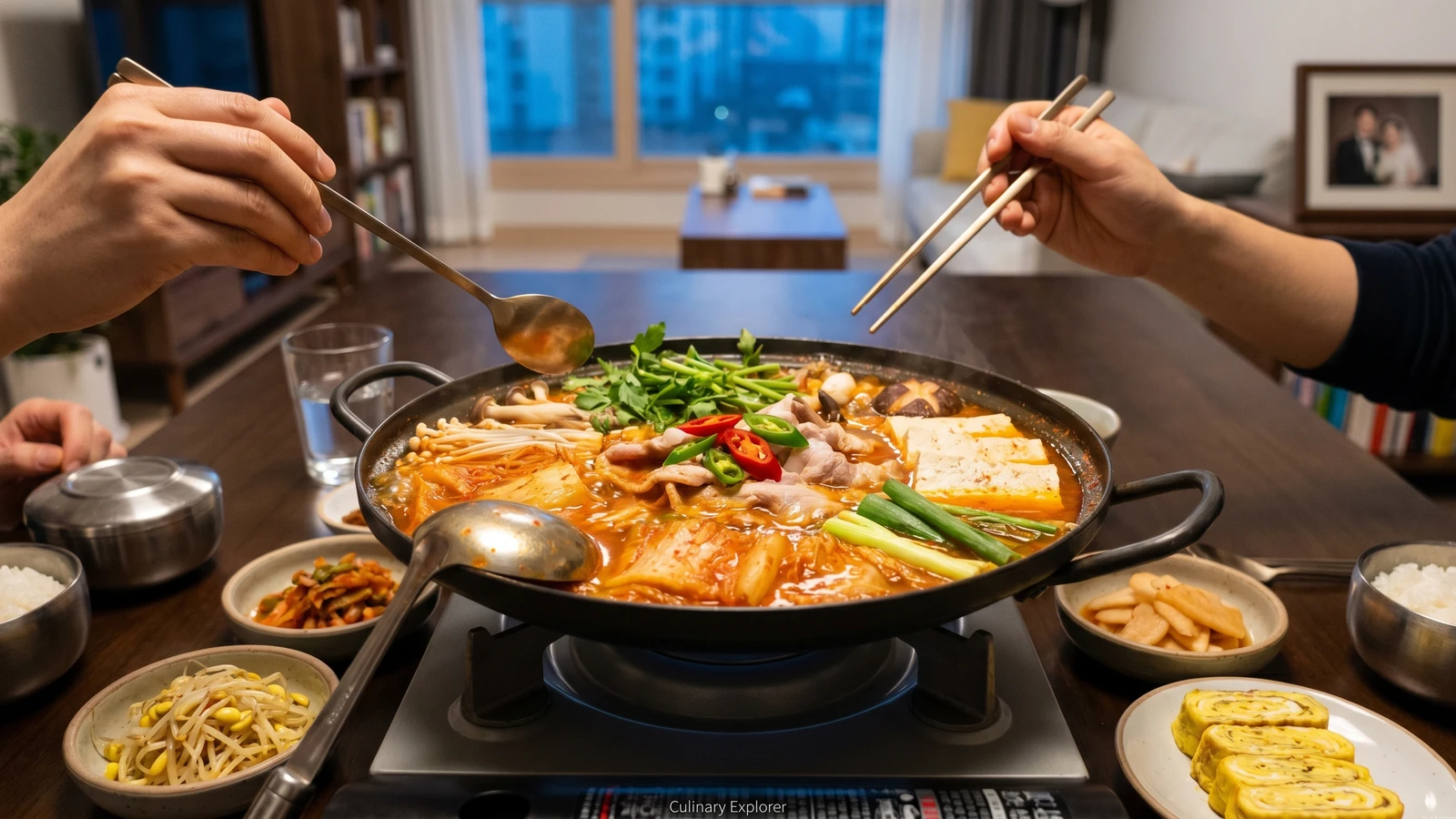
A wide table hot pot of sour kimchi, pork, tofu, and mushrooms, arranged before the broth goes in and simmered gently so the jar seasons the whole meal.
Kimchi-jeongol is not kimchi-jjigae in a wider pot. That is the first correction. A jjigae is usually built around one main ingredient and brought to the table already finished. A jeongol carries several ingredients arranged together, then cooks in front of the people who will eat it. The arrangement is not vanity. It tells you what is in the pan and lets each thing cook at its own pace before the broth pulls them together.
At my mother's table, the sour end of the kimchi jar never went begging. Too sharp to eat cold, it became soup, pancakes, fried rice, or a pan like this, with pork tucked beside tofu and mushrooms. This is budget food, yes, but don't confuse budget with careless. The kimchi has already done months of work for you. Trust the jar and add little else.
Tonight this dish asks for three things. Make a clean anchovy-kelp broth and pull the kelp before it turns bitter. Arrange the raw ingredients by color before the broth goes in. Then season at the end, not at the beginning, because every kimchi jar has its own salt and sourness. Write it down. Memory is a borrowed bowl.
Jeongol names a Korean family of wide, shallow hot pots arranged with several ingredients and cooked communally at the table; formal versions such as sinseollo belonged to court and wealthy households, but kimchi-jeongol itself is a home-table dish built from the kimjang jar. Its modern form belongs especially to the age of home refrigeration, when well-fermented cabbage kimchi could be kept longer and used deliberately in stews, hot pots, pancakes, and fried rice. The distinction from kimchi-jjigae is practical, not grand: jjigae is usually simmered finished in the kitchen, while jeongol is arranged, brought to the table, and cooked as people gather around it.
Quantity
5 cups
Quantity
1 piece, about 5 inches square
Quantity
12 large
heads and guts removed
Quantity
150g
peeled and cut into thick slices
Quantity
450g, about 2 packed cups
cut into 2-inch pieces
Quantity
1/2 cup
strained if gritty
Quantity
300g
thinly sliced and cut into 2-inch pieces
Quantity
2 teaspoons
divided
Quantity
2 teaspoons
minced and divided
Quantity
1 tablespoon, plus more if needed
Quantity
1 medium
cut into 1/2-inch wedges
Quantity
300g
cut into 1/2-inch thick rectangles
Quantity
120g
trimmed
Quantity
40g
soaked 20 minutes and cut once
Quantity
2
cut into 2-inch lengths
Quantity
60g
cut into 3-inch lengths
Quantity
1
sliced thin on the diagonal
| Ingredient | Quantity |
|---|---|
| water | 5 cups |
| dried kelp (dasima) | 1 piece, about 5 inches square |
| dried anchovies (myeolchi)heads and guts removed | 12 large |
| Korean radish (mu)peeled and cut into thick slices | 150g |
| well-fermented napa cabbage kimchi (baechu-kimchi)cut into 2-inch pieces | 450g, about 2 packed cups |
| kimchi brinestrained if gritty | 1/2 cup |
| pork belly or pork shoulderthinly sliced and cut into 2-inch pieces | 300g |
| gochugaru (Korean chili flakes)divided | 2 teaspoons |
| garlicminced and divided | 2 teaspoons |
| soup soy sauce (guk-ganjang) | 1 tablespoon, plus more if needed |
| onioncut into 1/2-inch wedges | 1 medium |
| firm tofucut into 1/2-inch thick rectangles | 300g |
| fresh mushroomstrimmed | 120g |
| dried sweet potato starch noodles (dangmyeon) (optional)soaked 20 minutes and cut once | 40g |
| scallionscut into 2-inch lengths | 2 |
| minari (Korean water celery) (optional)cut into 3-inch lengths | 60g |
| green chili (optional)sliced thin on the diagonal | 1 |
Put the water, kelp, anchovies, and radish in a pot over medium heat. When the water reaches a gentle simmer, pull out the kelp right away, because kelp left too long turns the broth slick and bitter. Simmer the anchovies and radish for 10 minutes more, then strain. Measure out 4 cups of broth for the jeongol.
Cut the sour kimchi into 2-inch pieces and save 1/2 cup of its brine. Use kimchi from the sour end of the jar, not fresh kimchi. The aged kimchi is the seasoning here, so the pot needs its acidity, salt, and fermented depth before it needs anything from your hand.
Toss the pork with 1 tablespoon of the kimchi brine, 1 teaspoon of the gochugaru, and 1 teaspoon of the minced garlic. This is not a heavy marinade. It only wakes the pork up enough to meet the kimchi without making every bite taste the same.
Stir together 4 cups anchovy broth, the remaining kimchi brine, soup soy sauce, the remaining 1 teaspoon gochugaru, and the remaining 1 teaspoon minced garlic. Taste it before it goes into the pan. It should be lightly salty and tart, not fierce, because it will reduce and the kimchi will keep seasoning the pot as it cooks.
Set a wide shallow jeongol pan on a portable burner, still off. Lay the onion on the bottom, then arrange the kimchi, seasoned pork, tofu, mushrooms, and soaked dangmyeon in separate sections around the pan. Put the sturdier ingredients near the broth and save the minari, scallions, and chili for the end. Jeongol should arrive at the table arranged by color before the broth goes in; once it simmers, it becomes food, but first it shows the cook paid attention.
Pour the seasoned broth around the sides of the pan, not straight over the tofu. Turn the burner to medium and bring the pan to a steady simmer. Cover for 5 minutes to get the pork cooking, then uncover and gently separate the pork pieces with chopsticks so none stay folded raw inside. Simmer 7 to 9 minutes more, until the pork is fully opaque with no pink and the kimchi has softened into the broth.
Add the scallions, minari, and green chili, then simmer 1 minute, just until the greens relax. Taste the broth. If it is flat, add soup soy sauce 1 teaspoon at a time. If it is too salty, add hot water 2 tablespoons at a time. If it is dull, add kimchi brine 1 tablespoon at a time. 손맛 is real, hand-taste is real, and I still measure it, so it can be handed on.
Keep the burner on low and let people serve themselves from the pan, taking pork, kimchi, tofu, and broth together. Eat it with hot rice and a few quiet banchan. As the pan thickens, add a ladle of hot water or spare broth. Jeongol is not carried out finished like jjigae; it lives in the middle of the table, changing as everyone eats.
1 serving (about 515g)
Culinary guides, cultural storytelling, and the editorial depth that makes cooking meaningful.
Discover Culinary ExplorerChef Jeong-sun
A clean summer soup of Korean zucchini and salted shrimp, built on quick anchovy-kelp broth and finished before the half-moons lose their shape on a weeknight table.
Chef Jeong-sun
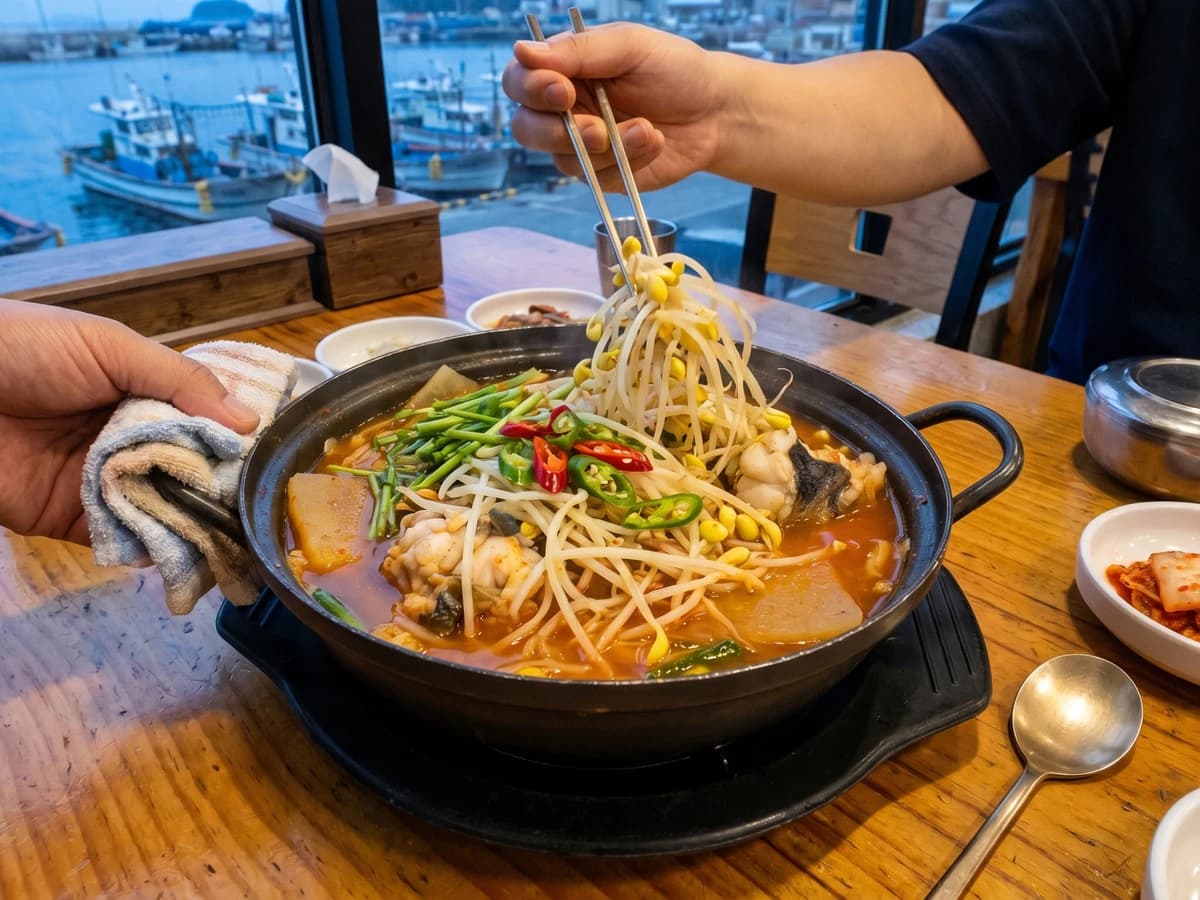
A Masan coast monkfish stew with firm white meat, gelatin at the bones, soybean sprouts for crunch, and a red broth seasoned to carry the fish, not bury it.

Chef Jeong-sun
A weeknight fish roe stew with radish and crown daisy in a clean spicy broth, where the whole success depends on adding the roe late enough that it sets tender, not chalky.

Chef Jeong-sun
Late-summer mallow leaves rubbed with salt until the bitter green water runs off, then simmered in a clean doenjang broth with dried shrimp, the quiet soup a Korean weeknight deserves.